Enforcement Rules for Evidence Collection Revised to Take Effect in January
Definitions Reestablished, Detailed Rules Added
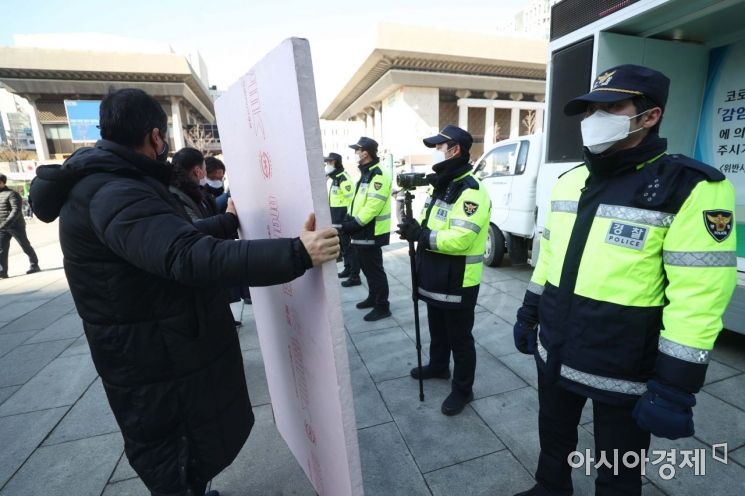
[Asia Economy Reporter Lee Gwan-joo] Starting next year, police 'evidence collection' activities at assembly and protest sites are expected to be significantly reduced. The intention is to strictly limit the methods, purposes, and use of evidence collection to guarantee peaceful assemblies and protests.
According to the police on the 27th, the National Police Agency plans to implement a revised version of the 'Evidence Collection Activity Rules' containing these details from January next year. This is the first revision since the rules were established as a police agency regulation in 2015.
The revision redefines the definition of evidence collection. Filming, recording, or videotaping 'illegal acts or closely related acts' at assembly sites is clearly limited to 'criminal investigation purposes.' Previously, indiscriminate evidence collection was possible simply on the grounds of illegal acts, even if not for criminal investigation purposes. The purpose of evidence collection is also changed accordingly to securing evidence for criminal investigations.
New provisions not present in the existing rules, such as ▲scope of evidence collection ▲notification of evidence collection facts ▲prohibition of using footage other than evidence collection materials, are also introduced. The scope of evidence collection is limited to when criminal acts such as violence are being committed or have just been committed, with a proviso allowing evidence collection before the criminal act only in urgent situations. Additionally, when collecting evidence, there is an obligation to notify the subject of the gist of the criminal facts and the start of evidence collection. Closed-circuit television (CCTV) installed on roads for traffic information collection, rather than evidence collection equipment, cannot be used to identify assembly participants. Evidence collection materials must be destroyed immediately if storage is unnecessary, even before the statute of limitations expires.
These contents largely accept the recommendations of the Police Reform Committee (Gyeonggae-wi) from September 2017. At that time, the committee issued the 'Recommendations for Guaranteeing Freedom of Assembly and Protest and Related Measures,' recommending a reduction in the scope of evidence collection.
Through this revision, the freedom of assembly and protest is expected to be more broadly guaranteed. The number of people arrested for violating the 'Assembly and Demonstration Act' was about 1,055 in 2015 and 1,011 in 2016, but dropped significantly to 482 in 2017, 429 in 2018, and 509 last year. With the revision of the evidence collection rules, the number of offenders violating the Assembly and Demonstration Act may decrease further. A police official said, "We will fully accept the recommendations of the Police Reform Committee and transfer the jurisdiction of evidence collection from intelligence to security," adding, "We plan to implement the revised rules in January next year."
© The Asia Business Daily(www.asiae.co.kr). All rights reserved.

















