The National Institute of Environmental Research and KOICA Sign Satellite Utilization MOU on the 27th
Implementing a 4.7 Billion KRW 'Environmental Satellite Joint Utilization Platform Construction Project'
Establishing Ground Remote Observation Networks in 13 Asian Countries Linked with Satellite Data
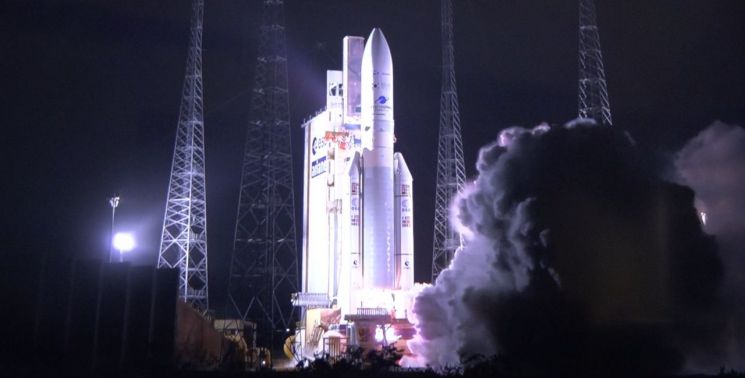
[Asia Economy Reporter Kim Bo-kyung] The world's first geostationary environmental satellite, "Chollian Satellite 2B," has taken the first step toward jointly utilizing atmospheric pollutant information observed with Asian countries.
On the 27th, the National Institute of Environmental Research signed a memorandum of understanding to promote the "Environmental Satellite Joint Utilization Platform Construction Project" with the Korea International Cooperation Agency (KOICA), the United Nations Economic and Social Commission for Asia and the Pacific, and the Korea Environment Corporation.
The Environmental Satellite Joint Utilization Platform Construction Project is an initiative to jointly utilize information on fine dust and climate change-causing substances observed by the Chollian Satellite 2B, launched last February, with 13 Asian countries.
The 13 Asian countries are Nepal, Laos, Mongolia, Myanmar, Bangladesh, Vietnam, Bhutan, Sri Lanka, India, Indonesia, Cambodia, Thailand, and the Philippines.
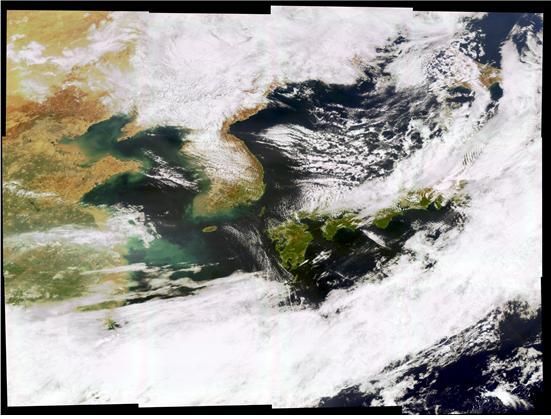
The Chollian Satellite 2B observes atmospheric pollutants and climate change-causing substances over a region covering most of the Asian continent, including western Japan, eastern India, southern Mongolia, and northern Indonesia.
From next year, observation information on fine dust, sulfur dioxide, nitrogen dioxide, ozone, formaldehyde, and others will be provided.
This project involves installing 20 ground remote observation devices called Pandora in the 13 Asian countries, starting with Thailand this year, to establish the Pandora Asia Network (PAN) by 2023. The project budget is 4.7 billion KRW (4 million USD).
The Institute will oversee the provision of environmental satellite data and the construction of ground observation networks in the 13 Asian countries. It will also operate a technical center to support satellite and ground remote observations.
KOICA will manage the overall project, including budget execution, project scheduling, and performance management for each institution's project implementation.
The United Nations Economic and Social Commission for Asia and the Pacific will support policy formulation related to air quality and operate capacity-building programs for utilizing environmental satellite data. The Korea Environment Corporation will be responsible for installing and pilot-operating ground observation equipment for the ground observation network construction.
This project was prepared to provide environmental satellite data to the 13 Asian countries, as promised in President Moon Jae-in's special Korea-ASEAN summit and the inaugural Blue Sky Day commemorative speech.
It is expected to enhance South Korea's international status by providing successful cases and experiences in solving air pollution and transferring advanced environmental technologies through joint research with research institutions in each country.
Kim Young-woo, head of the Climate and Air Research Division at the National Institute of Environmental Research, stated, "Since air pollution is difficult to improve by the efforts of a single country, we will strive to contribute to restoring blue skies by establishing a cooperative system among Asian countries."
© The Asia Business Daily(www.asiae.co.kr). All rights reserved.
![A Woman Who Jumps Holding a Stolen Dior Bag... The Mind-Shaking, Bizarre Con of a "Human Knockoff" [Slate]](https://cwcontent.asiae.co.kr/asiaresize/183/2026021902243444107_1771435474.jpg)

















