First Observation of Blue Emission at Graphene-Boron Nitride Interface
Potential Applications in Blue Emission LED Devices and Sensors
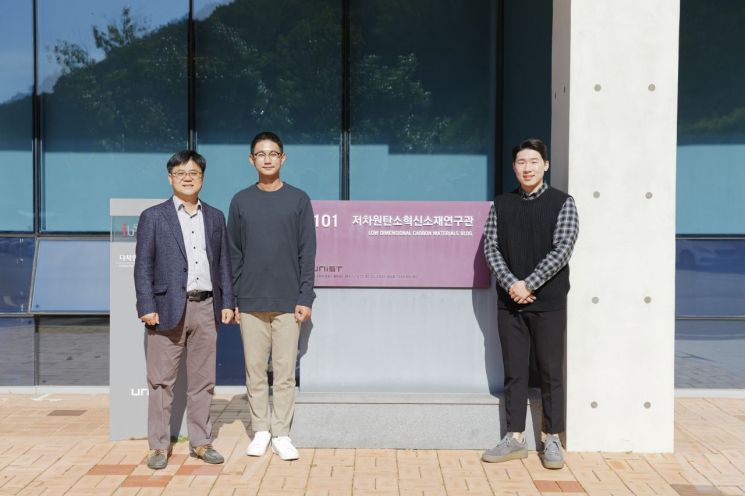
[Asia Economy Reporter Junho Hwang] Domestic researchers have developed a technology that utilizes graphene, which has metallic conductor properties, as a light source for display devices. On the 27th, Professor Hyunseok Shin's research team from the Department of Chemistry at Ulsan National Institute of Science and Technology announced that they have discovered blue luminescence at the interface between graphene and hexagonal boron nitride, also known as white graphene, for the first time. The related paper was recently published in Nature Communications.
Discovery of Blue Light in Graphene
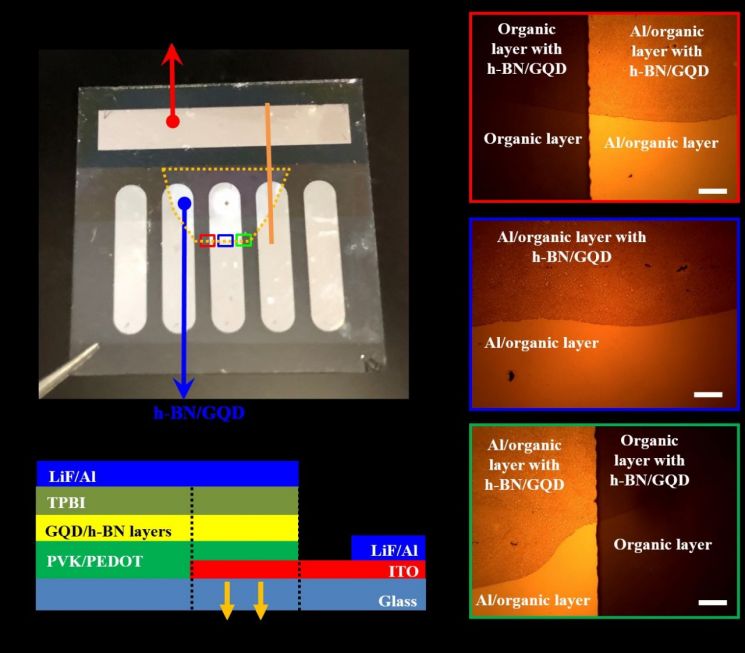
Professor Shin's team discovered the phenomenon of blue light emission at the interface between graphene and hexagonal boron nitride and developed a light-emitting device (light source) applying this phenomenon. The research team enhanced the emission intensity by vertically stacking boron nitride films embedded with graphene particles (graphene quantum dots) smaller than 20 nm. Not only graphene but also the combination of graphene and hexagonal boron nitride are flexible materials, enabling the creation of foldable or bendable display devices.
Dr. Kwangwoo Kim, the first author, explained, "We discovered the luminescence phenomenon at the interface of two materials, which had only been theoretically predicted until now, for the first time," adding, "This was possible thanks to our technology to fabricate two-dimensional material composites made of graphene and hexagonal boron nitride, which have similar crystal structures."
Emergence of New Energy Levels
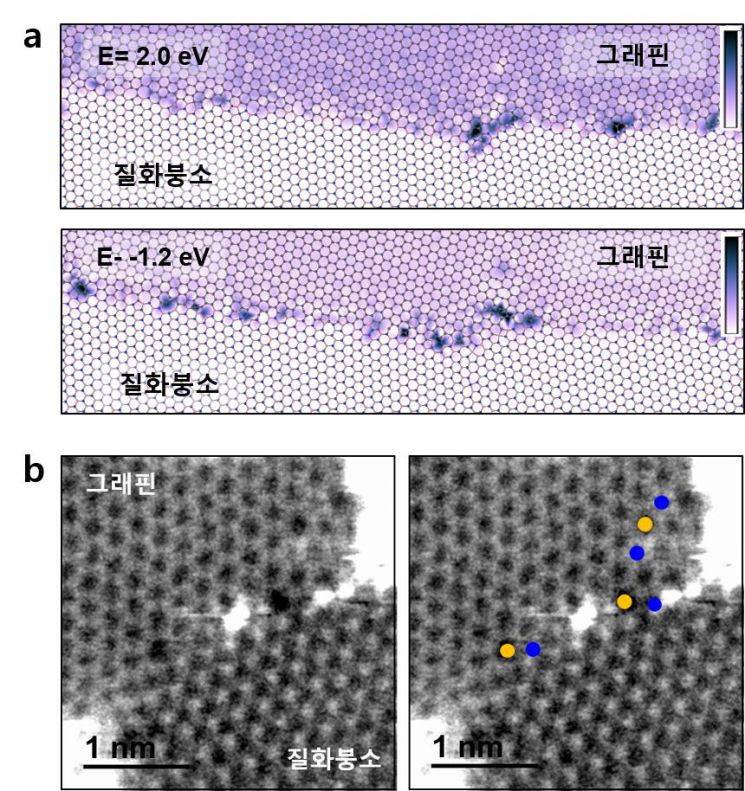
The research team also identified the cause of the luminescence phenomenon. Based on electron microscopy observations showing that the originally regular hexagonal shapes of the two materials changed to pentagonal and heptagonal shapes at the interface, they analyzed the energy of electrons within the material. The results concluded that the concentration of electrons (charges) at the interface created new energy levels, which caused the luminescence phenomenon.
Professor Shin stated, "This research is significant in demonstrating that the interface between the conductor graphene and the insulator (dielectric) boron nitride can be used as a light source material," and added, "By implementing optoelectronic devices such as photodetectors or LEDs based on these two-dimensional composites, this study is expected to greatly contribute to the advancement of the flexible display industry."
Meanwhile, graphene is a thin film where carbon atoms are connected in a hexagonal pattern. Despite its thinness, it is strong, flexible, and has high thermoelectric conductivity, earning it the nickname 'dream material.'
© The Asia Business Daily(www.asiae.co.kr). All rights reserved.














