[Asia Economy Reporter Donghyun Choi] The Seoul Metropolitan Government is expanding the scope of station areas and the targets and methods of projects to increase housing supply in station areas. In the future, projects will be possible in all 300 station areas, and the primary station area range allowing high-density development will be extended to 350 meters.
On the 27th, Seoul announced that it had revised the "Operational Standards for Station Area Housing and Public Rental Housing Construction" to include these changes. According to the revised standards, the city plans to supply an additional 8,000 households by 2022 and 22,000 households by 2025. This revision is part of the government's "Measures to Strengthen the Housing Supply Base in the Metropolitan Area" announced last May.
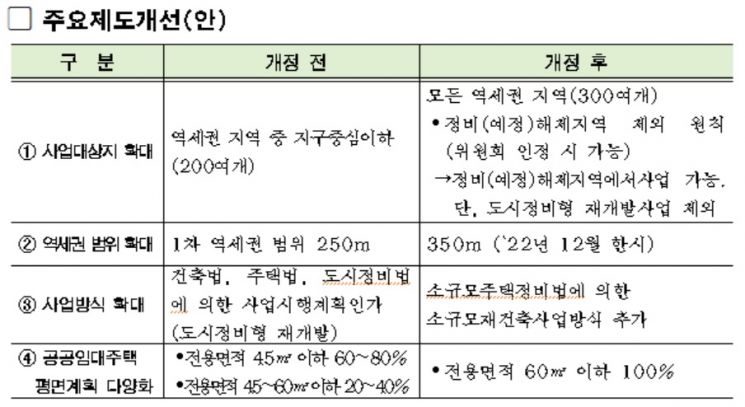
The main points of the operational standards revision are ▲expansion of project target areas in station areas (from 200 to 300 stations) ▲expansion of station area range (radius from platform boundary increased from 250m to 350m) ▲diversification of project methods (addition of small-scale reconstruction method) ▲diversification of public rental housing floor plans (flexible application for exclusive areas under 60㎡ without ratio restrictions).
First, the project target areas, which were previously limited to about 200 station areas classified as district centers or below in the Seoul 2030 Urban Basic Plan under the "National Land Planning and Utilization Act," have been expanded to all 300 station areas. Now, projects can be conducted in metropolitan centers, downtowns, regional centers, and district center station areas. However, the expansion to all station areas will be applied after the related ordinance is revised and is expected to be possible by early next year at the latest.
The range of the primary station area, where high-density development is possible, has been expanded from 250 meters to 350 meters from the platform boundary. However, this standard will be applied temporarily only until December 31, 2022. Generally, a station area refers to the area within a 500-meter radius from the boundary of subway, national railway, or light rail platforms. The area within 250 meters from the platform boundary is called the primary station area, and the area from 250 meters to within 500 meters is the secondary station area. In the primary station area, land use can be changed to quasi-residential areas, and floor area ratio can be increased up to 500%.
The project methods will also be diversified. In addition to the existing urban maintenance-type redevelopment methods under the Housing Act, Building Act, and Urban and Residential Environment Improvement Act, the small-scale reconstruction method under the "Special Act on the Maintenance of Vacant Houses and Small-scale Housing" has been added.
The construction ratio for public rental housing size has also been revised to allow flexible application for exclusive areas under 60㎡. This is expected to expand the supply of popular floor plans and be advantageous for social mix. Previously, for rental housing, the construction ratio was regulated to build 60-80% for units under 45㎡ and 20-40% for units between 45㎡ and 60㎡, making it inevitable to distinguish from sale housing.
Meanwhile, in areas where maintenance projects had been canceled and thus excluded from project targets, limited projects can now be promoted if district unit plans are established and the Housing Act, Building Act, and Special Act on the Maintenance of Vacant Houses and Small-scale Housing are applied. However, promotion through maintenance projects is excluded.
Kim Seongbo, Head of the Housing and Architecture Headquarters, said, "This revised standard was prepared as a follow-up measure to the government's plan to expand housing supply in the metropolitan area," adding, "By expanding housing supply in station areas where proximity to workplaces is possible, infrastructure is good, and public transportation infrastructure is concentrated, we will contribute to market stabilization."
© The Asia Business Daily(www.asiae.co.kr). All rights reserved.

















