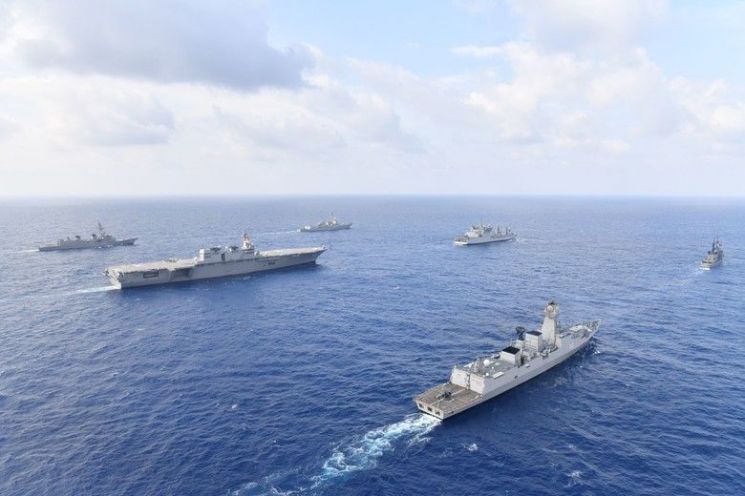
[Asia Economy Yang Nak-gyu, Military Specialist Reporter] The Navy's project to secure a 40,000-ton light aircraft carrier is set to officially begin. Inside and outside the military, there are opinions that a light aircraft carrier is necessary to respond to the naval forces of neighboring countries, but concerns have also been raised about costs, construction technology, and the feasibility of possessing a light aircraft carrier.
On the 27th, the Defense Acquisition Program Administration (DAPA) announced, "We will hold a kickoff meeting for the development of core technologies for the light aircraft carrier and review plans for securing core technologies and development schedules."
To operate a light aircraft carrier, a combat group consisting of escort ships and warships must be formed, along with submarines and reconnaissance assets to protect them. This is to defend against enemy anti-ship missiles and torpedo attacks. The U.S. nuclear carrier strike group is composed of the Nimitz aircraft carrier, the cruiser USS Princeton, the cruiser USS Chosin, one or two nuclear-powered submarines, and one large logistics support ship. The problem is cost. The Navy plans to invest 2 trillion won in building the light aircraft carrier and to operationalize it by 2033, but considering the maintenance costs of the combat group, it is predicted that a budget three to four times larger will be required.
Technology is also an issue. On the 15th, during the National Assembly audit, the Navy revealed that the light aircraft carrier will be designed to carry about 20 F-35B fighters capable of vertical takeoff and landing. For the F-35B to take off and land, a flight deck capable of withstanding temperatures exceeding 1,000 degrees Celsius emitted by the F-35B is required. DAPA plans to develop this technology domestically, but if development fails, even the introduction of the F-35B could be canceled. Due to the nature of aircraft carriers, 30% of the fighters remain on the lower deck maintenance hangar. The development of lift technology to move aircraft from the hangar to the flight deck is also uncertain.
Opposition to the introduction of the light aircraft carrier has also emerged, mainly in political circles. President Moon Jae-in mentioned the light aircraft carrier at last year's Armed Forces Day ceremony, expressing expectations that "with cutting-edge defense systems, our military will proactively respond to any potential security threats." However, even the ruling party has shown skepticism about the necessity of the light aircraft carrier. Ahn Kyu-baek, a member of the National Defense Committee from the Democratic Party of Korea, pointed out the operational status of the large transport ship Dokdo during the Navy audit, saying, "Instead of just thinking about increasing weapon systems like the light aircraft carrier, we should fully utilize the current forces."
Kim Dae-young, a research fellow at the Korea Institute for National Strategy, said, "Since the light aircraft carrier development is the first development project, there are many risk factors," adding, "Thorough project management by DAPA is essential, and since a huge budget is required, communication with the public is also very important."
© The Asia Business Daily(www.asiae.co.kr). All rights reserved.

















