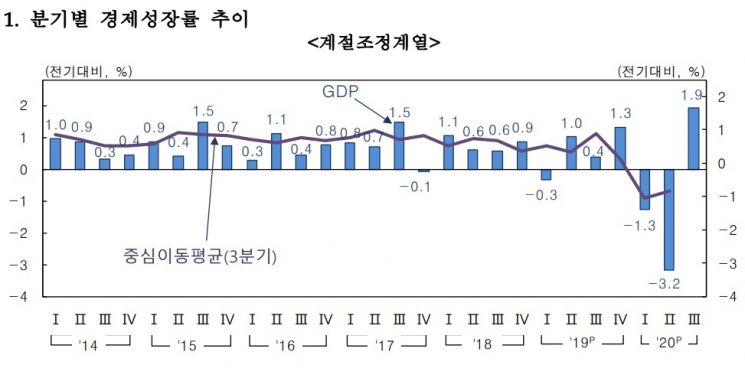
[Asia Economy Reporter Kim Eun-byeol] South Korea's economic growth rate in the third quarter rebounded more sharply than expected. This was due to a base effect as exports recovered compared to the second quarter (-3.2%).
On the 27th, the Bank of Korea announced that the real Gross Domestic Product (GDP, preliminary figure) for the third quarter was 456.8635 trillion won, an increase of 1.9% compared to the previous quarter. This is the highest quarterly GDP growth rate since the first quarter of this year (2.0%). When viewed to the second decimal place, the growth rate is 1.93%.
The lifting of movement restrictions in the US and Europe led to a rapid recovery in exports, which quickly boosted the growth rate. Exports, which had fallen to -16.1% in the second quarter, marking the worst shock since 1970, increased by 15.6% in the third quarter. Exports grew mainly in automobiles and semiconductors. Imports increased by 4.9%, centered on crude oil and chemical products. Imports also turned positive compared to the second quarter (-6.7%).
Private consumption, which grew by 1.5% in the first quarter, turned negative again (-0.1%). This was due to the strengthening of social distancing measures following the second wave of COVID-19 that began in mid-August. The record monsoon rains and heavy rainfall this summer also appear to have reduced private consumption.
Due to the impact of the monsoon and a reduction in the government's SOC budget, construction investment decreased by 7.8%, mainly in civil engineering construction. The decline in construction investment was the largest on a quarterly basis since the first quarter of 1998 (-9.6%). Facility investment increased by 6.7% as both machinery and transportation equipment rose.
A Bank of Korea official stated, "It is positive that facility investment has steadily increased despite the COVID-19 situation," adding, "Facility investment increased mainly in semiconductors and displays."
Meanwhile, real Gross Domestic Income (GDI) in the third quarter increased by 2.5% due to improved terms of trade. Real GDI exceeded the real GDP growth rate. An increase in GDI means improved corporate profitability, which enables consumption and investment and is expected to have a positive impact on employment.
© The Asia Business Daily(www.asiae.co.kr). All rights reserved.

















