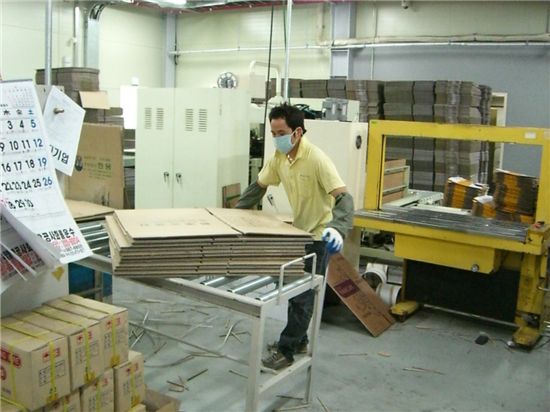
 An employee at a box company is bundling corrugated cardboard boxes with a banding machine.
 [Photo by Asia Economy DB]
[Asia Economy Reporter Kim Jong-hwa] "Psychological excess demand is pouring in." vs. "Withdraw the unilateral price increase and realize the price."
Since the fire at Daeyang Paper Industry, a corrugated paper raw material manufacturer in Ansan, Gyeonggi Province, on the 12th, which completely halted production, the long-standing problems in the domestic corrugated paper market have been fully exposed, intensifying internal conflicts within the industry.
Paper manufacturers, seizing the opportunity, raised the price of raw materials and are standing by, while raw material companies, fearing supply disruptions of corrugated paper, are buying more raw materials than needed, engaging in so-called 'hoarding.' Meanwhile, small businesses, relatively weaker and unable to hoard, are warning of a survival struggle, demanding "the unilateral cost increase be withdrawn and prices be realized."
According to the corrugated paper industry, after the Daeyang Paper fire, major raw material producers Taelim Paper and Ajin PNP raised raw material prices by about 20-25%. On the 16th, raw material companies such as Taelim Packaging notified the box industry of price increases. Although the exact increase rate has not been finalized, the industry expects about a 15% rise.
Paper manufacturers explained that since the implementation of the imported waste paper reporting system in July, imports of waste paper, the raw material for corrugated paper, have decreased, and domestic supply has also declined due to prolonged monsoons and heavy rains, making it inevitable to raise raw material prices. Corrugated paper raw materials produce 100% raw material from about 120% waste paper. The fire at Daeyang Paper gave paper manufacturers, who were considering the timing of the increase, an excuse to raise prices under the pretext of supply shortage.
However, the Korea Box Industry Cooperative (Box Cooperative) stated that the price of imported waste paper has steadily declined since June and is currently $178 per ton, about 10% lower than the previous month. Domestic waste paper prices slightly increased in the first half of this year but are traded at 76 won per kg, below the five-year average of 91 won. Since the price has continuously fallen to 60 won per ton this year, supply has been maintained through stable, slight increases depending on domestic supply and demand, they argued.
In fact, waste paper supply is reported to be stable. A paper manufacturer official revealed, "If waste paper supply becomes excessive, prices may fall, so some companies are trying to shift towards exports." This is why the Box Cooperative is outraged, saying, "Before the price increase, large corrugated paper manufacturers refrained from exporting corrugated paper, but there was no communication with related industries for sufficient self-help efforts to resolve deficits and coexistence."
The domestic corrugated paper box market consists of stages: "corrugated paper manufacturing - corrugated paper raw material - corrugated paper box." Paper manufacturers produce raw materials and supply them to raw material companies, which make corrugated paper from the raw materials and supply it to box manufacturers or directly produce boxes. Large corporations (paper manufacturers) enjoy a dominant market position by vertically integrating paper, raw materials, and boxes, occupying about 90% of the paper market, 70% of the raw material market, and 50% of the box market.
The corrugated paper raw material market share is held 70% by the Korea Corrugated Packaging Industry Cooperative (Corrugated Paper Cooperative), composed of 52 member companies (including large corporate affiliates) producing both corrugated paper raw materials and boxes, while the remaining 30% market is fiercely competed for by about 2,300 small and medium-sized member companies (Box Cooperative) striving for survival.
Although large corrugated paper companies raised raw material prices this time, they did not increase box prices for their box manufacturing affiliates. The Box Cooperative claims this is an "intent to drive small businesses out of business." For small businesses forced to raise box prices due to raw material price increases, this is seen as the tyranny of large corporations.
The Corrugated Paper Cooperative, which holds a dominant market position, prioritizes securing volume over price. In contrast, the Box Cooperative, composed of many small and medium-sized businesses, is structurally more sensitive to price than any other condition.
A Box Cooperative official said, "The irrational trade practice of raising raw material prices through vertical integration while not increasing prices for final products must be corrected and condemned," urging, "Large paper manufacturers who voiced a unified call for fair pricing of corrugated boxes in 2017 should keep their promise to pay the right price for boxes."
He also demanded, "Large corrugated paper manufacturers should immediately stop the sudden unilateral price increase notice without grace periods and communicate with the industry to reconsider the increase range in the spirit of coexistence." He added, "If these demands of the box industry are not resolved promptly, we will strongly pursue all countermeasures for survival, including legal measures to restore fair trade and market order."
In response, Kim Jin-moo, Executive Director of the Corrugated Paper Cooperative, emphasized, "The important issue now is supply, not price." He said, "When raw material companies request 10 trucks of raw materials from paper manufacturers, they only receive supplies equivalent to 2 to 5 trucks," adding, "Some companies have signed import contracts for several thousand tons by paying over 50,000 won per ton in Japan and Southeast Asia, but supply is still insufficient."
This means raw material companies feel a significant psychological fear that raw material supply may be interrupted. A paper manufacturer official admitted, "Hoarding by raw material companies is increasing." He described this as "psychological excess demand pouring in," analyzing, "This is due to a complex psychology of expecting raw material prices to rise further and wanting to secure quantities before that, as well as securing quantities ahead of the year-end peak season and next year's Lunar New Year peak season."
Regarding this, Executive Director Kim said, "We are requesting companies to refrain from excess demand." He added, "We have asked several paper manufacturers, including Jeonju Paper and Paper Korea, to increase supply through production switching, and have received promises," forecasting, "A turning point will come around mid-November. This week and next week will be the peak." He explained that within about two weeks, the psychological fear caused by supply reduction will calm down to some extent, resolving the supply shortage.
An industry official said, "Although the unexpected supply shortage has fully exposed the problems the domestic corrugated paper market has faced, solutions are hard to find," emphasizing, "It is time for large corporations, who hold a dominant market position, to show efforts to communicate with the industry for coexistence."
© The Asia Business Daily(www.asiae.co.kr). All rights reserved.
![User Who Sold Erroneously Deposited Bitcoins to Repay Debt and Fund Entertainment... What Did the Supreme Court Decide in 2021? [Legal Issue Check]](https://cwcontent.asiae.co.kr/asiaresize/183/2026020910431234020_1770601391.png)















