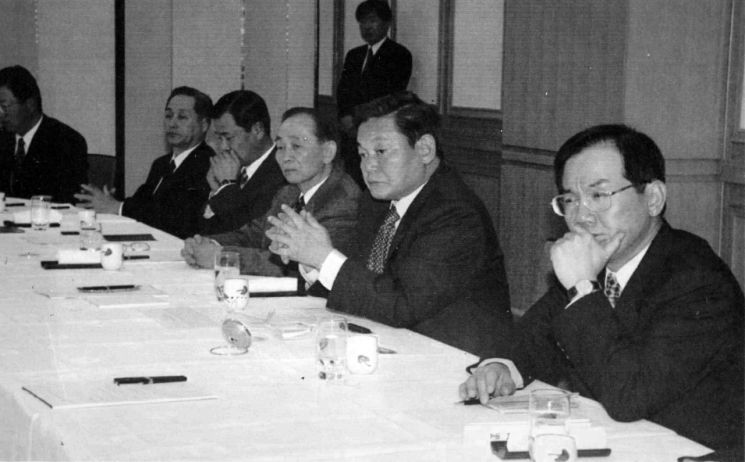
[Asia Economy Reporter Kim Hyewon] For Chairman Lee Kun-hee of Samsung, 'automobiles' were a source of both love and hate. He was a well-known car enthusiast who enjoyed speed and driving, but he failed in the automobile business. Right after his inauguration, Chairman Lee formed and led a task force (TF) for the automobile business, but in 2000, he ultimately raised the white flag. In an essay, he expressed special affection, saying, "I studied the automobile industry more than anyone else and met countless people. I subscribed to and read almost all major automobile magazines worldwide and met nearly all executives and engineers of the world's leading automobile makers. It was not started impulsively; I have been thoroughly preparing and researching for 10 years."
Under the banner of "reviving the dying Busan economy," Samsung entered the commercial vehicle business based in the Busan Shinho Industrial Complex and then launched into the passenger car business. In 1994, when Minister of Commerce, Industry and Energy Kim Cheolsu announced the acceptance of Samsung's passenger car business technology import report, Chairman Lee's dream seemed to be coming true. In 1995, the first groundbreaking for the Samsung Motors Busan plant took place, and the following year, Chairman Lee visited Busan. A test drive event for the project named KPQ (SM5) was also held. A famous anecdote is that at President Kim Dae-jung's inauguration ceremony in 1998, Chairman Lee rode in the highest-spec model of Samsung Motors, the SMS525V, instead of his usual Mercedes-Benz.
However, at that time, Samsung Motors was a business losing 1.5 million won per car sold. With the Kia Motors bankruptcy crisis and the International Monetary Fund (IMF) foreign exchange crisis, financial authorities demanded Samsung make a decision. Chairman Lee gave up Samsung Motors with tears. He placed it under court receivership, donated 3.5 million shares of Samsung Life Insurance he owned to creditors, and proposed compensation plans for workers and subcontractors. Samsung Motors was transferred to Renault in 2000, and Chairman Lee's automobile challenge ended regretfully.
Another bitter experience was failing to acquire Yukong (Korea National Oil Corporation) while receiving management training as the designated successor from Chairman Hoam Lee Byung-chul. As the head of Samsung's overseas business promotion committee, Chairman Lee entered the privatization bid for Yukong but lost to SK Group. For a while, he had to face his father's cold gaze. However, it is evaluated that the major business failures in his youth became the foundation for greater success as a manager for Lee Kun-hee.
© The Asia Business Daily(www.asiae.co.kr). All rights reserved.

















