Scheduled Supply Limited to 26,940 Households
Relatively Scarce in Suburban Areas
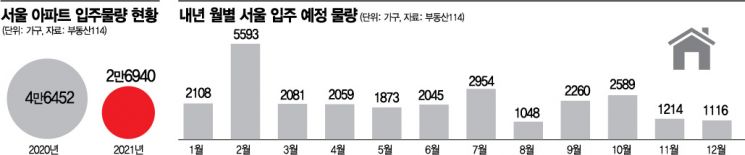
[Asia Economy Reporter Yuri Kim] Concerns are rising that the jeonse (long-term lease) shortage will worsen as the number of apartment move-ins in Seoul next year is expected to fall to less than 60% of this year's volume. This is because, amid an already reduced supply of new jeonse and monthly rental units due to the implementation of the lease renewal request system, it has become difficult to expect the buffering effect that new move-ins had previously provided. In particular, the move-in volume next year is relatively insufficient in the outskirts, where there is higher demand from low-income residents, compared to central areas such as Gangnam. According to Real Estate 114 on the 26th, the number of scheduled move-ins in Seoul next year is expected to be only 26,940 households. Compared to this year's 46,452 households, this is a reduced volume at about 58%.
Except for February, when 5,593 households, including 1,824 households in Godeok-dong, Gangdong-gu's Godeok Ja-i, will be completed, the monthly move-in volume is analyzed to be less than 3,000 households. In particular, in August, November, and December, the move-in volume is only about 1,000 households each, raising concerns that the jeonse shortage in the second half of the year will be more severe than in the first half.
By region, the move-in situation in the outskirts, where jeonse prices are relatively cheaper, is worse than in the Gangnam area. In Gangnam-gu, a total of 3,260 households, including 1,996 households at The H Ja-i Gaepo in July, will move in, and five complexes will move in in Seocho-gu as well. On the other hand, in Geumcheon, Mapo, Seodaemun, Seongdong, Songpa, Yangcheon, and Yeongdeungpo-gu, only one complex each is scheduled for move-in. In Gangbuk, Dobong, Seongbuk, Jongno, Gwanak, Guro, and Jung-gu, there are no scheduled move-ins at all.
In this move-in drought, the industry is concerned that young people, especially newlyweds who mostly demand new jeonse and monthly rentals, will be the most affected. Since jeonse prices have sharply risen after the new Housing Lease Protection Act was implemented at the end of July, if the supply-demand imbalance overlaps, the burden on new lease contract holders, who are excluded from the lease renewal request system and the rent ceiling system, will inevitably increase. A representative from a real estate agency in Mapo-gu said, "Because of the lease renewal request system, 90% of all lease contracts are renewals," and predicted, "There is a high possibility that the shortage of jeonse listings will continue until the end of July 2022, when two years have passed since the law's implementation."
The government is also unable to present a sharp solution to the jeonse shortage. Although Deputy Prime Minister and Minister of Economy and Finance Hong Nam-ki mentioned additional measures, and there is a possibility that additional measures will be announced at the real estate market inspection meeting scheduled for the 28th, even the Ministry of Land, Infrastructure and Transport, the main department in charge, is cautious about preparing countermeasures. This is because there is no effective way to artificially suppress demand or rapidly increase supply in the short term in the jeonse and monthly rental market, which is formed solely by actual demand. The 'standard rent system,' which is mentioned as a direct price control measure, has not even established proper price statistics, and even within the government, there is considerable controversy over infringement of private property rights due to excessive market intervention.
Yoon Ji-hae, chief researcher at Real Estate 114, said, "Considering that in the past, when jeonse prices rose for a long period, actual demand moved to the sales market, the stability of jeonse prices will significantly affect the sales market in the future."
© The Asia Business Daily(www.asiae.co.kr). All rights reserved.

















