“Dispute Resolution Procedures Are Not Intended to Prohibit Industrial Actions”
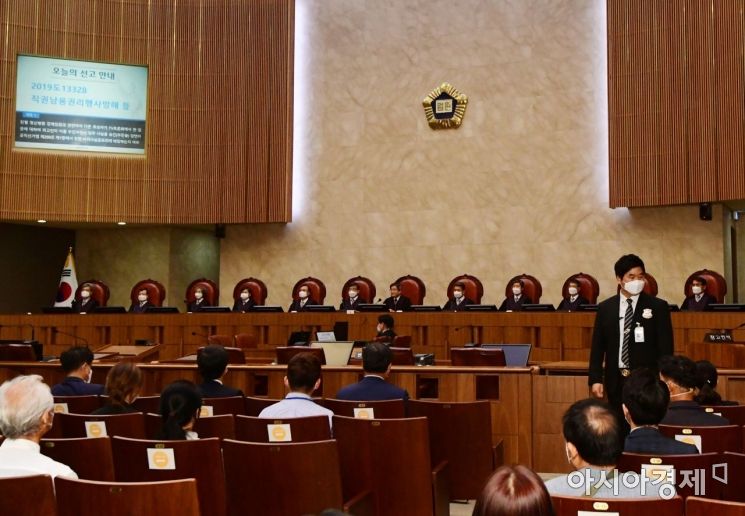
[Asia Economy Reporter Choi Seok-jin] The Supreme Court has ruled that even if a union member vote for a strike was conducted before the labor dispute mediation process by the Labor Relations Commission was completed, it is still valid if the labor dispute had already reached a strike state.
The purpose of requiring mediation before a labor dispute action under the Labor Union Act is to provide an opportunity to resolve the dispute in advance and avoid the occurrence of labor actions, not to prohibit the labor action itself.
The Supreme Court’s 2nd Division (Presiding Justice Noh Jeong-hee) announced on the 26th that it dismissed the appeal filed by Korea Railroad Corporation against the Central Labor Relations Commission and upheld the lower court’s ruling that ruled against the plaintiff in the unfair disciplinary action relief retrial cancellation lawsuit.
This case is related to the first and second strikes by the Railroad Union in 2013 in opposition to the introduction of a competitive system on the Suseo-origin KTX line.
Despite the first strike in December 2013 following a strike approval vote, Korea Railroad Corporation established the “Suseo-origin KTX Operating Corporation,” prompting the union to launch a second strike in February of the following year.
In response, Korea Railroad Corporation disciplined union officials with dismissals, suspensions, and pay cuts, alleging that strike participants obstructed one-person crew pilot operations and assaulted the head of the Search Vehicle Depot.
Subsequently, union members who received disciplinary actions filed relief applications with the Seoul Regional Labor Relations Commission and the Central Labor Relations Commission, both of which ruled the disciplinary actions unfair and canceled them.
Korea Railroad Corporation then filed a lawsuit requesting the cancellation of the Central Labor Relations Commission’s retrial ruling, arguing that the purpose of the first and second strikes was unrelated to “maintenance and improvement of working conditions,” and that the union member vote on the 2013 wage negotiation conducted before the first strike was essentially aimed at “blocking the establishment of the Suseo-origin KTX corporation,” not wage negotiations.
The corporation also claimed that the union’s second strike violated the “mediation exhaustion principle” stipulated by law.
However, the court stated, “It is clear that the 2013 wage negotiations and other wage-related issues were among the main purposes of the second strike, and although there are circumstances suggesting that issues such as the withdrawal of disciplinary actions against Railroad Union members, rotation transfers, and opposition to one-person crew were included in the purposes of the second strike, it is not recognized that the second strike would not have occurred if these were excluded. Therefore, there is no error in the lower court’s judgment that did not deny the legitimacy of the second strike’s purpose based on the legal principles regarding the legitimacy of the purpose of labor actions.”
Regarding the employer’s appeal that the strike was illegal because the mediation procedure by the Labor Relations Commission was not followed before the strike, the court cited previous Supreme Court rulings stating, “The purpose of Article 45 of the Labor Union Act, which requires mediation before labor actions, is to provide an opportunity to resolve disputes in advance and avoid the occurrence of labor actions, not to prohibit the labor action itself. Therefore, even if the labor action did not follow the mediation procedure stipulated by the mediation exhaustion rule, it does not automatically mean the labor action lacks legitimacy.”
Furthermore, the court added, “The lower court’s judgment that did not deny the legitimacy of the second strike solely because the union member vote conducted after the labor dispute state was reached took place before the Central Labor Relations Commission’s mediation procedure was completed does not contain an error in the legal principles regarding the procedural legitimacy of labor actions.”
© The Asia Business Daily(www.asiae.co.kr). All rights reserved.
!["The Woman Who Threw Herself into the Water Clutching a Stolen Dior Bag"...A Grotesque Success Story That Shakes the Korean Psyche [Slate]](https://cwcontent.asiae.co.kr/asiaresize/183/2026021902243444107_1771435474.jpg)
















