Creating 20 No.1 Products Through Constant Sense of Crisis and Innovation
Leading Semiconductor, Smartphone, TV, and Home Appliance Sectors with Unstoppable Investment
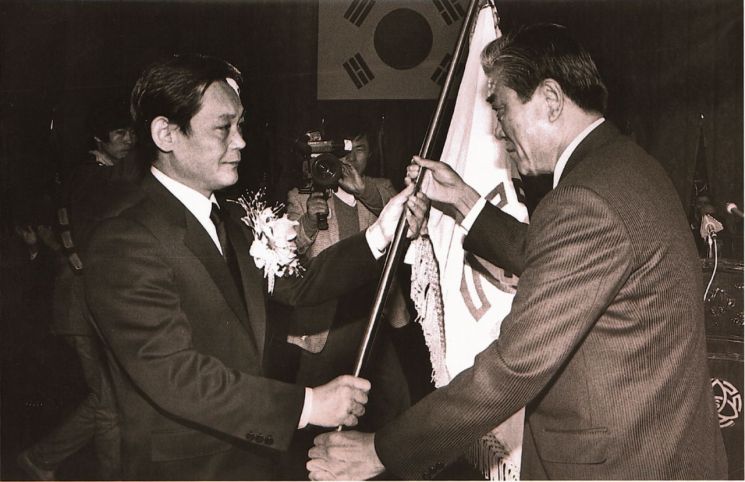
"Through future-oriented and challenging management, I will grow Samsung into a world-class top-tier company."
On December 1, 1987, Lee Kun-hee, then 46 years old, the chairman of Samsung, made this pledge with a confident voice at his inauguration ceremony. At the time of his inauguration, Samsung Group's sales were less than 10 trillion won, but by 2018, they had increased 39-fold to exceed 386 trillion won, and its market capitalization grew 396 times from 1 trillion won to 396 trillion won. Notably, on the 20th, global brand consulting firm Interbrand ranked Samsung Electronics 5th in its 'Global Top 100 Brands' list. The only companies with higher brand value than Samsung Electronics were Apple, Amazon, Microsoft, and Google. Samsung Electronics' brand value was estimated at $62.3 billion (approximately 71 trillion won), more than 12 times the $5 billion (43rd place) valuation in 2000.
The reason Lee is called the 'second founder' following the late Lee Byung-chul, the founding chairman of Samsung who established Samsung Sanghoe in 1938 with a capital of 30,000 won, is not just this. Lee Kun-hee created 20 world-leading products through relentless crisis awareness and innovation.
Among these, semiconductors, which lead South Korea's economy, are undoubtedly the best. Samsung Electronics, established in January 1969, laid its growth foundation through home appliances such as TVs and refrigerators, then acquired Korea Semiconductor in 1974 to establish a foothold in the semiconductor business. When Samsung declared in 1983 that it would produce semiconductors directly, there was concern not only from advanced countries and global companies but also within Samsung itself. The question was whether Samsung Electronics, which had just started making color TVs, could compete in the global semiconductor market. A Japanese company research institute even released a report titled 'Five Reasons Why Samsung Cannot Do Semiconductors,' criticizing the move.
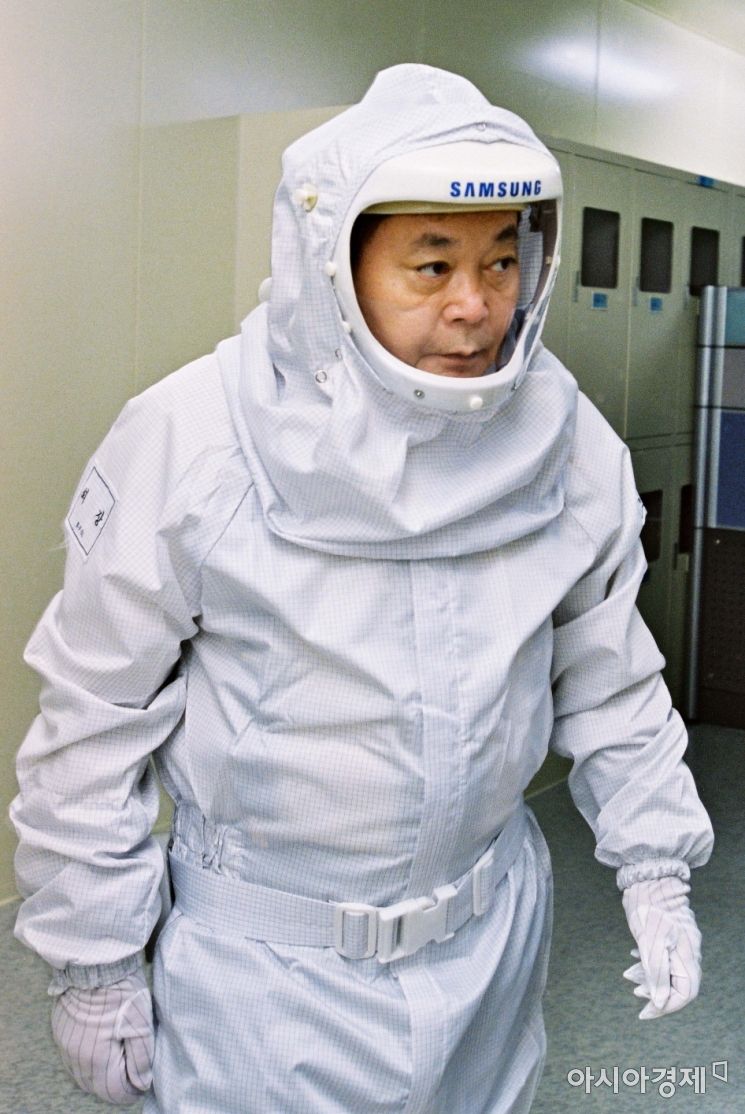
However, Lee Kun-hee, who succeeded Lee Byung-chul and led the semiconductor business, ended the controversy by successfully developing the 64K DRAM just six months after entering the semiconductor market, emphasizing the need to "break free from technological colonialism" with strong drive and bold investment. Through Lee Kun-hee's continuous investment, Samsung succeeded in developing the world's first 64-megabit DRAM in 1992, surpassing Japan for the first time and rising to number one globally.
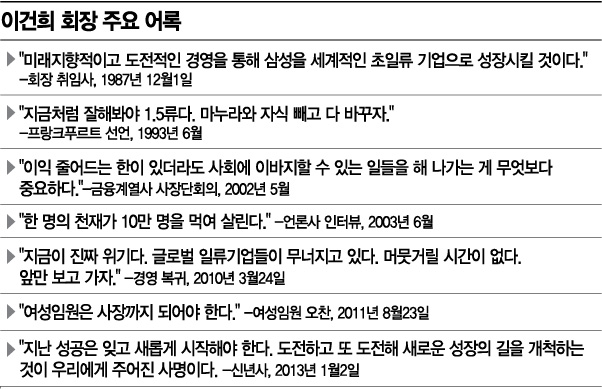
Samsung has recently introduced world-first technologies such as DRAM development using extreme ultraviolet (EUV) equipment and 3D stacked packaging technology for system semiconductors, maintaining the world's number one market share in memory semiconductors for over 30 consecutive years, demonstrating a semiconductor 'super-gap' management strategy. According to market research firm TrendForce, Samsung Electronics held dominant market shares of 43.5% in DRAM and 33.1% in NAND flash in the second quarter of this year. In the system semiconductor sector, known as the future of semiconductors, Samsung ranks second after Taiwan's TSMC but is increasing its market share annually aiming for first place.
In 1992, when the first world number one semiconductor product was launched, Lee Kun-hee was engulfed in anxiety. Although Samsung had just achieved global number one in semiconductors, its home appliances and mobile phones were still considered second or third tier by global standards. Because of this, Lee revealed in a 1997 essay that he felt a desperate sense that Samsung as a whole might fade away if things continued as they were, and he lost 10 kg in weight. Through the 'New Management Declaration' in Frankfurt in 1993 and the 'Burning Ceremony of Defective Anycall Phones' in 1995, Lee instilled the spirit of quality management into Samsung.
Since then, Samsung has maintained global number one positions for over a decade not only in semiconductors but also in smartphones, TVs, and home appliances. Notably, Samsung Electronics attracted attention in 1975 by launching the 'Economy TV,' the first in Korea to power on within 5 seconds without a long wait. Samsung Electronics later laid the foundation for becoming the world's number one TV market leader through the LCD TV introduced in 2006.
With the Bordeaux TV introduced at that time, Samsung Electronics surpassed Sony, the global electronics market predator. On its 40th anniversary in 2009, Samsung launched LED TVs evolved from LCDs, and in 2017, it released QLED TVs, continuously evolving. Samsung Electronics, focusing on 'QLED 8K TVs' and ultra-large TVs, plans to establish itself as the absolute leader in the TV market by promoting Micro LED TVs in the future.
© The Asia Business Daily(www.asiae.co.kr). All rights reserved.



















