President Moon Delivers Floral Tribute to Chairman Lee Geon-hee's Funeral via Chief of Staff
First Time Current Government's Chief of Staff Attends Businessman's Funeral
Previously Visited Japanese Military Comfort Women Victims and Firefighter Memorials
Former President Lee Myung-bak Personally Pays Respects to POSCO's Park Tae-joon and LG's Koo Pyung-hoe
Political and Business Leaders' Condolences Convey Government Philosophy Message
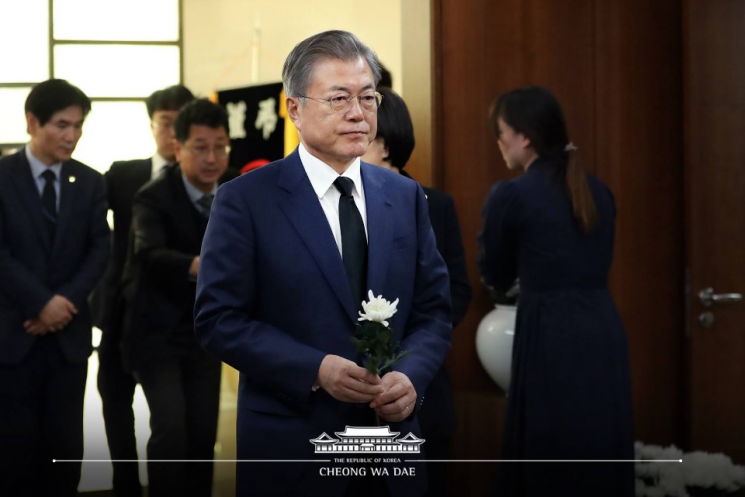 President Moon Jae-in is paying his respects at the funeral hall set up for the late Kim Bok-dong, a victim of the Japanese military sexual slavery, at Sinchon Severance Hospital in Seodaemun-gu, Seoul, on January 29 last year. Photo by Cheong Wa Dae
[Asia Economy Reporter Han Seung-gon] On the 25th, President Moon Jae-in sent No Young-min, Chief of Staff to the President, to the funeral hall of Lee Kun-hee (78), Chairman of Samsung, who passed away, to offer condolences along with a wreath. This is the first time in the current administration that the Chief of Staff has attended the funeral of a business leader.
President Moon expressed his condolences, saying, "I deeply mourn the passing of the late Chairman Lee Kun-hee, a symbol of Korea's business community, and extend my sincere condolences to the bereaved family." He added, "Chairman Lee, with his challenging and innovative leadership, grew the semiconductor industry into Korea's representative industry, dominated the global smartphone market, and developed Samsung into a global company, playing a pivotal role as a driving force behind Korea's economic growth."
In the political sphere, visiting the funeral of political and business figures itself sends a political message. Through guestbooks or condolence messages during the visit, individuals reveal their political, economic, and social orientations and philosophies.
Because of this, there is keen interest in President Moon's condolence visit to Chairman Lee's funeral. Previously, when business leaders passed away, President Moon sent the Chief of Policy Office, who oversees economic policy, to offer condolences on his behalf.
When Koo Bon-moo, Chairman of LG Group, passed away in May 2018, then-Chief of Policy Office Jang Ha-sung visited the funeral hall. In September last year, condolences were sent to the funeral hall of former Daewoo Group Chairman Kim Woo-joong, and in December, to the same funeral hall at Ajou University Hospital in Suwon, Gyeonggi Province. Kim Sang-jo, Chief of Policy Office, visited Kim's funeral hall. In January, when Shin Kyuk-ho, Honorary Chairman of Lotte Group, passed away, Chief Kim also attended the condolence visit.
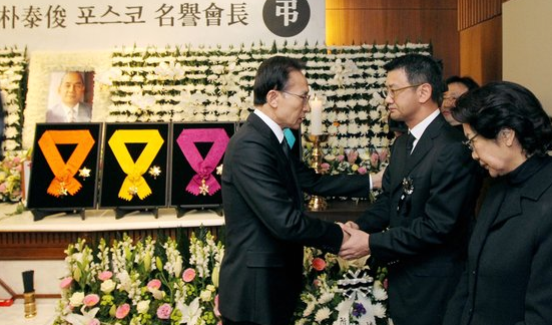 Former President Lee Myung-bak visited the funeral hall of the late Park Tae-joon, former chairman of POSCO, set up at Sinchon Severance Hospital on the afternoon of December 14, 2011, awarded the Order of Service Merit, Blue Stripes, and comforted the bereaved family. Photo by Cheong Wa Dae
On the other hand, there have been occasions when a sitting president personally visited the funeral of a business figure to send a message of creating a country favorable for business management.
Former President Lee Myung-bak personally visited the funeral halls of Park Tae-joon, Honorary Chairman of POSCO, in December 2011, and Koo Pyung-hoe, Honorary Chairman of E1 and founding advisor of LG, in October 2012. At that time, Kim Hyo-jae, Blue House Senior Secretary for Political Affairs, explained, "The government's policy was to respect businesspeople, so the president visited their funeral halls to pay respects."
Among these, the cases where President Moon personally visited the site to offer condolences were not for business figures but to comfort bereaved families who lost loved ones in tragic incidents. He also personally visited the funeral hall when a victim of the Japanese military sexual slavery passed away.
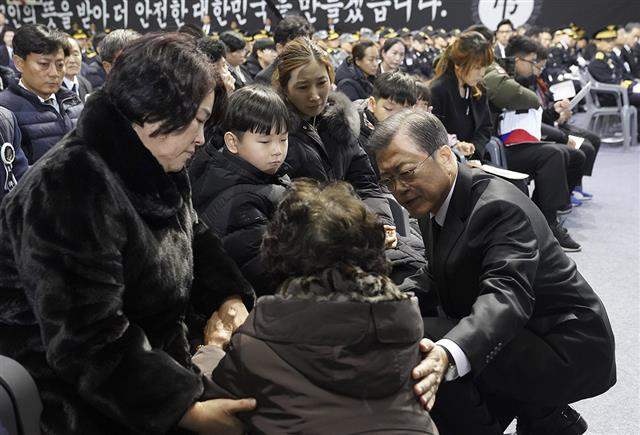 President Moon Jae-in consoles the bereaved families at the joint funeral ceremony for the firefighting aviation team members who died in the helicopter crash in the waters near Dokdo, held on the morning of December 10 last year at the gymnasium of Keimyung University in Dalseo-gu, Daegu. Photo by the Blue House
In January 2018, he visited the joint memorial altar for the Miryang fire disaster, and in January 2019, he paid respects at the funeral hall of the late Kim Bok-dong, a victim of the Japanese military sexual slavery. In December of the same year, he attended the funeral ceremony of five firefighting aviation personnel who died in a helicopter crash. All these actions align with his national policy philosophy emphasizing the resolution of the comfort women issue and the right to safety in disasters.
Meanwhile, President Moon did not visit the funeral halls of the late Park Won-soon, former Mayor of Seoul, and General Paik Sun-yup in July this year, which sparked controversy. However, wreaths in the president's name were sent to both funeral halls, and Chief No was dispatched to express condolences on his behalf.
However, President Moon also sent condolences to the funeral hall of the mother of former Chungnam Governor Ahn Hee-jung, who is serving a 3-year and 6-month prison sentence confirmed by the Supreme Court for sexually assaulting his secretary, drawing strong criticism from women in their 20s and 30s. This is interpreted as a condolence visit to a political ally on a socially sensitive and controversial issue.
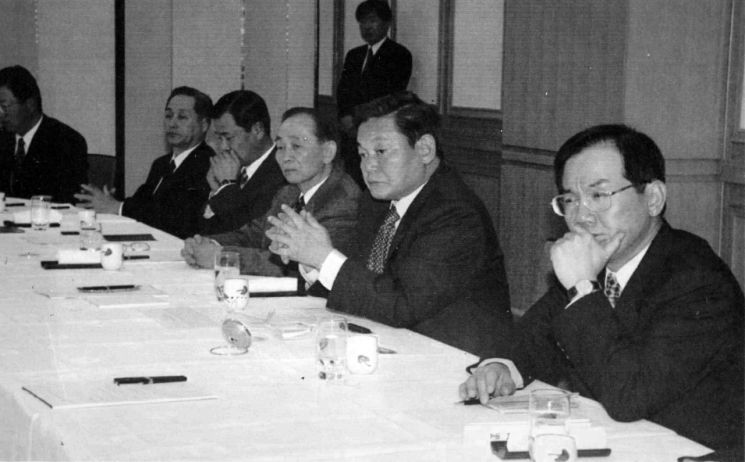 Lee Kun-hee, chairman of Samsung and a representative figure of the Korean business world, passed away on the 25th at Samsung Medical Center in Irwon-dong, Seoul. He was 78 years old. This is six years after he collapsed at his home in Itaewon-dong, Seoul, due to acute myocardial infarction in May 2014. His surviving family members include his wife Hong Ra-hee, former director of the Leeum Museum of Art; his son Lee Jae-yong, vice chairman of Samsung Electronics; his daughter Lee Boo-jin, president of Hotel Shilla; Lee Seo-hyun, chairwoman of the Samsung Welfare Foundation; and his son-in-law Kim Jae-yeol, president of the Samsung Economic Research Institute. In 1997, Lee Kun-hee, chairman of Samsung Group, presided over a meeting of the Japanese electronics subgroup presidents. [Image source=Yonhap News]
Meanwhile, on the 25th, Park Byeong-seok, Speaker of the National Assembly, Prime Minister Chung Sye-kyun, and leaders of ruling and opposition parties also sent wreaths and expressed condolences through messages to mourn the deceased. However, the ruling and opposition parties showed subtle differences in their views on Chairman Lee's achievements and shortcomings.
Lee Nak-yeon, leader of the Democratic Party of Korea, posted on his Facebook on the day, "I express my deep condolences on the passing of Samsung Chairman Lee Kun-hee," adding, "He led change with innovative leadership at every critical moment, including new management, creative management, and talent management." He also evaluated, "As a result, Samsung leapt forward as a global company in home appliances, semiconductors, and mobile phones."
However, he also expressed regret over Chairman Lee's role in strengthening the chaebol-centered economic structure. Lee said, "However, it cannot be denied that he had a negative impact by reinforcing the chaebol-centered economic structure and refusing to recognize labor unions," adding, "He also left shadows such as opaque governance, tax evasion, and collusion between politics and business."
Joo Ho-young, floor leader of the People Power Party, positively evaluated Chairman Lee's impact on Korean society. In a statement titled "Praying for the repose of Chairman Lee Kun-hee, a giant of the Korean economy," Joo said, "Lee Kun-hee, an innovative leader who led Samsung to become the world's No. 1 company with the bold message 'Change everything except the family,' has passed away," and "We pray for the true rest of the deceased who lived every moment of his life to the fullest."
Chairman Lee, who passed away at the age of 78 on the 25th, suffered an acute myocardial infarction on the night of May 10, 2014, at his home in Itaewon-dong, Yongsan-gu, Seoul, received cardiopulmonary resuscitation (CPR) at Soonchunhyang University Seoul Hospital near his home, and was then transferred to Samsung Medical Center in Seoul.
He remained bedridden for six years and five months and passed away in the early morning of the 25th at Seoul Samsung Medical Center in Irwon-dong, Seoul. Born in 1942, he became the second chairman of Samsung Group in 1987 after the death of his father, Lee Byung-chul, the founder of Samsung Group, and led the Samsung Group.
© The Asia Business Daily(www.asiae.co.kr). All rights reserved.



















