[Asia Economy Reporter Hwang Yoon-joo] Samsung Heavy Industries is stepping up to secure design technology capabilities for floating structures, the substructure of floating offshore wind power, in line with the increasing demand for floating offshore wind power generation.
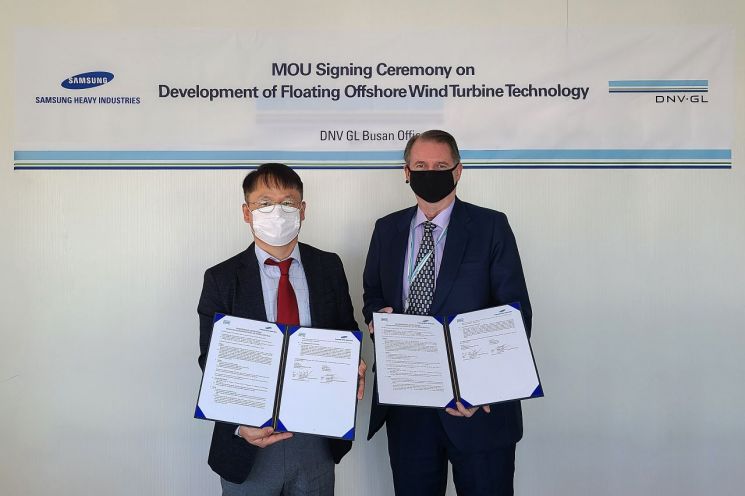
Samsung Heavy Industries announced on the 26th that it has signed an agreement with Norwegian classification society DNV GL for the "joint development of large-capacity floating offshore wind design technology."
Through this agreement, Samsung Heavy Industries will conduct joint research with DNV GL, which leads global technology certification and standardization related to offshore wind power, to develop ▲element technologies for designing large offshore wind floaters ▲digital twin-based remote maintenance technology for offshore wind power, among others. Floaters are large structures that support wind power facilities on the sea and are mainly similar in design to semi-submersible oil production facilities, which are one of the marine plant products.
Accordingly, Samsung Heavy Industries plans to respond to future demand by developing competitive offshore wind floater models based on its accumulated marine engineering capabilities and manufacturing experience.
Jung Ho-hyun, Head of Technology Development at Samsung Heavy Industries, emphasized, "As global interest in climate change and renewable energy spreads, demand for floating offshore wind power is expected to increase. We will secure independent design capabilities for offshore wind floaters based on our strengths in executing marine projects."
Meanwhile, floating offshore wind power has the advantage of relatively fewer site restrictions compared to onshore, allowing for large-scale development and higher efficiency, which can significantly increase power production. The Global Wind Energy Council (GWEC) forecasted in its Global Offshore Wind Report released this year that the annual new capacity of floating offshore wind power will increase significantly from 11 megawatts (MW) in 2019 to 2,000 megawatts (MW) by 2030.
© The Asia Business Daily(www.asiae.co.kr). All rights reserved.
![User Who Sold Erroneously Deposited Bitcoins to Repay Debt and Fund Entertainment... What Did the Supreme Court Decide in 2021? [Legal Issue Check]](https://cwcontent.asiae.co.kr/asiaresize/183/2026020910431234020_1770601391.png)
















