Chinese Communist Party to Hold 19th Central Committee's 5th Plenary Session from 26th
Likely to Emphasize 'Dual Circulation Policy' Focused on Expanding Domestic Demand
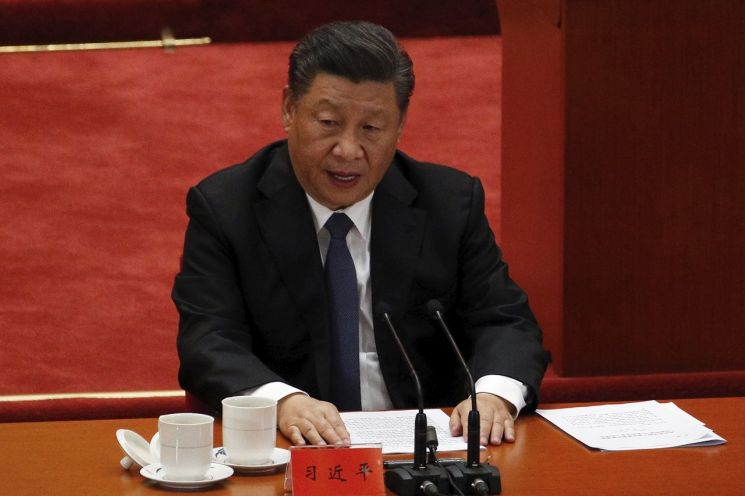
[Asia Economy Reporter Kim Eunbyeol] As the Central Committee, the highest authority of the Chinese Communist Party, begins the 19th Central Committee's 5th Plenary Session (5th Plenum) today, it is anticipated that China's emphasis on the "dual circulation" development strategy focused on domestic demand will have a negative impact on South Korea.
According to foreign media such as Politico and Taiwan Central News Agency (CNA) on the 26th, Chinese President Xi Jinping and the top Chinese leadership will gather in Beijing for four days starting today to hold the 19th 5th Plenum. It is expected that the outline of the five-year economic development plan, centered on the "dual circulation" strategy focused on domestic demand, will be discussed at this meeting.
The dual circulation strategy is a concept first mentioned by President Xi in May, referring to a mid- to long-term economic development strategy that expands international trade (international circulation) based on building a self-reliant economy focused on domestic demand (domestic circulation). Although it implies expansion in both domestic and international spheres, the core emphasis is on China boosting domestic demand to achieve economic self-reliance. The aim is to activate consumption and investment to reduce external dependence while expanding the economy.
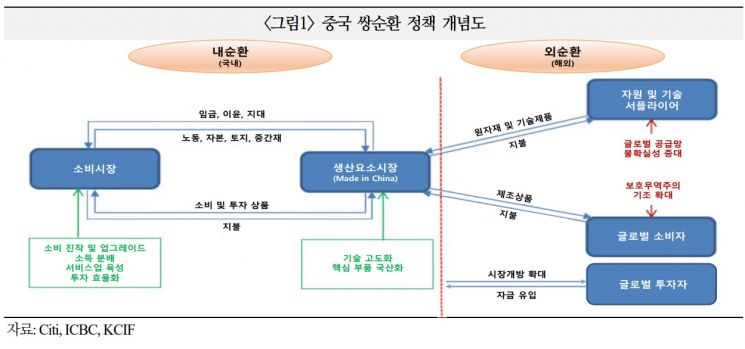
In particular, the dual circulation strategy also strongly implies reducing dependence on the United States. Experts expect that since the 19th 5th Plenum is held ahead of the U.S. presidential election on December 3rd, measures to reduce dependence on the U.S. will also be discussed. Even if Democratic candidate Joe Biden wins the U.S. presidential election, the anti-China stance is expected to continue, so China plans to respond by expanding support for advanced industries that have high U.S. dependence and relatively low technological levels. Currently, the localization rate of technology in Chinese semiconductor companies has increased from 8.5% in 2010 to 15.4% last year but remains low.
Nam Kyung-ok, senior researcher at the International Finance Center, said, "The full-scale implementation of the dual circulation policy may accelerate changes in global trade and investment flows," adding, "As China's domestic supply chain ecosystem becomes more complete, negative impacts are expected for countries exporting intermediate goods to China such as South Korea, Japan, and Germany." For South Korea, where China is the largest export market, this means a reduction in intermediate goods exports and intensified competition in third markets. Nam also pointed out that since the U.S. has recently requested participation in the anti-China coalition, signs of the revival of the ban on Korean entertainment exports (Hallyu ban) could negatively affect exports to China.
However, products and technologies that are difficult to substitute through imports, as well as final consumer goods, may actually see expanded market entry by riding on China's domestic demand activation, resulting in a positive side effect. Nam added, "China's emphasis on both domestic and international circulation implies that complete localization of all imported components is impossible," and "As China's semiconductor self-reliance efforts face difficulties due to U.S. sanctions on Huawei, fully independent technological development is practically difficult."
© The Asia Business Daily(www.asiae.co.kr). All rights reserved.
![User Who Sold Erroneously Deposited Bitcoins to Repay Debt and Fund Entertainment... What Did the Supreme Court Decide in 2021? [Legal Issue Check]](https://cwcontent.asiae.co.kr/asiaresize/183/2026020910431234020_1770601391.png)
















