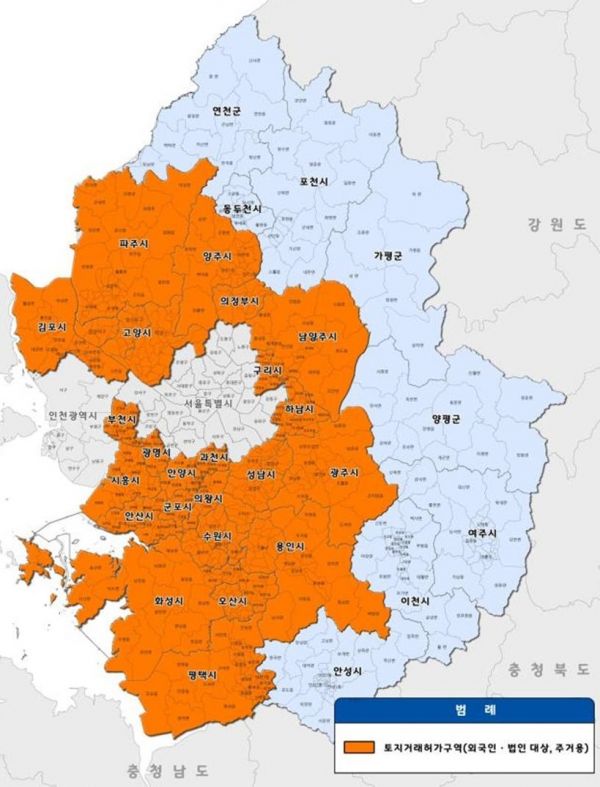
 Map of Land Transaction Permission Zones Designated for Foreign Corporations in Gyeonggi-do (Provided by Gyeonggi-do)
[Asia Economy Reporter Lee Chun-hee] Gyeonggi Province has designated 23 out of 31 cities and counties within the province as foreigner and corporation land transaction permission zones to actively block speculative real estate transactions.
On the 23rd, Gyeonggi Province held an urban planning committee meeting and announced on the 26th that it had reviewed and approved a plan to designate a total area of 5,249.11㎢ across 23 cities and counties, including Suwon City, as land transaction permission zones for foreigners and corporations. The permission applies only when acquiring land that includes housing, and the designation period is six months from the 31st of this month to April 30th of next year.
Earlier in July, Gyeonggi Province designated 221.98㎢ within the province as a land transaction permission zone to "fundamentally block speculative land transactions by planned real estate investors." Through this recent measure, the province aims to preemptively block speculative real estate acquisitions by foreigners and corporations. Eight cities and counties including Pocheon, Dongducheon, Yeoju, Icheon, Anseong, Yeoncheon, Gapyeong, and Yangpyeong were excluded from the designation as they have relatively low real estate transaction volumes by foreigners and corporations and are either border areas or agricultural, mountainous, or fishing villages, where speculation concerns are considered low.
Accordingly, in the 23 designated cities and counties, foreigners and corporations must obtain permission from the head of the relevant local government to acquire land that includes housing. Violations will result in imprisonment for up to two years or a fine of up to 30% of the individual publicly announced land price at the time of contract conclusion.
A Gyeonggi Province official explained the reason for limiting the regulation to foreigners and corporations: "This is intended to reduce the administrative burden on government agencies, prevent side effects such as demand concentrating in Seoul and Incheon due to a balloon effect, and minimize inconvenience to domestic residents' normal real estate transactions." The official added, "Given the nature of the land transaction permission system, which imposes an obligation to use the land for the approved purpose, it is expected to effectively block speculative demand by foreigners and corporations within the designated cities and counties."
According to Gyeonggi Province, from January to July this year, corporations acquired 9,580 apartments within the province, a 370% increase (7,544 units) compared to 2,036 units during the same period last year. The number of buildings such as apartments, commercial buildings, and villas acquired by foreigners also increased by 32% (1,338 units) to 5,423 units compared to 4,085 units in the previous year.
© The Asia Business Daily(www.asiae.co.kr). All rights reserved.

















