[Asia Economy Reporter Changhwan Lee] With just over two months remaining until the third phase of the Emissions Trading Scheme (2021?2025), it has been found that companies are unable to establish investment plans due to a lack of greenhouse gas reduction technologies.
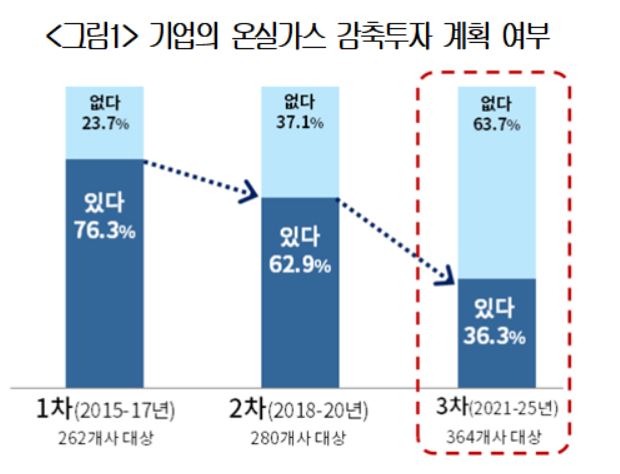
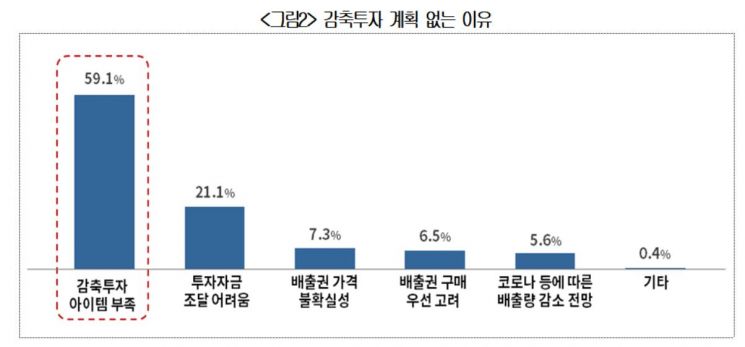
On the 26th, the Korea Chamber of Commerce and Industry (KCCI) announced the results of a survey on the "Response Status to the Emissions Trading Scheme" conducted among 364 companies participating in the scheme. Only 36.3% of the companies responded that they have "plans to invest in greenhouse gas reduction" during the third phase. Among the reasons for not setting investment plans, 59.1% of companies cited a "lack of items for reduction investment."
The KCCI has surveyed companies' responses during each phase of the emissions trading scheme. During the first phase (2015?2017), 76.3% of respondents had plans to invest in greenhouse gas reduction, and during the second phase (2018?2020), 62.9% responded similarly.
According to the "3rd Emissions Allocation Plan" announced by the government last September, the greenhouse gas reduction target for the third phase is strengthened by about 4% compared to the second phase, and the proportion of paid allocation will increase from 3% to 10%. This means that the burden on companies to reduce greenhouse gases will increase, but due to the lack of reduction technologies, investments may actually decline.
◆The Reason for No Reduction Investment Plans is ‘Lack of Reduction Investment Items’
In this survey, companies most frequently pointed to "lack of reduction investment items" (59.1%) as the reason for not having plans to invest in greenhouse gas reduction. This was followed by "difficulty in securing investment funds" (21.1%), "uncertainty of emission allowance prices" (7.3%), "prioritizing emission allowance purchases" (6.5%), and "reduced emissions due to COVID-19, etc." (5.6%).
A manufacturing industry official said, "Through steady investments during the first and second phases of the emissions trading scheme, we have already achieved world-class energy efficiency in the same industry sector," adding, "To reduce greenhouse gases further, the development and commercialization of additional reduction technologies are urgently needed."
Accordingly, companies participating in the survey selected "development and dissemination of greenhouse gas reduction technologies" (30.3%) as the top priority task the government should pursue during the third phase. This was followed by requests for "stabilization of emission allowance prices" (28.8%), "expansion of financial support for reduction investments" (23.7%), "expansion of incentives for reduction investments" (10.9%), and "expansion of external reduction projects" (6.2%).
A KCCI official stated, "If reduction targets are set high without the advancement of greenhouse gas reduction technologies, it will negatively affect not only the industrial ecosystem but also jobs," and added, "It is necessary to review the level of development of greenhouse gas reduction technologies planned when establishing the 2030 national reduction target and to develop them systematically."
◆Top Difficulty in the 1st and 2nd Phases was ‘Volatility of Emission Allowance Prices’ … Need for ‘Price Stabilization Measures’
During the first and second phases, companies most frequently cited "volatility of emission allowance prices" (25.5%) as the main difficulty related to the emissions trading scheme. This was followed by "lack of reduction investment items" (25.1%), "excessive administrative burden" (20.5%), "frequent system changes" (19.4%), and "lack of emission allowance liquidity" (9.5%).
The emission allowance price started at 8,600 KRW in January 2015 and experienced repeated fluctuations. From the end of last year to April this year, it surged to the 40,000 KRW range, then plunged to the high 10,000 KRW range in August, and recently rose again to the mid-20,000 KRW range.
Professor Lee Ji-woong of Pukyong National University said, "If the volatility of emission allowance prices is high, companies inevitably find it difficult to make decisions regarding greenhouse gas reduction investments and emission allowance trading," adding, "It is necessary to enhance market stabilization measures by referring to cases in the EU, the US, and other regions that introduced emissions trading schemes earlier than us."
Kim Nok-young, Director of the Sustainable Management Center at KCCI, said, "If the first and second phases were pilot operation stages of the emissions trading scheme, the third phase marks the full implementation stage. Therefore, it is necessary to foster reduction technologies and stabilize emission allowance prices to encourage companies to reduce greenhouse gases," and added, "Since the revenue from paid emission allowance allocations collected from companies amounts to several hundred billion KRW annually, it should be utilized for the development and dissemination of greenhouse gas reduction technologies."
© The Asia Business Daily(www.asiae.co.kr). All rights reserved.
![Clutching a Stolen Dior Bag, Saying "I Hate Being Poor but Real"... The Grotesque Con of a "Human Knockoff" [Slate]](https://cwcontent.asiae.co.kr/asiaresize/183/2026021902243444107_1771435474.jpg)












