Hong Nam-ki: "The Enforcement Decree Was Already Revised Two and a Half Years Ago... We Have No Choice but to Proceed as Is"
Additional Jeonse Measures to Be Announced as Early as This Week
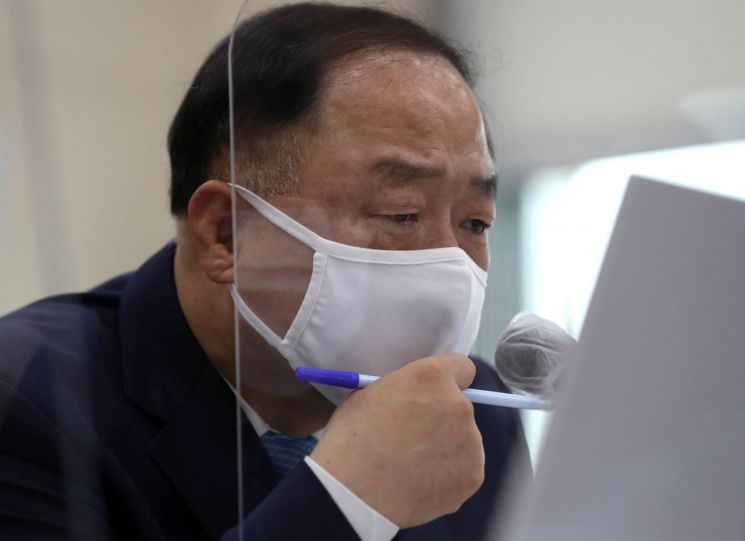 Hong Nam-ki, Deputy Prime Minister and Minister of Economy and Finance. (File photo) [Image source=Yonhap News]
[Asia Economy Reporter Joo Sang-don] The government has maintained its position to strengthen the major shareholder threshold for imposing capital gains tax on stocks to 300 million KRW, while changing family aggregation to individual aggregation.
Earlier on the 22nd, Hong Nam-ki, Deputy Prime Minister and Minister of Economy and Finance, stated during the National Assembly Planning and Finance Committee comprehensive audit, "The enforcement decree was already revised two and a half years ago to set the major shareholder threshold at 300 million KRW," adding, "We will proceed as is, but we are preparing to switch family aggregation to individual aggregation."
Under current law, a major shareholder is defined as holding 1 billion KRW or more in a single stock, and capital gains tax of 22-33% (including local tax) is imposed on the capital gains. According to the '2017 Tax Law Amendment,' the major shareholder criteria will be gradually expanded and the capital gains tax threshold strengthened. Accordingly, from April 2021, shareholders holding 300 million KRW or more in a single stock will be required to pay capital gains tax on their gains.
Regarding the market impact of lowering the major shareholder threshold from the current 1 billion KRW to 300 million KRW next year, Deputy Prime Minister Hong said, "There will be some impact, but it will be limited," and added, "I will keep in mind the advice to monitor the market impact closely."
Among the upcoming jeonse (long-term lease) measures expected to be announced as early as this week, proposals such as introducing a 'standard rent'?which sets the rent price based on a designated standard house considering its use, area, and structure?and applying rent and lease price caps to new housing were rejected. This is because direct price controls face strong opposition and are judged unlikely to significantly stabilize the jeonse market immediately. When Democratic Party lawmaker Jung Il-young asked if the 'standard rent' had been reviewed, Hong replied, "It has not been reviewed," and also said, "The cap system for new housing has not been reviewed either."
Deputy Prime Minister Hong explained that the additional jeonse measures will be prepared within the scope that does not conflict with existing policies. He said, "Various measures can be taken as jeonse measures, but they cannot be easily adopted if they conflict with efforts to stabilize the real estate market," adding, "Nevertheless, whether small or large measures, the government is reviewing all possible options in close consultation with related ministries."
© The Asia Business Daily(www.asiae.co.kr). All rights reserved.

















