Announced Plan to Triple Facilities Over 5 Years Through the 'Green New Deal'
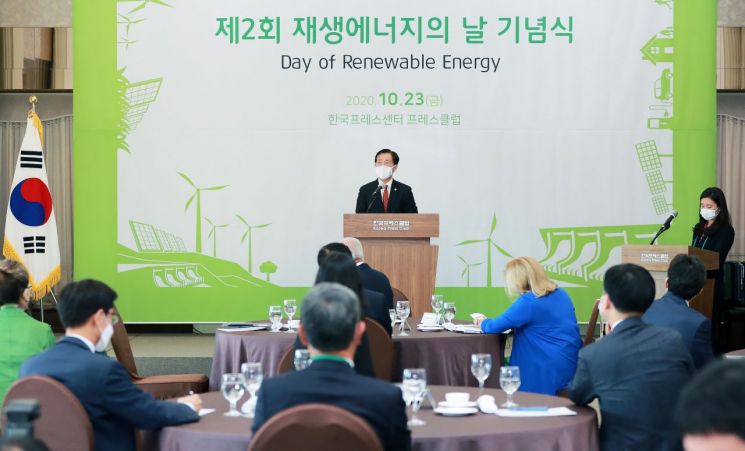 Minister Sung Yun-mo of the Ministry of Trade, Industry and Energy delivering a congratulatory speech at the '2nd Renewable Energy Day Ceremony' held at the Korea Press Center Press Club in Seoul on the 23rd. The ceremony was attended by Lee Hak-young, Chairman of the National Assembly Industry, Trade, and Energy Venture Business Committee; Maria Castillo Fernandez, Ambassador of the European Union (EU) to Korea; Yoo Young-sook, Chairman of the Climate Change Center; Lee Wan-geun, President of the Solar Industry Association; Jin Woo-sam, President of the New and Renewable Energy Society; Moon Jae-do, Representative of the Energy Valley Forum; and about 30 other industry, academia, and research officials related to new and renewable energy. (Photo by Ministry of Trade, Industry and Energy)
[Asia Economy Reporter Moon Chaeseok] South Korea's renewable energy has officially turned two years old. Over the past year, the renewable energy industry has produced outcomes such as the Green New Deal, the establishment of the RE100 framework (a corporate commitment to source 100% of electricity from renewable energy by 2050), and the mandatory hydrogen power generation system (HPS).
Although hydrogen is a new energy source with different characteristics from renewable energies like solar and wind power, it has been operated under the same Renewable Portfolio Standard (RPS) system for new and renewable energy supply obligations. The HPS system is a highly anticipated policy in the renewable energy sector as it is expected to reduce market imbalances.
Industry, Academia, and Research Institutes Pledge Public-Private Cooperation on Renewable Energy
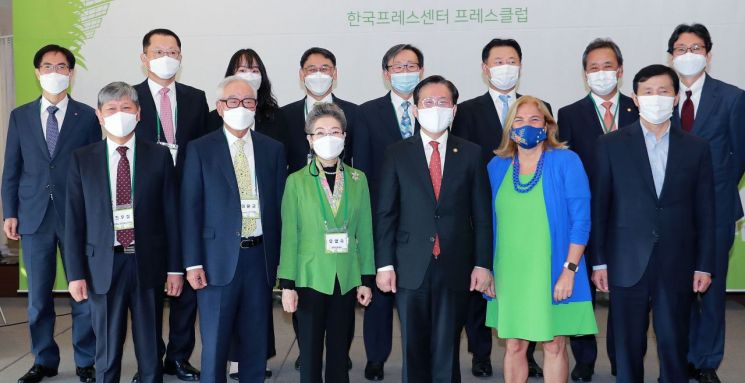 Minister Sung Yun-mo of the Ministry of Trade, Industry and Energy delivering a congratulatory speech at the "2nd Renewable Energy Day Ceremony" held at the Korea Press Center Press Club in Seoul on the 23rd. The ceremony was attended by about 30 people, including Lee Hak-young, Chairman of the National Assembly Industry, Trade, and Venture Businesses Committee; Maria Castillo Fernandez, Ambassador of the European Union (EU) to Korea; Yoo Young-sook, Chairperson of the Climate Change Center; Lee Wan-geun, President of the Solar Industry Association; Jin Woo-sam, President of the New and Renewable Energy Society; Moon Jae-do, Representative of the Energy Valley Forum; and other industry, academia, and research officials related to new and renewable energy. Minister Sung Yun-mo is the third from the right in the front row. (Photo by Ministry of Trade, Industry and Energy)
According to the Ministry of Trade, Industry and Energy on the 25th, about 30 stakeholders in new and renewable energy attended the event on the 23rd. The event was graced by the presence of Minister Sung Yun-mo of the Ministry of Trade, Industry and Energy, members of the National Assembly (Lee Hak-young, Chair of the Industry, Trade, and Venture Businesses Committee), the European Union (Maria Castillo Fernandez, EU Ambassador to Korea), related organizations (You Young-sook, Chairperson of the Climate Change Center; Lee Wan-geun, President of the Korea Photovoltaic Industry Association), academia (Jin Woo-sam, President of the New and Renewable Energy Society), and industry (Moon Jae-do, CEO of Energy Valley Forum).
Attendees pledged private sector cooperation to build and expand the renewable energy industrial ecosystem. Given that many renewable energy development projects this year were 'community participation' types and concerns persist over the increasing market share of Chinese components, it was understood that industry development would be difficult relying solely on government efforts.
Earlier, at the end of last month, the Ministry announced plans to discover 4,000 energy innovation companies in six promising sectors by 2025. Currently, announcements of the 9th Basic Plan for Electricity Supply and Demand (9th Electricity Plan), which includes renewable energy supply and demand targets for the next decade, and the 5th Basic Plan for New and Renewable Energy (New Basic Plan) are forthcoming.
Green New Deal, RE100, HPS... Significant Achievements
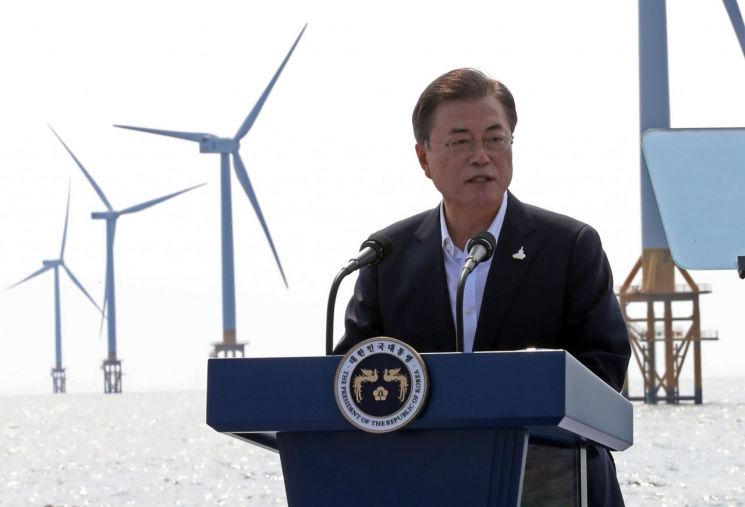 President Moon Jae-in emphasizing the importance of strengthening offshore wind power competitiveness and green energy at an event related to the Korean New Deal held on July 17 in the Southwest Sea Offshore Wind Power Demonstration Complex in Gochang-gun, Jeollabuk-do. (Image source=Yonhap News)
In 2020, marking its official second anniversary, South Korea's renewable energy played a significant role in awakening the growth momentum of the national economy as a whole.
The Green New Deal policy, which aims to create 659,000 jobs and reduce 12.29 million tons of greenhouse gases by investing 73.4 trillion won, is a representative example. Solar and wind power generation, which was 15.8 GW last year (based on the '2019 New and Renewable Energy Supply Statistics (Preliminary)' by the Korea Energy Agency), is planned to be significantly increased to 26.3 GW by 2022 and 42.7 GW by 2025. This is a government initiative to address concerns such as low power generation efficiency, vulnerability of solar facilities to natural disasters, forest damage, and market encroachment by Chinese components.
A regulatory framework to encourage domestic companies' participation in RE100 has been established. Early last month, the government introduced five domestic implementation methods: green premium system, purchase of Renewable Energy Certificates (REC), third-party Power Purchase Agreements (PPA), equity investment, and self-generation. Until now, Korean companies have expressed their intention to participate in RE100 mainly through MOUs with overseas companies (a representative case being SK Hynix's agreement with Apple in July), but domestic participation was difficult due to insufficient systems.
It is also notable that South Korea announced plans to introduce the world's first mandatory hydrogen power generation system (HPS) in 2022. Although HPS is a new energy industry policy for hydrogen, not renewable energy, it is expected to accelerate the development of 'green hydrogen' and enhance synergy with renewable energy, drawing significant interest from the renewable energy sector. Generally, related organizations are structured around new and renewable energy, which includes both new energy and renewable energy.
The HPS system aims to encourage companies with high energy consumption to increase purchases of hydrogen fuel cell facilities. However, issues such as the obligated entities (either Korea Electric Power Corporation as the seller or one of the power producers), the method of imposing obligations (whether by annual obligation ratio like RPS or by capacity), and hydrogen supply measures (how quickly the transition to green hydrogen can be made) need to be resolved.
© The Asia Business Daily(www.asiae.co.kr). All rights reserved.



















