Telecom Industry Refutes 'Taking 15% Commission' Claim... Estimated at 3-4%
[Asia Economy Reporter Seulgina Jo] The so-called ‘30% app toll fee’ controversy sparked by Google, which dominates the domestic application ecosystem, has unexpectedly bounced to the three major mobile carriers. This is due to claims that when making in-app payments on Google Play, up to half, or a maximum of 15%, goes to the telecom companies. However, this applies only to one of several payment methods, namely mobile phone micropayments, and it has been confirmed that the actual share going to telecom companies from the total in-app payment amount is only 3-4%.
In particular, during this process, without clear fact-checking, the Korea Internet Corporations Association, which includes Naver and Kakao, and the Korea Startup Forum targeted the telecommunications industry, turning what should have been a focus on curbing Google’s commission abuse into an internal ‘family feud.’ Criticism continues that before the internet industry shifts Google’s market monopoly issues onto domestic manufacturers and telecom companies, everyone should unite to normalize the K-app market.
Telecom Industry Responds to ‘Taking Half of the Commission’ Claims: "Malicious Falsehoods"
The Korea Telecommunications Operators Association (KTOA), which includes SK Telecom, KT, and LG Uplus, issued a statement on the night of the 23rd saying, "The Internet Industry Association (Inki-hyeop) and Korea Startup Forum (Kospo) must immediately stop their malicious false claims related to Google and Apple’s market dominance controversy."
Earlier, during the National Assembly’s Science, ICT, Broadcasting and Communications Committee audit, Democratic Party lawmaker Yoon Young-chan, formerly of Naver, and People Power Party lawmaker Lee Young revealed that up to 15% of Google’s 30% app commission fee goes to telecom companies through telecom billing methods. Following this, Inki-hyeop and Kospo strongly criticized the three telecom companies, expressing "deep regret over the telecom companies’ behavior of sharing Google’s excessive commissions (15% distribution), which has increased the burden on content usage fees," prompting KTOA to issue a direct rebuttal within a day.
In its statement, KTOA pointed out that the internet industry’s claims about telecom companies’ involvement in pre-installing app markets and sharing half of the commissions are false, emphasizing that "telecom companies have not cooperated in expanding Google and Apple’s market influence."
First, they raised their voice that "pre-installation of their own OS and app markets is a matter of agreement with manufacturers, and telecom companies cannot intervene or have any means to be involved." On the contrary, the telecom-led app market One Store competes with Google Play and Apple App Store and is working to normalize competition in the domestic app market through One Store.
Additionally, KTOA pointed out that "the claim by Inki-hyeop that telecom companies take 15% of the total payment amount is not true, and the telecom companies’ share of mobile phone payment commissions is around 3-4%." They explained that the ‘sharing half of the commission’ claim targeted by the internet industry is a malicious falsehood.
Telecom Share Limited to Mobile Micropayments... Estimated at 3-4%, Not 15%
According to industry confirmation, the three telecom companies charging half of the 30% in-app payment service commission on Google Play applies only to telecom billing payments (DCB). Telecom billing payments refer to mobile micropayments that appear together with mobile phone bills. According to industry estimates, the largest portion of Google app payments is credit cards, with mobile phone payments accounting for only about 20-30%. Based on this, if in-app payment revenue is considered 100, the telecom companies’ share is 3-4%, not 15%.
Rather, with the recent rise of simple payment methods such as KakaoPay, the commission rate paid to telecom companies is confirmed to be decreasing. Currently, Google Play operates payment methods including credit cards, Payco points, KakaoPay, and cultural gift certificates, in addition to mobile micropayments.
Lawmaker Lee Young, who was the starting point of the controversy, also clarified that the commission revenue taken by the three telecom companies applies only to telecom billing payments. However, as media reports spread unclearly and the internet industry, which should have been cautious in fact-checking, took the lead in attacking the three telecom companies, it turned into a ‘family feud.’ Lawmaker Yoon Young-chan even made remarks that further fueled the controversy, suggesting, "Isn’t this revenue sharing for telecom companies pre-installing Google services?"
In response, KTOA stated, "Commission rates are directly decided by Google and Apple’s global policies. Even if domestic telecom companies lower mobile payment commissions, only Google’s revenue generated in Korea increases, with no benefits returned to users," rebutting the internet industry’s claim that telecom companies’ commission receipts increase users’ content usage burdens.
They also criticized, "Before shifting Google’s market monopoly issues onto manufacturers and telecom companies, Inki-hyeop should first discuss and find solutions internally, as Google is a member of Inki-hyeop."
When the Focus Should Be on Stopping Google’s Abuse, Only Internal Conflicts... Bill Passage Also Fails
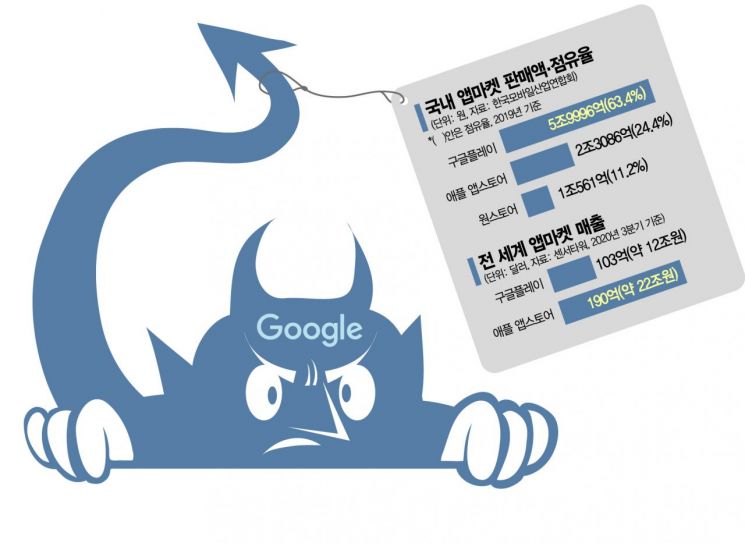
The view inside and outside the industry regarding this controversy is bitter. Despite generating enormous profits domestically while avoiding taxes and network usage fees, Google is abusing its monopolistic position of as much as 70% to enforce commission abuse, yet the internet and telecom industries are divided and fighting each other.
Moreover, the National Assembly’s Science, ICT, Broadcasting and Communications Committee extended its audit until midnight the previous day but ultimately failed to pass the ‘Google Abuse Prevention Act (Amendment to the Telecommunications Business Act).’ Initially, the ruling and opposition parties had agreed to merge six amendment bills to the Telecommunications Business Act, which included provisions to prevent Google’s forced 30% app commission and mandatory in-app payments, and to approve them as a committee alternative by the last day of the audit. However, People Power Party lawmakers raised concerns about rushed legislation and requested a delay.
Earlier, Google announced that starting next year, app developers on Google Play selling content and items will be forced to use Google’s payment method (in-app payment), taking a 30% commission in the process. Unlike Apple App Store, Google expanded its commission policy, previously applied only to games, to all content and apps. This is feared to threaten the survival of domestic app developers and lead to price increases for major content such as webtoons and music.
Especially at the audit on the 22nd, Google Korea Executive Director Lim Jae-hyun, who appeared as a witness, said regarding the Google Abuse Prevention Act, "(If passed by the National Assembly) we may have to reconsider our business model." As a monopolistic business operator, Google effectively made a threatening statement leveraging developers and consumers by mentioning changes to its business model that could broadly impact the domestic ecosystem during the audit.
The controversy over Google’s unfair practices contradicts its founding motto, "Don't Be Evil." The industry already recognizes that proper competition is impossible with market power alone, so there is growing support for quickly implementing the bill and accelerating efforts to restore competition in the domestic app market to revitalize the ecosystem. Earlier, Lee Jae-hwan, CEO of One Store, who appeared at the audit, suggested, "To be effective, two things must be included: punishing the abuse of dominant market power and enabling content providers to release through domestic app markets without hesitation."
KTOA stated, "If telecom companies only sought to profit from Google and Apple, they would not have launched the integrated One Store in 2016 with participation from the three telecom companies and Naver," adding, "Normalizing the K-app market is the top priority to jointly advance Korea as a global content powerhouse."
© The Asia Business Daily(www.asiae.co.kr). All rights reserved.
![User Who Sold Erroneously Deposited Bitcoins to Repay Debt and Fund Entertainment... What Did the Supreme Court Decide in 2021? [Legal Issue Check]](https://cwcontent.asiae.co.kr/asiaresize/183/2026020910431234020_1770601391.png)