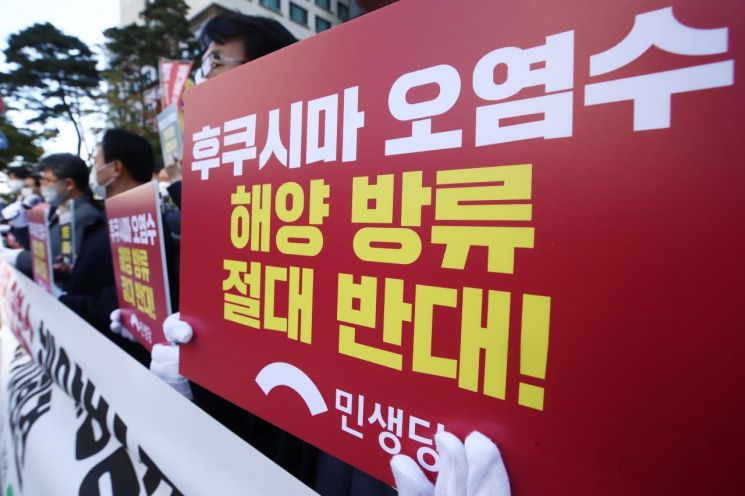
 Minsaeng Party officials hold placards at a press conference opposing the discharge of contaminated water from the Fukushima nuclear power plant into the ocean, held on the 23rd in front of the Statue of Peace near the former Japanese Embassy in Jongno-gu, Seoul. Photo by Yonhap News
[Asia Economy Reporter Hana Na] The Japanese government's decision to discharge contaminated water from the Fukushima Daiichi Nuclear Power Plant into the ocean, initially expected on the 27th, is likely to be postponed.
On the 24th, Japanese media such as Asahi Shimbun and Nihon Keizai Shimbun reported that Hiroshi Kajiyama, Minister of Economy, Trade and Industry, stated at a press conference after the Cabinet meeting on the 23rd that the government would not decide on the policy regarding the ocean discharge of contaminated water accumulated at the Fukushima Daiichi Nuclear Power Plant on the 27th, saying, "It is not at a stage where we can convey a specific decision timeline."
Previously, Japanese media had reported that the government would hold a meeting of relevant ministers on the 27th to discuss decommissioning and contaminated water measures related to Fukushima Daiichi and decide on the ocean discharge of contaminated water. They analyzed that "due to repeated negative opinions from the fishing industry regarding ocean discharge, the government seems to be carefully deciding the policy."
According to Kyodo News, the Japanese government has received about 4,000 public opinions concerning the ocean discharge of Fukushima nuclear power plant contaminated water. Among these, approximately 2,700 expressed concerns about the safety of ocean discharge, and about 1,400 opinions stated that "there was no national consensus in the government's decision-making process."
Meanwhile, about 70% of the contaminated water currently stored at Fukushima contains radioactive substances exceeding standard levels, including tritium, which cannot be removed with current technology. Tokyo Electric Power Company (TEPCO) has indicated that the contaminated water storage tanks are reaching saturation and has continuously proposed ocean discharge of the contaminated water as a solution.
In response, as of September, the Japanese government is reviewing a plan to reprocess the contaminated water, which has increased to about 1.23 million tons, to reduce it below standard levels and then release it into the Pacific Ocean, presenting this as the only solution.
© The Asia Business Daily(www.asiae.co.kr). All rights reserved.

















