Seocho-gu "Reducing Tax Burden for Residents Struggling Due to COVID-19"
Seoul City "Violates Tax Law Principles and Raises Equity Issues with Other Districts"

[Asia Economy Reporter Jo In-kyung] Seocho-gu, one of the 25 autonomous districts in Seoul, announced an ordinance to unilaterally reduce property tax by 50%, prompting Seoul City to immediately decide on legal action. The power struggle between Seoul City and Seocho-gu over the property tax reduction will ultimately be subject to legal judgment.
On the 23rd, Seocho-gu proceeded as scheduled to announce the ordinance to reduce property tax for single-homeowners with a standard market value of 900 million KRW or less and began preparing refund procedures. Seoul City, which had previously requested the district council to reconsider the property tax reduction, also decided after internal review on the same day to file for a suspension of execution and sue at the Supreme Court next week.
Seocho-gu explained, "To reach a consensus with Seoul City, we have repeatedly requested meetings with the acting mayor of Seoul since the 13th and waited for a date, but on the evening of the 21st, Seoul City finally notified us of their refusal to meet," adding, "We decided we could no longer wait and proceeded with the announcement."
Seocho-gu Reduces District Tax Portion by 50% for Single-Homeowners with Standard Market Value Below 900 Million KRW
The ordinance by Seocho-gu is based on the Local Tax Act provision allowing local government heads to reduce property tax by 50% in disaster situations. It reduces 50% of the district’s share of property tax (which is 25% of the total property tax) for single-homeowners with homes valued at 900 million KRW or less. Seocho-gu explained that the ordinance was enacted because the economic difficulties caused by the COVID-19 pandemic and adjustments to real estate official prices have increased the property tax burden on ordinary citizens.
However, Seoul City opposes the ordinance, arguing that it creates a tax base category not provided for in the Local Tax Act, violating the principle of legality in taxation and raising fairness issues with the other 24 districts. Seoul City also points out that the ordinance disproportionately benefits owners of high-priced homes while excluding the homeless, thus violating tax fairness.
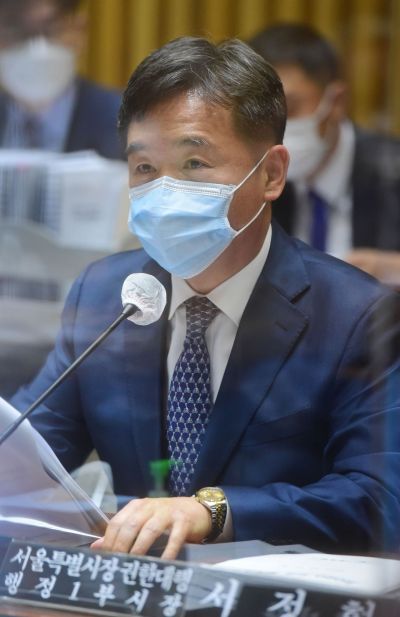
At the National Assembly’s Public Administration and Security Committee’s audit of Seoul City on the 15th, Acting Mayor Seo Jung-hyup said, "Although the matter was discussed at the District Mayors’ Council, the other 24 districts do not agree, so it is unfair for only Seocho-gu to proceed," adding, "I believe property tax reductions should be pursued as a central government policy."
In response, Seocho-gu rebutted, saying, "We did not create a new tax base category but set a reasonable criterion of ‘single-homeownership with a standard market value of 900 million KRW or less’ to select property tax reduction targets," and insisted, "There is no violation of higher laws." They also argued, "It is illogical to discuss fairness between those who suffer from sharp property tax increases and the homeless, similar to how year-end tax adjustments apply only to taxpayers."
Furthermore, Seocho-gu pointed out, "Since only the district tax portion is reduced while the joint tax portion remains unchanged, it does not affect the financial conditions of other districts," noting that in 2004, 20 districts, and in 2005, 15 districts, had each reduced property tax by 10-40% according to their financial conditions.
Seoul City Raises Issues of Ordinance’s Illegality and Fairness... Likely to Leave Decision to Supreme Court
Seoul City, which had already announced legal action against Seocho-gu’s ordinance enactment plan, is expected to file a lawsuit for ordinance invalidation at the Supreme Court next week and simultaneously apply for a suspension of execution.
If the court accepts Seoul City’s application for suspension of execution, Seocho-gu will have to halt related work and wait for the court’s substantive judgment. Since it is unlikely that the court’s final ruling will be issued within this year, it seems difficult for Seocho-gu’s ordinance to be implemented within the year.
Minister of the Interior and Safety Jin Young said in a National Assembly audit regarding this issue, "We are conducting an internal legal review," but also added, "I fundamentally believe local autonomy should be respected."
Meanwhile, some criticize Seocho-gu’s move as a populist act driven by the political ambitions of Seocho-gu Mayor Cho Eun-hee. Mayor Cho is the only district mayor in Seoul affiliated with the opposition party.
© The Asia Business Daily(www.asiae.co.kr). All rights reserved.


















