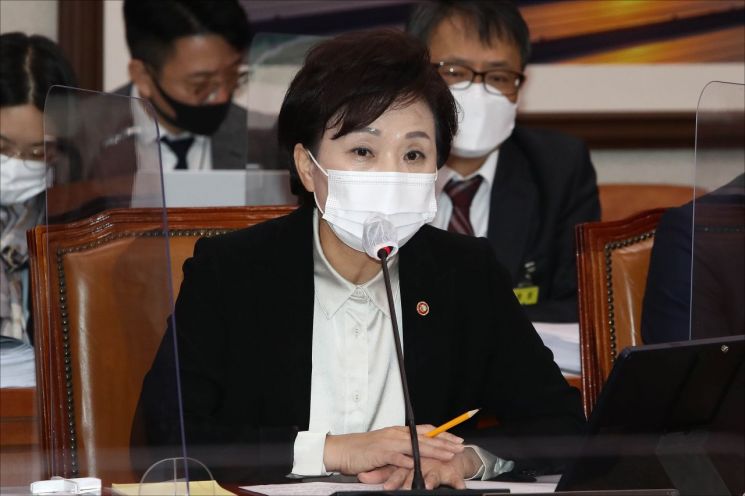
[Asia Economy Reporter Yoo In-ho] On the 23rd, Kim Hyun-mi, Minister of Land, Infrastructure and Transport, announced that she will unveil next month a plan to improve public rental housing, including measures to supply mid-to-large sized public rental units that middle-class families can also afford.
At the comprehensive audit of the National Assembly Land, Infrastructure and Transport Committee on the same day, in response to a question from Assemblyman Cheon Jun-ho of the Democratic Party of Korea regarding public rental housing plans for the middle class, Minister Kim said, "We are consulting with the financial authorities on expanding the size of public rental units to supply to the middle class, and we will provide specific plans in November," adding, "It seems there will be changes in the financial authorities' support policies."
Earlier in August, President Moon Jae-in proposed a plan to make public rental housing a 'quality lifelong home' that anyone, including the middle class, would want to live in.
The Ministry of Land, Infrastructure and Transport is considering increasing the area of integrated-type rental units to up to 85㎡ to allow middle-class residents and raising the median income criteria above 130%.
Minister Kim further emphasized, "New forms of public rental housing will be implemented in various ways in the 3rd phase new towns, etc. Improving the quality of public rental housing and dramatically increasing the quantity is a major task I am committed to pursuing during my tenure as minister."
In response to Assemblyman Hong Ki-won's question about the evaluation of the Moon Jae-in administration's real estate policies, Minister Kim said, "Among the government's comprehensive measures, the September 13, 2018 plan is evaluated as having had the most positive impact on the market."
Minister Kim added, "After the September 13 plan, interest rates were stable and showed a downward trend in early 2019, but mid-year, as interest rates were lowered, there was a tendency to enter an upward phase again," emphasizing, "Fundamentally, tax collection must continue to manage the real estate market in a low-interest-rate environment."
Regarding the review of comprehensive real estate tax reductions for long-term homeowners with one house, Minister Kim stated, "We revised the law to provide an 80% tax cut for long-term holders of one house per household, which I believe offers significant benefits," and added, "I do not think there is a need for special tax reform at this time."
This clearly indicates opposition to the Democratic Party leader Lee Nak-yeon's proposal to ease the comprehensive real estate tax for long-term homeowners who actually reside in their homes.
Minister Kim expressed concern about the growing instability in the jeonse (long-term lease) market due to the Bank of Korea's base interest rate cuts. In response to Assemblyman Park Sang-hyuk's remark that "the biggest cause of current jeonse market instability is the historically low interest rates," Minister Kim said, "We are also worried that the prolonged ultra-low interest rate situation is having a very significant impact on market instability."
She added, "I agree with measures such as tax credits to reduce tenants' burdens," explaining, "Since this issue requires consultation with the financial authorities, we will work together to discuss it."
Meanwhile, regarding the issue of overwork deaths among delivery workers, Minister Kim said, "As our society moves toward a contactless society, the volume of deliveries is increasing, and society is becoming more dependent on delivery services," adding, "I am sorry about the situation where delivery workers are dying from overwork behind these changes."
Minister Kim added, "To ensure that the deaths of delivery workers are not in vain, it is necessary for not only the delivery workers but also the companies to share overall responsibility so that delivery workers can work stably. The government will announce measures without delay."
© The Asia Business Daily(www.asiae.co.kr). All rights reserved.

















