Professor Lee Jung-eun of Kyung Hee University and International Research Team Announce Research Findings
Analysis of Meteorites Formed in Early Solar System
New Evidence of Solar Formation Discovered
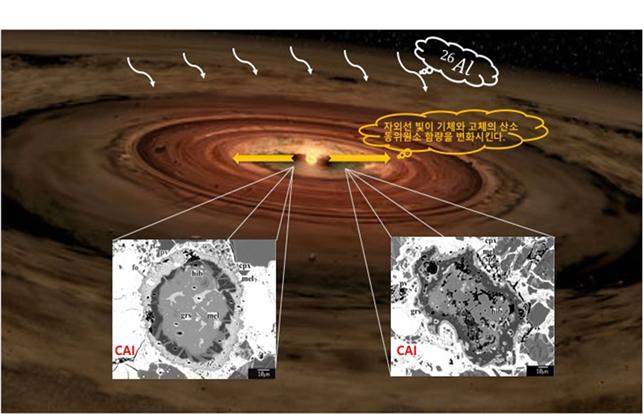 Model of the protosun and the protoplanetary disk of the early solar system. Ultraviolet rays emitted by the protosun can cause changes in the oxygen isotope content of the solar nebula, the protoplanetary disk. The two inserted images are backscattered electron images of calcium-aluminum-rich inclusions (CAIs) analyzed in this study. (Photo by NASA JPL-Caltech/Lyons/ASU/Lee Jeong-eun)
[Asia Economy Reporter Junho Hwang] New evidence has emerged suggesting that the Sun was born alongside massive stars that emit ultraviolet rays. An international multidisciplinary research team, including Professor Lee Jeong-eun from the Department of Space Science at Kyung Hee University, analyzed meteorites formed in the early stages of the solar system's formation and published their findings in the international academic journal Science Advances on the 24th.
The Sun Was Not Born Alone
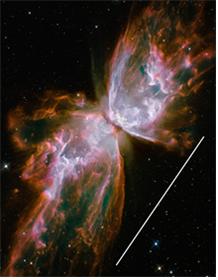 The Butterfly Nebula, the star-forming region of the Tarantula Nebula. The newly born star at the center is obscured by surrounding dust material and is not visible. The ultraviolet rays emitted by this star alter the distribution of oxygen isotopes in the protoplanetary disk surrounding the star. The white scale represents 2 light-years or 120,000 times the distance between the Sun and Earth (120,000 AU). (Photo by NASA and ESA)
The international research team, composed of faculty from Kyung Hee University, the University of Hawaii, and the University of Copenhagen, focused on calcium-aluminum-rich inclusions (CAIs) contained in chondrite meteorites to investigate the early state of the solar system's formation. Through this, they analyzed the oldest non-volatile solid particles in the solar system contained in meteorites and found evidence that these particles were exposed to strong ultraviolet radiation while still in the molecular cloud state before the Sun was formed.
They discovered that the oxygen isotope content in inert inclusions formed between 10,000 and 20,000 years after the solar system began forming in the primordial solar system molecular cloud showed significant variation.
Until now, there has been controversy in the academic community about the timing of this phenomenon caused by ultraviolet radiation?whether it occurred while the solar system was still in the molecular cloud state or after gravitational contraction had taken place, forming the protoplanetary disk known as the solar nebula.
The Sun May Have Formed Within a Star Cluster...

Professor Lyons stated, "The part we analyzed this time is an extremely early stage in the history of the solar system. This early stage is not enough time to consider that oxygen isotope changes occurred in the solar nebula, the protoplanetary disk."
Professor Krot explained the significance of the research results, saying, "Many elements measured in the solar system show isotope content variations, and recent findings indicate that their origin lies in the primordial solar system molecular cloud. Our study reveals that oxygen is no exception."
Recent studies examining isotope ratios of elements such as nitrogen have also reported that the influence of ultraviolet radiation must have occurred in the primordial solar system molecular cloud.
Professor Lee Jeong-eun said, "To explain the distribution of oxygen isotope content measured in our solar system, the primordial solar system molecular cloud must have been exposed to strong ultraviolet light. This implies that at the time the solar system began to form, there must have been massive stars emitting strong ultraviolet radiation nearby," adding, "The presence of such massive stars nearby suggests that the Sun was formed within a star cluster."
© The Asia Business Daily(www.asiae.co.kr). All rights reserved.


















