First Short Story Collection 'Sarang-i Steak-rani'... Eight Truly Unfamiliar Love Stories
[Asia Economy Reporter Park Byung-hee] 'A man abandoned by his mother and wife. The only thing a man can do in a semi-basement room is fold and fly paper airplanes. One day, a hostess working at a karaoke bar in front of the house visits the man's semi-basement room. She is a woman the man has been watching regularly. He even flew paper airplanes toward her. The woman, who seemed to settle in the man's room, one day says she plans to leave for Hokkaido, Japan. Upon hearing her intention to leave, the man folds her away as well.'
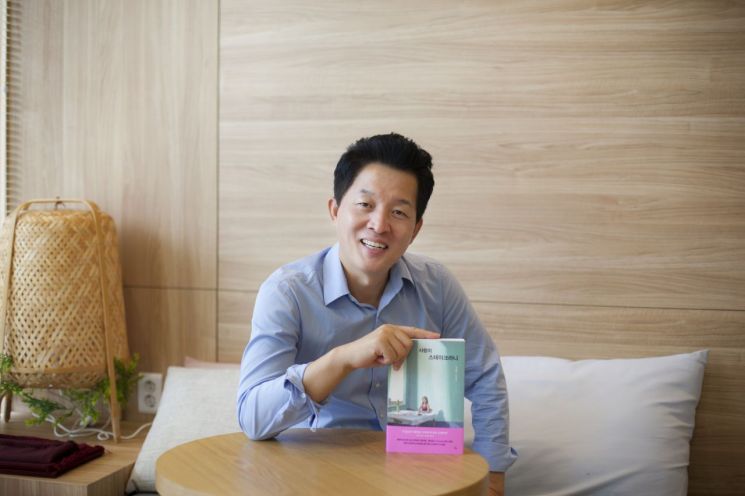
Folded away? The imagination in the short story "Paper Airplane" is unfamiliar. It even feels audacious. Curious about the meaning of "folded away," I met with writer Ko Yo-han (51, photo). I asked if it meant harm. He replied that he is not such a cruel person.
"Saying 'killed' would be very cruel, and that is not the author's intention. The man is trying to hold the woman back from going to Hokkaido. Folding here means holding on to her in a way. I added a fantastic element to the reality. Folding expresses the man's heartbreaking feelings. The man folds everything he loves into paper airplanes. Even before folding the woman, he folds everything inside the house."
"Paper Airplane," which shows an unfamiliar sensibility, was introduced in the literary translation journal "Asymptote" through the translation by Bruce Fulton, a professor at the University of British Columbia in Canada, and his wife Yoon Joo-chan. Professor Fulton, who has translated Korean literature for about 50 years, described "Paper Airplane" as "a terrifyingly beautiful and cruelly sad story."
"Paper Airplane" is one of eight short stories included in the late writer's first collection "Love is a Steak," published in September.
The protagonist in "Wandering in a Dream," who dreams of his deceased father and sets out to find a temple he saw in the dream, shows a different tone from "Paper Airplane." The story of lovers framed within the narrative feels like a scene from the 1980s "TV Literature Hall." The man, who has even set a wedding date, decides to become a monk after a chance visit to a temple. The woman, unable to follow, opens a teahouse in front of the temple and settles there.
The temple the man seeks in the story is Eundangsa. The actual inspiration for the writer was Songgwangsa in Soyang-myeon, Wanju-gun, Jeonbuk Province. The writer said that imagination becomes very free when visiting unfamiliar places. When he was deeply into Buddhism and often visited mountain temples, he had strange imaginations on the way to Songgwangsa. "It was a temple with a beautiful cherry blossom path stretching out, so pretty that I thought, 'This is a place where one might consider becoming a monk.'"
"Wandering in a Dream" is a piece the writer wrote while longing for his father. "My father was a gentle and kind man who never raised his voice in his lifetime. When I was seven, I went to a temple in Jinan, Jeonbuk, with my father. The lonely temple scenery at that time left a strong impression of my father that has not faded even after more than 20 years." The writer wrote "Wandering in a Dream" at age 27. Strangely, shortly after writing the story, his father passed away, and he even wondered whether to continue writing.
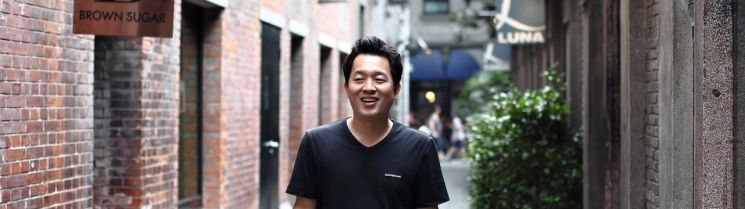
The reason "Wandering in a Dream" could be released to the world 24 years later was because the writer debuted late. Ko Yo-han debuted in 2016 by winning the New Writer Awards from "Literary Thought" and "Writer's World." "I debuted 20 years after starting to write novels, and four years later, my first collection was published. My family was very happy. Thanks to the collection, I had a joyful Chuseok."
The difficult-to-publish collection captivated readers with its unfamiliar sensibility. The book, published in early September, became so popular that it went into its sixth printing within a month.
Ko said he wants to write novels with unique imagination and exquisitely beautiful sentences. His rigorous revision process is a means to achieve the writing he pursues. "For one short story, I basically revise 500 times, usually 1,000 times. I can write about three to four short stories a year, but I spend one to two years, usually three years, revising each story."
The writer said he never gets tired of reading his work repeatedly but rather enjoys the "taste of revision." "When writing, there are things inside me that I want to express. I have to pull all of them out. But it takes quite some time to extract what's inside. The narrative, sentences, and imagination all have to satisfy me. I write until I am satisfied. The more I revise, the higher the quality of the writing becomes. Also, at some point, imagination beyond what I have suddenly pops out. I revise for that one sentence that suddenly appears. I keep revising repeatedly to find the sentence I truly like."
The writer plans to publish his first full-length novel next summer. The spatial background is New York, and the protagonist is a 39-year-old undocumented Korean man. The writer said he has been interested in unconventional and broken love stories rather than beautifully completed love since childhood, citing Thomas Hardy's "Tess" and Marguerite Duras's "The Lover" as impressive reads. He plans to explore a shocking love story in his first full-length novel to be published next year.
© The Asia Business Daily(www.asiae.co.kr). All rights reserved.


















