Request for Overtime Work to Union for Additional Production of 400,000 Units
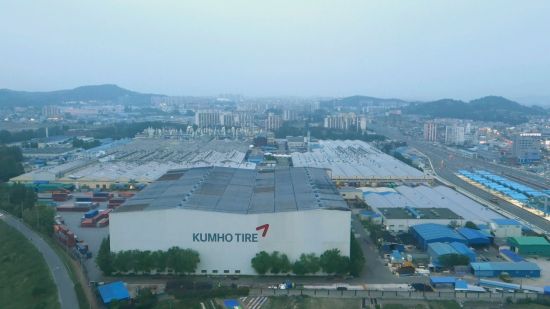
[Asia Economy Reporter Kiho Sung] Kumho Tire has initiated a push for a 64-hour workweek to respond to the surge in orders from global regions such as Europe and the United States.
According to the tire industry and the Kumho Tire Labor Union on the 23rd, Kumho Tire recently decided to temporarily implement a 64-hour workweek at its domestic factories to produce an additional 400,000 units and has reportedly requested cooperation from the union. A Kumho Tire union official stated, "It is true that the company recently requested overtime work," adding, "The union will review relevant laws and manpower management from multiple angles and will hold practical discussions or a consultative body to make a decision."
According to the revised Enforcement Rules of the Labor Standards Act implemented by the Ministry of Employment and Labor earlier this year, special extended work of up to 12 hours per week is allowed in cases of a surge in workload (approval reason No. 4). The maximum approval period per instance is four weeks, and if additional special extended work is needed, approval must be obtained again. Furthermore, it is allowed for up to 90 days per year. An industry insider explained, "If special extended work is carried out, workers will receive additional pay accordingly," and added, "If there are no major issues, the union is likely to welcome this."
The reason Kumho Tire decided on additional production is due to increased orders from major automobile markets in the United States and Europe. Currently, the spread of the novel coronavirus disease (COVID-19) in these regions is uncontrollable, and Korea is reportedly gaining attention as a stable supply source.
Meanwhile, as global automobile demand and factory operating rates show signs of recovery, improvements in the tire industry's performance are also expected. In particular, in South Korea and China, increased sales of completed vehicles have led to a rise in the supply of Original Equipment Tires (OET), and in Europe, demand for Replacement Tires (RET) has recovered to a considerable extent. In China, as of June, wholesale sales of completed vehicles increased by 1% year-on-year, and sales of new car tires rose by 11%.
The decline in raw material (such as rubber) prices is also expected to have a positive impact on performance. In the second quarter, prices of natural rubber and synthetic rubber fell by about 20% compared to the first quarter. Raw material prices account for 20-30% of tire production costs.
© The Asia Business Daily(www.asiae.co.kr). All rights reserved.
















