Yoon Seok-yeol "Prosecutor General Not Subordinate to Minister of Justice" Statement
Chu Mi-ae Rebuttal "Public Official Under Minister of Justice's Command and Supervision"
Expert "Officially a Subordinate but Inappropriate in This Situation"
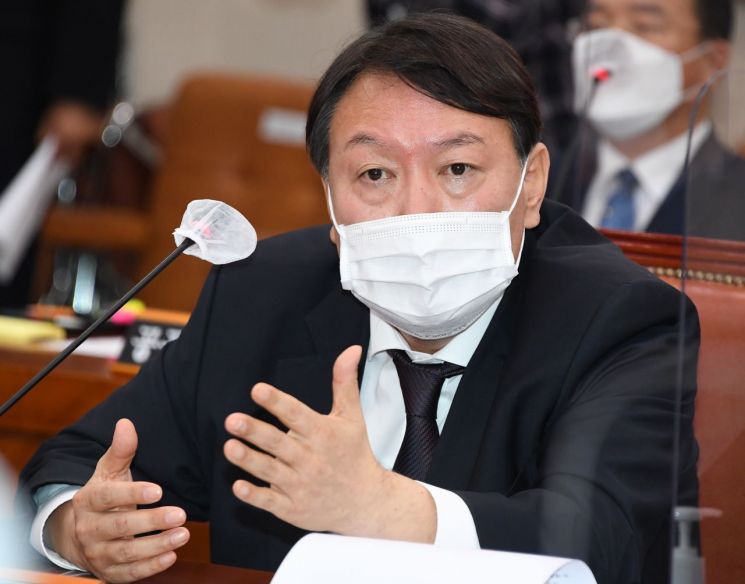 Prosecutor General Yoon Seok-yeol is responding during the Supreme Prosecutors' Office audit held by the National Assembly's Legislation and Judiciary Committee in Yeouido, Seoul, on the morning of the 22nd.
 [Image source=Yonhap News]
[Asia Economy reporters Han Seung-gon and Kim Seul-gi] Prosecutor General Yoon Seok-yeol made remarks on the 22nd at the Supreme Prosecutors' Office National Assembly audit, stating that he is not a subordinate of the Minister of Justice, sparking debate over the 'hierarchical relationship' between the Prosecutor General and the Minister.
At the Supreme Prosecutors' Office audit held at the National Assembly that day, Prosecutor General Yoon said regarding Minister Chu's suspension of investigation directives, "It is truly unreasonable to listen to people who have committed serious crimes and are expected to receive heavy sentences and then strip the Prosecutor General of his command authority," adding, "Legally, the Prosecutor General is not a subordinate of the Minister."
In response, Minister Chu posted on his Facebook that "The Prosecutor General is a public official who is legally subject to the command and supervision of the Minister of Justice," rebutting Prosecutor General Yoon's remarks.
Park Jin-young, the Democratic Party's standing deputy spokesperson, also pointed out in a statement that day, "The Prosecutor General is under the command of the Minister of Justice, who is delegated authority by the President. The Prosecutors' Office Act exists as a subordinate law to the Ministry of Justice under the Government Organization Act," adding, "However, to ensure political neutrality, the independence of investigations is guaranteed, and routine command is not exercised."
Under current law, the Prosecutor General is subject to the command of the Minister of Justice. Article 8 of the Prosecutors' Office Act (Command and Supervision by the Minister of Justice) stipulates that "The Minister of Justice is the highest supervisor of prosecutorial affairs and generally commands and supervises prosecutors, and specifically commands and supervises only the Prosecutor General regarding particular cases."
Additionally, Article 32 of the Government Organization Act states, "To oversee prosecutorial affairs, the Prosecutors' Office is established under the Ministry of Justice." Therefore, organizationally, the Prosecutors' Office belongs to the Ministry of Justice, and the Prosecutor General can be considered a subordinate of the Minister of Justice.
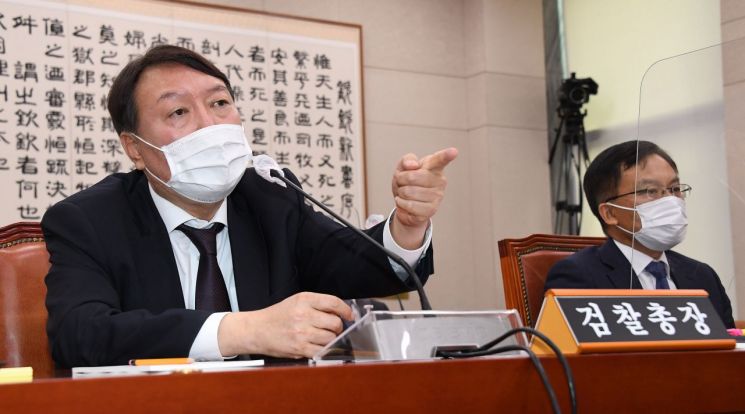 Prosecutor General Yoon Seok-yeol is responding during the Supreme Prosecutors' Office audit held by the National Assembly's Legislation and Judiciary Committee in Yeouido, Seoul, on the morning of the 22nd.
 [Image source=Yonhap News]
The issue is whether the Prosecutor General must 'unconditionally obey' the Minister of Justice's orders because he holds a lower position. According to the Korean dictionary, 'subordinate' refers to a person in a lower position in terms of rank but commonly implies a relationship of 'command and obedience.'
Because of this, if the Prosecutor General and the Minister of Justice have a 'relationship where the subordinate obeys the superior's orders,' it could be inappropriate as it would undermine the independence of prosecutorial investigations.
Prosecutor General Yoon also said at the audit, "The Minister is a politician and a political appointee. If the Prosecutor General is a subordinate of the Minister, then investigations and prosecutions would be subject to political control, which is far from the political neutrality and judicial independence of the prosecution."
This sparked a debate in political circles. On the 23rd, Democratic Party lawmaker Seol Hoon criticized in an interview on YTN Radio's 'Hwang Bo-seon's Start of a New Morning,' saying, "This is a direct denial of Article 8 of the Prosecutors' Office Act. The Prosecutor General must naturally be under the command of the Minister of Justice. Of course, it seems like he is saying he is not a subordinate in a superior-subordinate relationship, but that is nonsense."
However, People Power Party lawmaker Hong Moon-pyo countered on the same broadcast, "We need to consider why the term 'subordinate' came about. I think he used the term to emphasize that 'I am not someone who just follows orders.'"
Hong said, "He used the term 'subordinate' while emphasizing that the prosecution does not just do as told, so I don't think it's a matter of strictly interpreting the term based on specific articles or clauses."
Meanwhile, experts pointed out that although the Prosecutor General is organizationally a subordinate of the Minister of Justice, implying that he is someone who 'just follows orders' would undermine the independence of the prosecution.
Professor Jang Young-soo of Korea University Law School said, "Organizationally and structurally, it is true that the Minister of Justice is the superior and the Prosecutor General is the subordinate," but added, "However, considering that 'subordinate' is not a legal term and that it implies 'someone who does as the superior commands,' the Prosecutor General is not a subordinate of the Minister of Justice."
Professor Jang explained, "The Minister is a politician, and the prosecution is a quasi-judicial institution with political neutrality. If the prosecution acted according to the Minister of Justice's orders, it would be a step backward for prosecutorial reform," adding, "To put it metaphorically, the President appoints the Chief Justice of the Supreme Court, but we do not call the Chief Justice the 'President's subordinate.' If the Chief Justice were the President's subordinate, it would be like violating the principle of separation of powers."
© The Asia Business Daily(www.asiae.co.kr). All rights reserved.


















