Homeowners with Tenants in a Bind... Downsizing or Seeking Monthly Rent
Massive Jeonse Refugees Emerging... Prices Soar in Bundang, Gwangmyeong, and More
[Asia Economy Reporters Donghyun Choi, Onyu Lim, Chunhee Lee] # Mr. A, who lives in a 84㎡ (exclusive area) apartment in Bundang New Town, Gyeonggi Province on a jeonse lease, is caught in a dilemma due to the landlord's intention to move in. The jeonse asking price for this apartment, which was 570 million KRW two years ago, has risen by more than 300 million KRW to 900 million KRW, but he cannot even get a jeonse loan because he owns an apartment in Yongin City. Since it is difficult to move due to his children's education and he has no extra funds, he is forced to either move to a much smaller place or look for a banjeonse (semi-monthly rent) with monthly rent exceeding 1 million KRW. He lamented, "Contrary to the government's explanation that jeonse prices rose due to the desire for better housing amid low interest rates, this is the reality tenants are facing now."
Tenants who have fallen outside the protection of the 'Lease 2 Laws'?the right to request contract renewal and the cap on jeonse and monthly rent?are being cornered by soaring jeonse prices. In particular, many tenants who own one home have no capacity to afford the jeonse prices that have surged by hundreds of millions of KRW due to government loan restrictions, and are being pushed to the outskirts. The market is seeing a proliferation of 'another Hong Nam-ki' cases.
On the 23rd, Asia Economy found that major areas in Gyeonggi Province classified as Seoul commuting zones, such as Bundang, Gwangmyeong, and Gimpo, are experiencing sharp rises in jeonse prices, creating a large number of jeonse refugees.
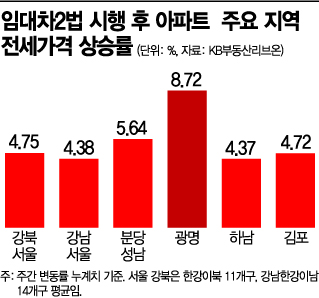
According to KB Live On, as of the 19th, the weekly apartment jeonse price increase rate in Gyeonggi Province was 0.34%, marking three consecutive weeks of increase. Especially, Gwangmyeong showed the highest increase rate in Gyeonggi at 1.47%, followed by Gimpo (1.21%), Bundang District of Seongnam (1.10%), and Giheung District of Yongin (1.04%), all showing steep upward trends with weekly average increases exceeding 1%. Since the implementation of the Lease 2 Laws at the end of July, the cumulative weekly jeonse price increase rates in these areas have reached ▲Gwangmyeong 8.72% ▲Bundang 5.64% ▲Gimpo 4.72% ▲Hanam 4.37%. These increases are similar to or even higher than those in 14 districts south of the Han River in Seoul (4.38%) and 11 districts north of the Han River (4.75%).
In Bundang New Town, where there is high demand for education, jeonse listings for the popular 84㎡ size are almost nonexistent in most complexes. Some complexes have no listings at all, or only one or two. A representative from H Real Estate Agency in Seohyeon-dong, Bundang, said, "Although it varies by complex, jeonse asking prices have surged by 200 to 300 million KRW over the past two to three months. Since there are hardly any listings, tenants have no room to negotiate prices."
In Gwangmyeong City, where reconstruction and redevelopment relocation demand overlaps, landlords set the prices. For example, in Cheolsan-dong's Cheolsan Raemian Xi apartment complex, which has about 2,000 households, there is only one jeonse listing for an 84㎡ unit. A representative from B Real Estate in the area said, "With the relocation of Cheolsan Jugong 8 and 9 complexes starting in earnest last week, the entire Gwangmyeong City is experiencing a jeonse shortage."
In Hanam, jeonse prices have surpassed the sale prices of newly built large complexes. The 84㎡ units in Hanam Gamidong's 'Hanam Powell City,' which will start move-ins next month, have a maximum sale price of 572 million KRW, but current jeonse prices are formed at 600 to 700 million KRW.
Among those most severely affected by the deepening jeonse crisis are tenants who own homes in outlying areas but rent elsewhere. While non-homeowners can at least cover increased deposits by taking low-interest jeonse loans, homeowners are blocked from accessing jeonse loans.
Previously, the December 16 real estate measures banned jeonse loans for owners of homes valued over 900 million KRW, and the June 17 measures introduced a rule to recall jeonse loans if an apartment over 300 million KRW is acquired in speculative overheated zones or regulated areas. Experts say that the fact that the KB Live On Seoul apartment monthly rent index rose 0.78% last month?the highest since statistics began in December 2015?is a repercussion of the Lease 2 Laws.
© The Asia Business Daily(www.asiae.co.kr). All rights reserved.

















