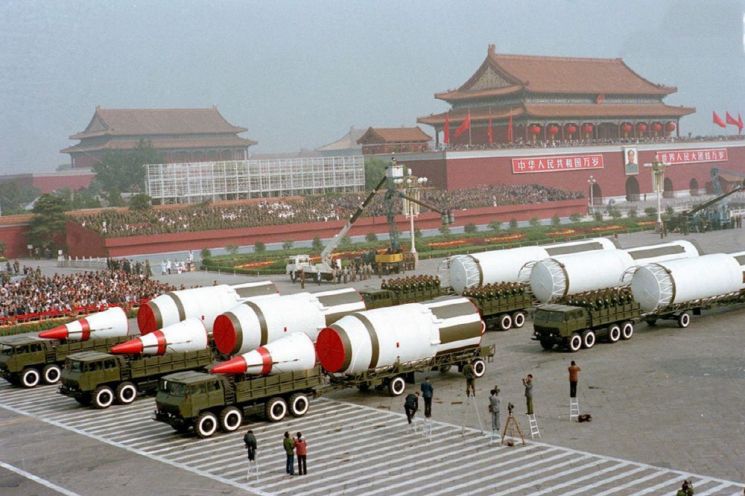
 The Dongfeng-5 is the first ICBM, or intercontinental ballistic missile, developed by China, boasting the largest size. Photo by the Chinese Ministry of National Defense
[Military Analyst Kim Daeyoung]The Dongfeng (Dongfeng)-5 is China’s first developed ICBM, or intercontinental ballistic missile, boasting the largest size. Measuring 32.6 meters in length, 3.35 meters in diameter, and weighing 183 tons, the Dongfeng-5 ranks as the third largest ICBM in the world, following Russia’s R-36 and RS-28 Sarmat, which are nicknamed Satan.
The Dongfeng-5B, with a maximum range of 15,000 km, can carry out nuclear strikes across the United States and Russia. Since the early 1960s, as relations between China and the Soviet Union deteriorated, the need arose for China to strengthen its independent strategic nuclear strike capabilities. Subsequently, the development of the Dongfeng-5 began in earnest, with its first test launch conducted in October 1971 at Jiuquan, Gansu Province, China. However, at that time, China was devastated by the Cultural Revolution, an ultra-left socialist movement led by Mao Zedong, which caused societal collapse and technological regression. As a result, the technological development necessary for mass production stagnated, leading to a wasted decade. After Mao Zedong’s death and with Deng Xiaoping becoming the de facto leader of the Chinese Communist Party, China returned to a normal development trajectory.
Before the full-scale deployment of the Dongfeng-5, China prepared a large-scale test launch to verify the missile’s performance. Known as Mission 580 or Project 718, the Dongfeng-5 test involved launching the missile from the Chinese mainland to a designated virtual target point 9,000 km away in the South Pacific. To support this, the Chinese Navy dispatched 18 vessels, including the Type 051 destroyer, survey ships, supply ships, and rescue ships, forming the 580 fleet. This 580 fleet was the Chinese Navy’s first large-scale fleet since the founding of the People’s Republic of China.
On D-Day, May 18, 1980, the Dongfeng-5 intercontinental ballistic missile launched from mainland China flew 9,000 km and hit the designated virtual target in the South Pacific. The Chinese Navy’s 580 fleet used observation ships to accurately track the simulated warhead’s atmospheric re-entry and subsequently recovered it, bringing it back to China.
Through Mission 580, China announced to the world that it had become a country possessing intercontinental ballistic missiles. From 1981, the Dongfeng-5 ICBM began deployment with China’s Second Artillery Corps (now the Rocket Force). Starting in 1983, the Dongfeng-5 was upgraded to extend its range to 13,000 km. This upgraded missile was called the Dongfeng-5A (Type A).
The Dongfeng-5 ICBM also greatly contributed to China’s space development, with related technologies applied to the development of the Changzheng-2 (Long March-2) rocket. The Dongfeng-5 was first publicly displayed at the National Day military parade in October 1984 and has appeared in every parade since. By 2000, three brigades operating Dongfeng-5 missiles had been established within the Second Artillery Corps. On September 3, 2015, at the military parade held in Beijing commemorating the 70th anniversary of the Chinese People’s War of Resistance Against Japanese Aggression and the World Anti-Fascist War Victory, the Dongfeng-5B (Type B), equipped with MIRV (Multiple Independently targetable Reentry Vehicle) warheads, was unveiled.
© The Asia Business Daily(www.asiae.co.kr). All rights reserved.
![User Who Sold Erroneously Deposited Bitcoins to Repay Debt and Fund Entertainment... What Did the Supreme Court Decide in 2021? [Legal Issue Check]](https://cwcontent.asiae.co.kr/asiaresize/183/2026020910431234020_1770601391.png)















