[Asia Economy Reporter Su-yeon Woo] The business community has expressed concerns that the introduction of the class action system and punitive damages system being promoted by the government could lead to side effects such as abuse of litigation or planned lawsuits. They argue that abuse of litigation could benefit only foreign specialized law firms while damaging the overall national economy.
The Korea Employers Federation (KEF) held a forum on the 22nd under the theme "Is the Expansion of Class Action and Punitive Damages Systems Desirable?"
At the online forum, Kim Yong-geun, KEF's full-time vice chairman, expressed concern that "Although the two bills announced for legislation (the Class Action Act and the Commercial Act amendment) aim to efficiently remedy victims, in reality, unlimited class actions will be possible without restrictions on lawyers, increasing the likelihood of professional brokers encouraging lawsuits or the rampant occurrence of planned lawsuits."
He added, "Above all, small and medium-sized enterprises (SMEs) and mid-sized companies, which lack the capacity to respond to lawsuits, could face existential threats to their companies. Currently, our companies are already burdened by excessive criminal penalties, administrative sanctions, and civil lawsuits, and if such burdens continue, companies will inevitably become passive in developing new technologies, products, and services."
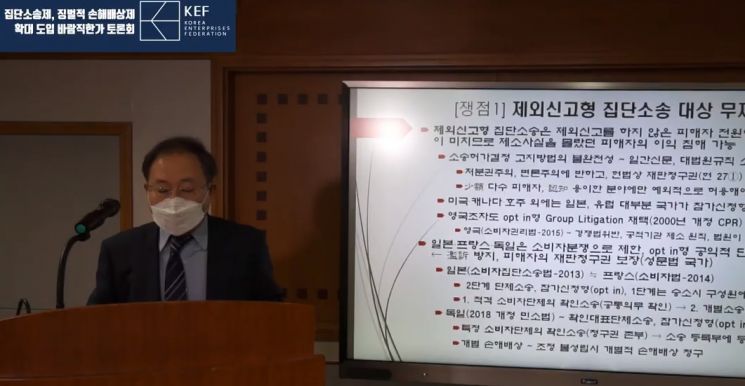 Professor Han Seok-hoon of Sungkyunkwan University School of Law is giving a presentation on the issues of the class action system at an online forum on the expansion of the class action system and punitive damages hosted by the Korea Employers Federation on the 22nd. Photo by Kyeongchong
Professor Han Seok-hoon of Sungkyunkwan University Law School, who presented at the forum, proposed a compromise plan to improve the current civil procedure law’s joint lawsuit system and representative plaintiff system. Professor Han pointed out, "The Class Action Act opens the door to abuse of lawsuits aimed at large settlement amounts, providing hunting grounds for foreign specialized law firms and causing damage to companies and the national economy."
Professor Han also cited cases in the United States where the early introduction of the class action law caused companies to suffer from huge compensation amounts, extensive submission of litigation materials, and declines in stock prices and corporate image. He introduced overseas examples, noting that in Europe, including Germany, concerns about abuse of lawsuits have led to a preference for opt-in style collective lawsuits rather than the American-style class action system.
Professor Yoon Seok-chan of Pusan National University, who presented on the punitive damages system, pointed out that the government's Commercial Act amendment should limit the establishment requirements for punitive damages liability?currently defined as "intent or gross negligence of the perpetrator"?to "malicious intent." Professor Yoon said, "In the United States, when a multiplied damages system is introduced based on actual damages, it is implemented with a limit of 2 to 3 times. A punitive damages limit of 5 times is excessive."
He added, "The 1992 McDonald's coffee case, often cited as a typical example of the U.S. punitive damages system, actually sparked discussions about the relevant regulations in the U.S. In American academia, debates on the unconstitutionality of excessive punitive damages have been actively conducted since the 19th century."
© The Asia Business Daily(www.asiae.co.kr). All rights reserved.

















