Korea Real Estate Board October 3rd Week Price Trend Survey
Increase in Jeonse Price Growth for Apartments in Capital and Provinces
Seoul Also Continues Rise in Sales and Jeonse Prices
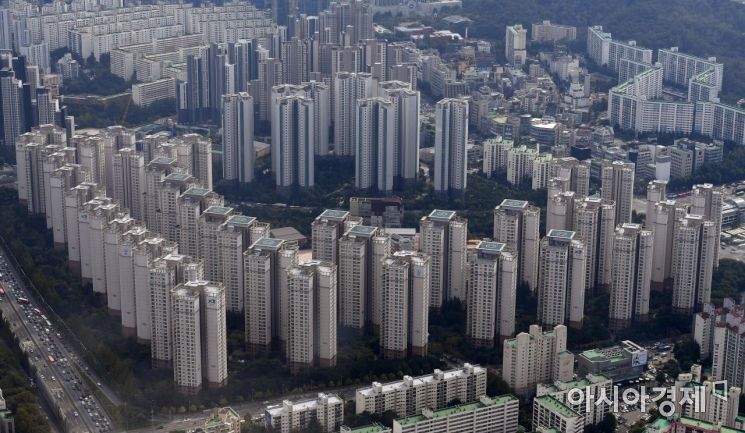
[Asia Economy Reporter Moon Jiwon] The "Jeonse crisis" is worsening as it spreads from Seoul and the metropolitan area to the entire country.
According to the weekly apartment price trend for the third week of October released by the Korea Real Estate Board on the 22nd, the nationwide apartment Jeonse prices rose by 0.21% compared to the previous week as of the 19th.
This is the largest increase in 5 years and 6 months since the third week of April 2015 (0.23%).
While Seoul showed an unstable trend with a 0.08% rise for three consecutive weeks, the metropolitan area Jeonse prices increased by 0.21%, a larger rise than the previous week (0.16%).
This was influenced by the rising Jeonse prices in Gyeonggi-do apartments over the past three weeks: 0.17% → 0.19% → 0.24%.
In the provinces, prices rose from 0.16% last week to 0.21% this week, marking the largest increase in 7 years and 6 months since the third week of April 2013 (0.21%).
Jeonse prices rose in most regions including Ulsan (0.46% → 0.50%), Chungbuk (0.16% → 0.36%), Daegu (0.10% → 0.22%), and Incheon (0.23% → 0.39%).
Gangwon (0.24% → 0.27%), Chungnam (0.20% → 0.28%), Gyeongnam (0.06% → 0.09%), Gyeongbuk (0.08% → 0.13%), Jeonnam (0.08% → 0.09%), and Jeonbuk (0.05% → 0.07%) also saw larger increases.
Although the increase slowed, Sejong City (1.37% → 1.26%) also showed a high rate of increase.
The Jeonse crisis, which began due to the government's successive real estate measures, is spreading from Seoul to Gyeonggi-do, the metropolitan area, and nationwide.
Seoul apartment Jeonse prices have been rising for 69 consecutive weeks.
Songpa-gu (0.11%) had the highest increase, and Gangnam, Seocho, and Gangdong-gu (0.10%) also showed high increases.
Jeonse supply shortages continued in Nowon-gu (0.10%), Yongsan-gu (0.10%), Seongbuk-gu (0.09%), and Mapo-gu (0.06%).
The Korea Real Estate Board explained, "With the prolonged low interest rates expanding liquidity, combined with strengthened residency requirements and the implementation of the renewal claim right, the shortage of Jeonse listings continues, leading to sustained price increases mainly in areas with good education and transportation."
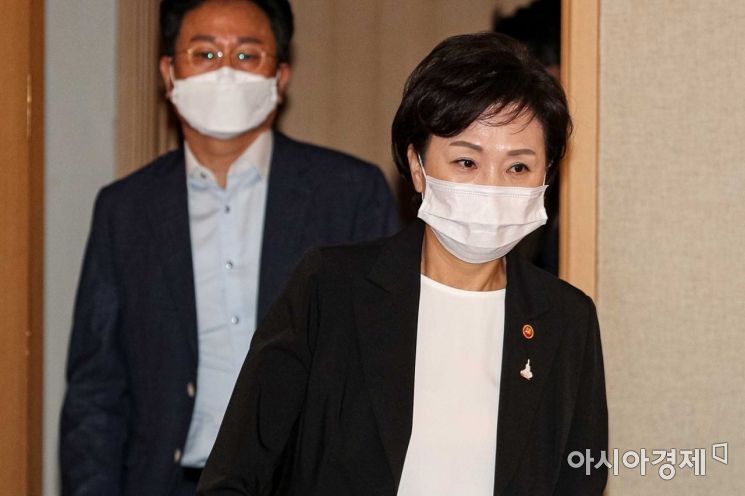 Minister of Land, Infrastructure and Transport Kim Hyun-mi is attending the '6th Real Estate Market Inspection Meeting of Related Ministers' held at the Government Seoul Office in Jongno-gu, Seoul on the 8th of last month. Photo by Kang Jin-hyung aymsdream@
The apartment sales market also continued its upward trend.
Nationwide apartment prices rose by 0.12%, increasing the rise for three consecutive weeks (0.08% → 0.09% → 0.12%).
Seoul recorded a 0.01% increase for nine consecutive weeks. Gangnam-gu, which had turned to a decline with -0.01% last week after 18 weeks, returned to a flat 0.00% in one week.
Seocho, Songpa, Gangdong-gu, as well as Mapo, Gwangjin, and Jongno-gu also showed flat trends.
Except for Jungnang-gu, which increased from 0.01% last week to 0.04% this week, and Gwanak-gu, which rose from 0.02% to 0.03%, all other districts rose only between 0.00% and 0.02%.
The Korea Real Estate Board analyzed, "Since the July 10 measures, buying demand has generally slowed, but due to a decrease in new supply and relative shortage of Jeonse listings, transactions have continued mainly in complexes priced below 900 million KRW or small-sized units, sustaining the upward trend."
Gyeonggi-do increased from 0.10% to 0.14%, and Incheon from 0.08% to 0.12%. Seongnam Bundang-gu (0.15% → 0.20%), Goyang Deogyang-gu (0.20% → 0.31%), and Ilsan Dong-gu (0.17% → 0.22%) showed significant increases.
In Incheon, buying demand concentrated in areas with transportation benefits and mid-to-low priced complexes, expanding the rise from 0.08% to 0.12%.
Apartment sale prices in provincial metropolitan cities rose by 0.21%, increasing from 0.18% the previous week.
Daegu (0.26%) showed a large increase centered on Suseong-gu (0.64%) and Dalseo-gu (0.32%), and Busan (0.23%) also rose significantly in Suyeong-gu (0.66%), Haeundae-gu (0.52%), and Yeonje-gu (0.48%).
Sejong, which has the issue of "administrative capital relocation," saw apartment prices rise by 0.25% this week, but the rate of increase continues to shrink due to fatigue from the rapid rise.
© The Asia Business Daily(www.asiae.co.kr). All rights reserved.


















