'Forest of Inclusion' Biodiversity Conservation Possible Through Forest Management
Artificial Forests with Management Projects Serve as Buffers for Natural and Non-Forest Areas
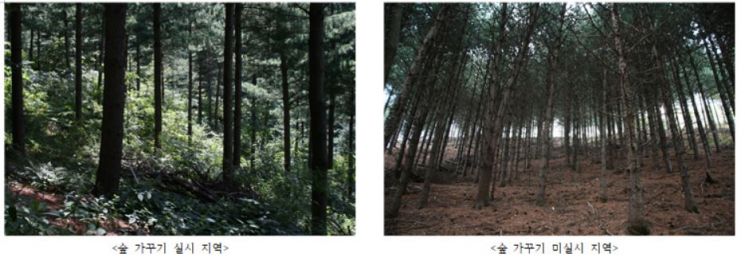 In the forest where forest management has been carried out (left), understory vegetation is naturally growing in clusters. In contrast, the forest without forest management (right) shows a difference in that, despite the trees becoming dense, vegetation does not grow in the understory. Provided by the National Institute of Forest Science, Korea Forest Service
[Asia Economy (Daejeon) Reporter Jeong Il-woong] A study has found that forest tending significantly helps enhance the inherent inclusive value of forests.
The Korea Forest Service’s National Institute of Forest Science recently conducted a study titled “Development of Technology to Enhance Biodiversity in Artificial Forests” in collaboration with the Chuncheon National Forest Management Office, revealing on the 23rd that forest tending has more than three times the effect on the development of understory vegetation in artificial forests.
First, comparing a 30-year-old Korean pine forest (artificial forest) that was tended with one that was not, the species richness of the entire understory vegetation differed significantly: 55 species in the tended area versus 17 species in the untended area.
Specifically, in the tended area, 550 individual plants per hectare grew, whereas in the untended area, 1,500 individual plants per hectare grew, making the latter appear to be a denser forest visually.
However, when considering species richness, the results were the exact opposite. For example, in the tended area, 26 shrub species and 41 herbaceous species were distributed, totaling 55 species, while in the untended area, no shrubs grew and only 17 herbaceous species were present.
In other words, the intensively managed forest through forest tending had a richer understory species diversity than the visually denser forest.
Based on these results, the National Institute of Forest Science emphasizes the importance of forest tending projects following the establishment of artificial forests. In the forestry sector, there is already a growing consensus that managed artificial forests can enrich biodiversity and provide various beneficial functions.
This aligns with the shift in domestic forestry projects from soil conservation and afforestation to preservation and management. Currently, 64% of South Korea’s land is covered by forests, most of which are dense. This is thanks to the successful soil conservation and afforestation projects carried out continuously from the 1970s through the 1980s.
Indeed, South Korea is recognized internationally as a representative success story in forest restoration, having planted over 10 billion trees with nationwide participation during this period.
However, past soil conservation projects focused primarily on quantitative growth. As a result, South Korea still faces challenges in the qualitative growth of its forestry sector. While it succeeded in covering the land with green forests, it fell somewhat short in enhancing the value of forests as resources and conservation targets.
Reflecting this reality, forest tending projects began to be actively promoted from 2004 onward (building on existing silviculture projects). Furthermore, the recent research results from the National Institute of Forest Science not only prove the effectiveness of forest tending projects but also provide justification for their continued implementation.
Above all, the institute highlights that intensively tended artificial forests serve as buffer zones between natural forests and non-forest areas, playing a crucial role in the conservation of the entire forest ecosystem.
Additionally, the creation and continuous management of artificial forests bring changes to the forest environment, creating conditions for diverse organisms to thrive. This ultimately enhances ecological functions and values while positively impacting global warming issues such as carbon absorption.
Dr. Yang Hee-moon of the Climate Change Ecology Research Division at the National Institute of Forest Science stated, “Artificial forests are substitute forests (afforestation projects) established to restore damaged or barren areas back to forest. When management projects such as forest tending are added, artificial forests will serve as buffer zones between native natural forests and non-forest areas, contributing to the conservation of the entire forest ecosystem and becoming sustainable forest assets.”
© The Asia Business Daily(www.asiae.co.kr). All rights reserved.
!["The Woman Who Threw Herself into the Water Clutching a Stolen Dior Bag"...A Grotesque Success Story That Shakes the Korean Psyche [Slate]](https://cwcontent.asiae.co.kr/asiaresize/183/2026021902243444107_1771435474.jpg)
















