Perovskite Solar Cells Open Commercialization Path with '1+1' Technology
UNIST Researchers Overcome Weakness of Highly Stable Materials, Nearing Commercialization Milestone
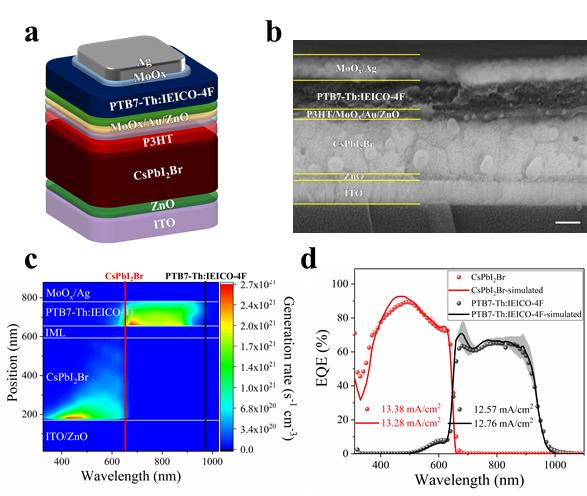 Structure and performance study illustration of a tandem solar cell based on lead-free perovskite developed by UNIST researchers.
[Asia Economy Yeongnam Reporting Headquarters Reporter Kim Yong-woo] If solar cells that use the infinitely supplied sunlight as an energy source become commercialized, it would create a world without energy worries.
The commercialization of ‘Perovskite solar cells,’ which brings this imagination to reality, is approaching.
Domestic researchers have developed an inorganic perovskite solar cell with an efficiency close to the commercialization milestone of 20%, achieving 18% efficiency. This is a 45% increase from the previous 12.5% efficiency. The related academic and industrial sectors are paying attention.
The research team led by Professor Jang Sung-yeon of the Department of Energy Chemical Engineering at Ulsan National Institute of Science and Technology (UNIST) developed a hybrid solar cell using hetero (different species) materials.
This is a ‘1+1 technology’ that combines an inorganic perovskite solar cell with a polymer solar cell that has different properties. The polymer material absorbs the near-infrared region of sunlight that the inorganic perovskite material cannot absorb, thereby increasing the cell efficiency.
Using inorganic perovskite as the light-absorbing material (photoactive layer) allows the creation of solar cells with much better thermal stability than general organic-inorganic mixed perovskite materials.
This is because it contains no volatile substances and is structurally stable. However, when made into solar cells, this material has the disadvantage of lower efficiency compared to general organic-inorganic mixed perovskite materials.
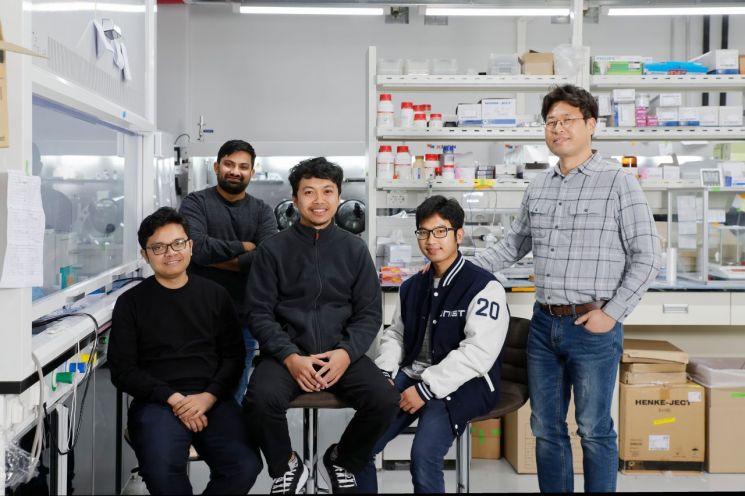 Professor Jang Seong-yeon (far right) and the research team at Ulsan National Institute of Science and Technology.
The research team compensated for the weaknesses of inorganic perovskite solar cells by using two types of photoactive layers together. They created a ‘1+1 tandem structure’ cell where the ‘perovskite unit cell (sub-cell)’ and the ‘polymer material unit cell’ are connected vertically in series.
The perovskite unit cell absorbs the visible light region of sunlight, while the polymer material unit cell absorbs the near-infrared region.
Professor Jang explained, “Through optical simulation, we designed perovskite and polymer materials with complementary solar absorption regions, and minimized the ‘voltage loss’ that occurs when combining the two unit cells, significantly increasing efficiency.”
The newly developed perovskite-polymer hybrid tandem solar cell can be easily manufactured through a ‘low-temperature solution process’ for the entire production process.
This method involves dispersing the cell materials in a liquid (solvent) and printing them like stamping. Thanks to this, it is more advantageous for mass production and much cheaper in manufacturing costs compared to existing silicon solar cells.
Professor Jang Sung-yeon said, “The hybrid tandem solar cell developed this time applies technology that maximizes the advantages of each material,” and predicted, “Through this, it will be possible to develop high-efficiency and high-stability inorganic perovskite-based solar cells with over 28% efficiency in the future.”
This research was published on October 6 in ‘Advanced Energy Materials,’ a leading journal in the energy materials field. The research was supported by the National Research Foundation of Korea (NRF) through the Mid-career Researcher Program and the Climate Change Response Project.
© The Asia Business Daily(www.asiae.co.kr). All rights reserved.
![User Who Sold Erroneously Deposited Bitcoins to Repay Debt and Fund Entertainment... What Did the Supreme Court Decide in 2021? [Legal Issue Check]](https://cwcontent.asiae.co.kr/asiaresize/183/2026020910431234020_1770601391.png)

















