After Xi Jinping's Dual Circulation Theory Mention, Continual Decline... 6.6556 Yuan per Dollar
Weak US Dollar Leads to Overseas Funds Flowing into China... US Economic Recovery is Key
[Asia Economy Beijing=Special Correspondent Jo Young-shin] The Chinese yuan has been showing continuous strength, recently hitting its lowest level in over two years and three months.
As the US dollar weakens, global funds with nowhere else to go are flocking to China, causing a surge in demand for the Chinese yuan.
On the 22nd, the People's Bank of China, the country's central bank, announced the midpoint exchange rate at 6.6556 yuan per dollar, up 0.34% from the previous day. This is the lowest level since July 9, 2018, when it was 6.6393.
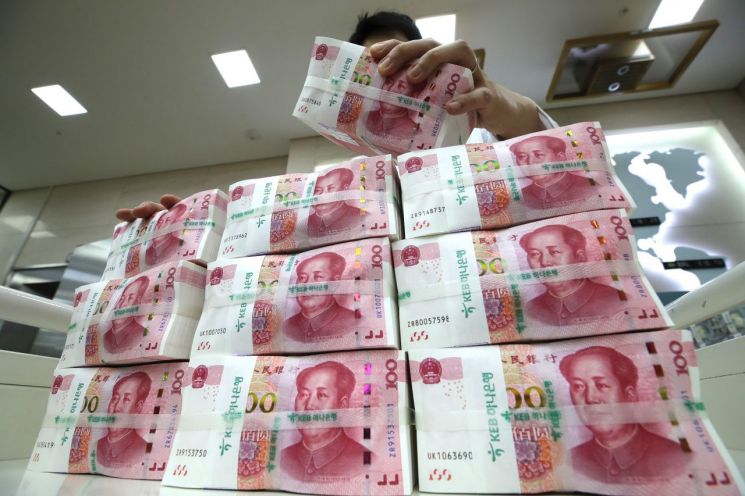
The yuan turned strong as the Chinese economy achieved a 'V'-shaped rebound in the second quarter, and after a 4.9% growth announcement in the third quarter, it took a breather before resuming its upward trajectory. Optimistic expectations for the Chinese economy in the fourth quarter have further fueled the prevailing view that the yuan's strength will continue through the end of this year.
The decline in the yuan's reference exchange rate means the yuan's value has risen, indicating a strong rally of the yuan in the recent foreign exchange market.
◇ Yuan Strength Rally to Continue for the Time Being = From May to July, the yuan traded around 7 yuan per dollar, but since September, the 6 yuan level has become entrenched.
The yuan surged to 7.1316 yuan per dollar on May 29 amid rising uncertainties due to escalating US-China tensions and concerns over the novel coronavirus (COVID-19).
However, after the announcement of China's second-quarter economic growth rate, the balance shifted from weakness to strength. The yuan's strength means its value has increased and that capital is flowing into China.
Won Bin, chief researcher at China Minsheng Bank, stated about the yuan's strong momentum, "It means the fundamentals of the Chinese economy are improving." He explained that optimistic outlooks on the Chinese economy have led to inflows of overseas funds into China, resulting in the yuan's strength.
Following China's 4.9% growth in the third quarter, the market consensus is solidifying around expectations of 5-6% growth in the fourth quarter.
Whether the yuan's strength will persist ultimately depends on the US economy. If the US economy signals recovery, overseas funds that flowed into China may exit back to the US.
Since the Chinese yuan cannot be considered a safe asset in the long term, the prevailing view is that the yuan's strength will end when the US economy recovers.
◇ China Enjoying Yuan Strength = From the Chinese government's perspective, yuan strength is not entirely positive. As a manufacturing and exporting country, yuan appreciation reduces export profitability.
This means that for the same exported goods, the amount of money (yuan) received decreases. This is why the Chinese government has been reluctant to allow the yuan's value to rise, despite criticism and pressure from the US accusing China of currency manipulation.
However, since Chinese President Xi Jinping mentioned the 'dual circulation' strategy in May, China's stance has changed 180 degrees.
The dual circulation strategy is a policy that has driven the Chinese economy by activating domestic demand alongside manufacturing and exports. The focus of economic policy has shifted from exports to domestic consumption (imports).
While yuan strength reduces export profitability, it improves import profitability. Reflecting the exchange gains from yuan appreciation, product prices can be lowered. The same products can be offered more cheaply, stimulating consumption.
A source in Beijing said, "Considering exports and other factors, Chinese foreign exchange authorities cannot continuously tolerate yuan strength," and added, "Exchange rate policies may be set after the 5th Plenary Session of the 19th Central Committee (19th 5th Plenum)."
© The Asia Business Daily(www.asiae.co.kr). All rights reserved.

















