Labor and Experts Criticize Government Proposal at Discussion on 21st
Ministry of Employment Aims for Union Law Passage in Two Months
Labor Sector: "Special Employment Workers Should Also Be Allowed to Form Unions"
Management: "Dismissed and Unemployed Workers Should Be Banned from Workplace Access"
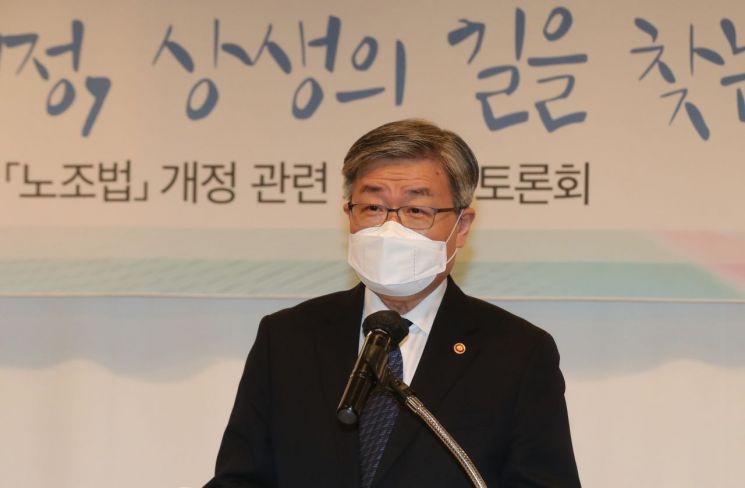
[Asia Economy Reporter Kim Bo-kyung] The government is racing against time to pass the Labor Union Act this year, which would allow union activities for dismissed and unemployed workers. This is despite fierce opposition from all sides due to sharply divided labor and management positions on each legal provision. The government is also conducting a nationwide public relations campaign, contracting with private companies for tens of millions of won, to raise awareness about the necessity of ratifying the International Labour Organization (ILO) core conventions.
At the labor-management-government forum held on the 21st at the Royal Hotel in Jung-gu, Seoul, heated debates took place over the government-proposed amendments to the Labor Union Act. This was the last opportunity for labor, management, and government to communicate before the bill is formally reviewed in the regular National Assembly session. The Ministry of Employment and Labor emphasized the need to pass the bill within this year to ratify the ILO core conventions and pushed for speed. However, the gap between labor and management positions remained wide. Labor sought greater freedom for union activities, while management took opposing stances on each issue to maintain stable business operations.
For example, regarding 'union activities by dismissed and unemployed workers within company-specific unions,' management expressed concerns that unions might bring up political and social issues such as reinstatement of dismissed workers, potentially escalating labor-management conflicts. They demanded that non-working union members such as dismissed and unemployed workers be fundamentally prohibited from entering workplaces. Conversely, labor argued that provisions preventing non-working union members from being elected as union officers or delegates are unfair. Labor also insisted that workers in special employment types (teukso hyeong geunro jongsaja, or special types of workers) should be allowed to establish unions.
Regarding strikes and other industrial actions in the government bill, management insisted on a total ban on workplace occupation during disputes, while labor feared that even peaceful industrial actions within workplaces could be unduly restricted.
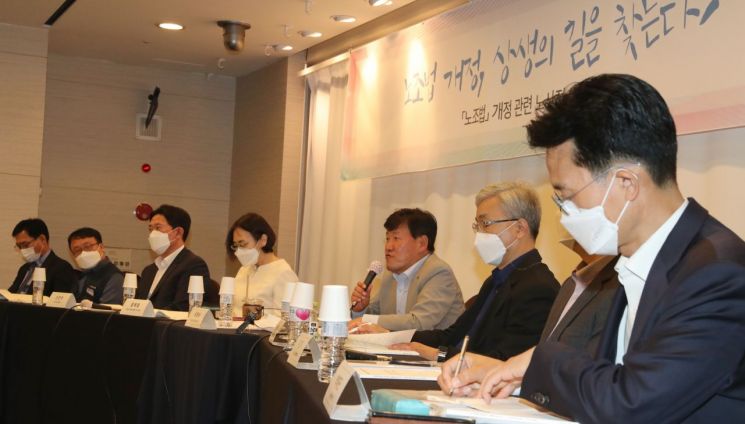
Shin In-su, head of the Legal Office at the Korean Confederation of Trade Unions (KCTU), harshly criticized the Labor Union Act amendment as an "unprecedented regression" and a "law that seriously undermines basic labor rights," stating that "there is nothing in it that meets ILO standards or substantially enhances labor rights compared to the current law." Yoo Jeong-yeop, head of the Policy Headquarters at the Federation of Korean Trade Unions (FKTU), proposed, "Let's consider a plan to pre-ratify the ILO core conventions and then pursue legal and institutional improvements during the one-year period before the conventions come into effect."
Lee Jun-hee, head of the Labor Relations Legislation Team at the Korea Employers Federation (KEF), said, "I agree with the need to ratify the ILO core conventions," but added, "It should be pursued comprehensively along with institutional improvements to secure balance in labor-management relations." Management also proposed deleting the prohibition on replacement labor during strikes and allowing replacement labor at levels comparable to major advanced countries.
Ratification of the ILO core conventions was a campaign pledge of President Moon Jae-in. On this day, labor, management, and experts all agreed with the saying, "Amending the Labor Union Act is harder than constitutional revision," and criticized the government for trying to resolve the issue through social dialogue (Economic, Social and Labor Council). Labor and management blame the government, while the government shifts responsibility to the National Assembly. However, the situation in the National Assembly is also challenging. The People Power Party, led by emergency committee chairman Kim Jong-in, is preparing labor reform bills aimed at increasing labor flexibility. Labor-related laws promoted by both ruling and opposition parties are clashing in the Environment and Labor Committee, making substantial progress in bill discussions unlikely.
Meanwhile, last month the Ministry of Employment and Labor signed a contract with a private company for 48 million won to prepare a nationwide public relations campaign and contest to promote the necessity of ratifying the ILO conventions. This project includes developing key phrases that express the main contents of the ILO core conventions considering the public's policy understanding level, and creating key images that convey the spirit of the ILO core conventions. The plan is to produce card news, posters, and other content containing government messages for both online and offline promotion.
© The Asia Business Daily(www.asiae.co.kr). All rights reserved.


















