Aiming for a Fundamental Shift in Housing Perception from 'Ownership' to 'Sharing'
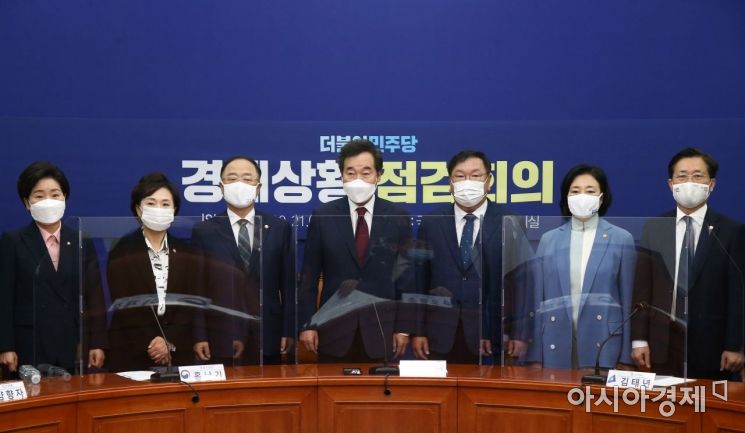 On the 21st, Lee Nak-yeon, the party leader, Hong Nam-ki, Deputy Prime Minister and Minister of Economy and Finance, along with party leadership and related ministry ministers, attended the economic situation review meeting held at the Democratic Party leader's office in the National Assembly. They are taking a commemorative photo before the meeting begins. Photo by Yoon Dong-joo doso7@
[Asia Economy Reporter Park Cheol-eung] The real estate measures being prepared by the Democratic Party of Korea include expanding public housing targets to the middle class and providing customized supply tailored to household diversification, aiming to shift perceptions from 'ownership' to 'sharing.' There are also opinions that it is necessary to create such a public housing city model through the development of new towns. Along with discovering new sites, large-scale regeneration projects for deteriorated original downtown areas (Wondosim) nationwide are expected to be carried out. Earlier, Democratic Party leader Lee Nak-yeon’s declaration of a "groundbreaking alternative" appears to reflect this fundamental change in mind.
Lee Kwang-jae, a member of the National Assembly’s Planning and Finance Committee, said in a phone interview with Asia Economy on the 22nd, "The party has been continuously conducting extensive research on housing policy over the past several months," adding, "Unlike small-sized rental housing until now, we need to create truly livable public housing going forward. Fundamental residential innovation is necessary through supply tailored to class and income levels." Lee is active as a leading 'policy brain' within the party, proposing the 'New Deal Fund,' one of the core elements of the 'Korean-style New Deal.'
He continued, "With the rapid increase in single-person households and the diversification of households, public housing suitable for the digital era is needed," and added, "We should also pay attention to the recently growing concept of shared housing."
Shared housing separates private living spaces but shares areas for rest, exercise, and leisure, spreading as a new housing trend alongside the increase in single-person households.
Moon Jung-bok, a member of the National Assembly’s Land, Infrastructure and Transport Committee from the Democratic Party, said, "The basic direction of the Democratic Party is to move away from the concept of rental housing targeting low-income groups and expand it to the middle class, creating housing based on the concept of sharing rather than ownership," adding, "It is necessary to diversify the structure and form of public housing according to life cycles."
He added, "If a new 4th generation new town is developed, it would be good to make it a place to experimentally introduce these ideas. The intention is to reduce the focus on owning a home."
Along with site development, regeneration of original downtown areas is a main axis. Lee Kwang-jae said, "There are many ways to supply housing," and mentioned, "It should be done not only in the metropolitan area but nationwide; for example, in Busan, more than half of the houses are over 30 years old."
Gyeonggi Province Governor Lee Jae-myung also emphasized at the Gyeonggi Province audit on the 20th, "It is true that it costs money to refurbish the main downtown area, but we have to go that way."
Moon Jung-bok said, "It is negative to develop sites while leaving the original downtown areas as they are," and added, "We need to create laws and systems that make urban regeneration easier."
He continued, "The problem with past redevelopment and reconstruction was that original residents were displaced, but in future urban regeneration, it will be essential to have measures that allow original residents to settle."
He also proposed a supply plan including metropolitan area expansion with comprehensive transportation measures. Moon said, "There is resistance in the process of finding available land, but it is necessary to consider expanding the metropolitan area to Chungcheong and Sejong City," adding, "Expansion of transportation networks must be fundamentally included."
On the 19th, Lee Nak-yeon announced the formation of the 'Future Housing Promotion Team,' stating, "We will increase the responsibility of the state and local governments for housing, expand the public nature of housing, and prepare groundbreaking alternatives to alleviate the public’s anxiety and dissatisfaction." It is known that the promotion team will prepare the first round of measures for monthly rent and lease next week.
© The Asia Business Daily(www.asiae.co.kr). All rights reserved.

















