[Asia Economy Reporter Joselgina] 1.6 trillion KRW. This is the amount calculated using the current Radio Waves Act Enforcement Decree's 'government calculation formula' for the reuse fee of 2G, 3G, and LTE mobile communication frequencies whose usage period expires next year. However, the government claims that 2 to 4 trillion KRW more should be added, causing backlash from telecom companies. Without clear standards, the soaring reassignment fees, stretched like a rubber band, have led to criticism calling it a 'frequency overcharge.' Excessive allocation fees inevitably translate into a burden on the public who use telecommunication services.
Ambiguous Reassignment Fees... Industry Backlash
At the comprehensive audit of the Ministry of Science and ICT by the National Assembly's Science, Technology, Information and Broadcasting Committee (STIBC) on the 22nd, the frequency reassignment fees scheduled to be announced next month were addressed as a major issue. Of the 320 MHz of frequencies expiring next year, 310 MHz are subject to reassignment, excluding SK Telecom's 10 MHz 2G bandwidth where service has already ended.
The key issue is the fee calculation method. The three telecom companies argue that 1.6 trillion KRW is appropriate according to the government formula, which reflects 3% of the expected and actual revenue during the period of borrowing the frequency. On the other hand, the government emphasizes a proviso clause that allows reflecting past auction prices if the frequency was allocated through auctions before. If half of the past auction price and half of 3% of expected revenue are reflected, as in the 2017 reassignment of the 2.1 GHz band, the reassignment fee is estimated to be around 2.9 trillion KRW.
Moreover, recent revelations during the national audit showed that the government included up to 5.5 trillion KRW for frequency reassignment fees in next year's budget proposal, intensifying controversy over 'arbitrary calculation.' This is the background behind the term 'frequency overcharge.' Some criticize this as a government tactic aimed at increasing fiscal revenue. By expanding the gap with the amount claimed by the three telecom companies to about 4 trillion KRW, the government can appear to secure an appropriate fee while somewhat accommodating the industry's position by offering discounts.
Kim Young-sik, a member of the People Power Party who recently proposed an amendment to the Radio Waves Act to clarify the criteria for calculating frequency allocation fees, pointed out, "There is no specific delegation regulation related to fee calculation, leading to criticism that the government arbitrarily calculates fees." Han Jun-ho of the Democratic Party also emphasized, "Considering that frequencies are the core of mobile networks forming the basis of the digital new deal, objectivity and legitimacy must be guaranteed in the fee calculation process." Currently, the frequency reassignment research team operated by the government does not include the three telecom companies, the users involved. Han added, "If the research team composition is biased, controversy is inevitable."
Recurring Frequency Overcharge Controversy
The industry is even considering not receiving reassignment for some of the frequencies currently on the market. In this case, the national resource of frequencies would remain unused, and the service quality for the public using 3G, LTE, etc., would inevitably deteriorate. Given the nature of the telecom business, which operates by obtaining frequency usage rights from the government, it is not easy for operators to take such a hardline stance. This reflects their judgment that the government's actions exceed the delegation scope of the current Radio Waves Act.
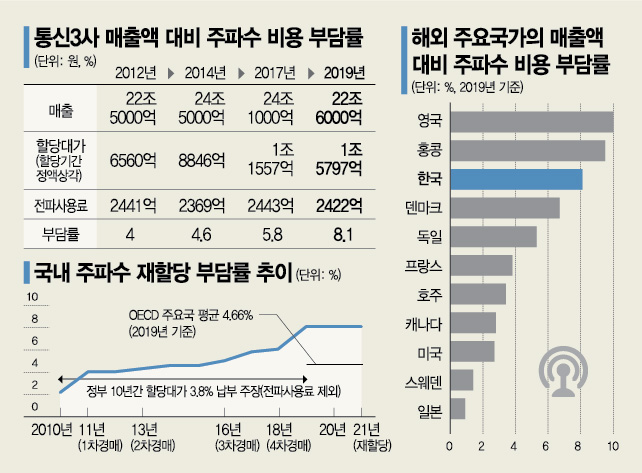
The recurring frequency overcharge controversy reduces operators' management predictability, hinders 5G investment, and is feared to negatively affect customers using telecommunication services. Overseas, in countries like Germany and Italy, excessive auction fees have caused investment shrinkage or business license returns, leading to a trend of lowering allocation fees with a long-term perspective. Based on last year, the average frequency allocation fee burden rate relative to revenue among OECD countries is 4.66%. In contrast, Korea's frequency allocation fee burden rate reaches 8.1%. However, the Ministry of Science and ICT argues that considering the burden rate over the past 10 years, the average is 3.89%, which is not a high level.
In academia, there is strong criticism that reflecting past auction prices may be illegal. Professor Park Jong-su of Korea University stated at a related seminar, "The fee calculation is based on unclear regulations that exceed the limits of delegated legislation," and "there is a high possibility of illegality." An expert senior committee member of the Democratic Party's Policy Committee, Ahn Jeong-sang, also expressed a personal opinion that "there is a possibility of illegality" and argued for the need to amend the Radio Waves Act.
Criticism also arises that this contradicts the purpose of the Radio Waves Act, which considers the economic value of frequencies. Professor Shin Min-su of Hanyang University pointed out, "Attention should be paid to the fact that the market value of 3G and LTE frequencies differs from past new allocations." An industry insider raised their voice, saying, "Reassignment aims to protect existing users and ensure stable service," and "reflecting past auction prices is unfair."
© The Asia Business Daily(www.asiae.co.kr). All rights reserved.

















