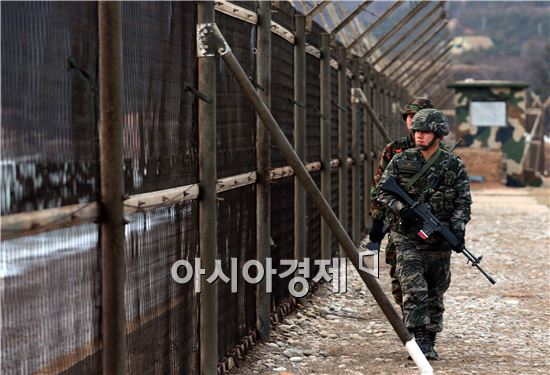
 Five soldiers injured in the shooting incident at the Eastern Front GOP (General Outpost) on the 21st are being transferred to the Armed Forces Capital Hospital.
[Asia Economy Yang Nak-gyu, Military Specialist Reporter] Although a 15.9km section of the forward area General Outpost (GOP) was damaged due to heavy rains in August this year, most of it has not yet been restored. There are concerns that North Korean landmines could be washed away through the damaged surveillance system, creating gaps in monitoring.
According to data submitted by the Army Ground Operations Command to Kang Dae-sik, a member of the National Assembly Defense Committee from the People Power Party, the section of the forward area GOP scientific surveillance system that was toppled or severed due to heavy rain amounts to 15.9km. Yeoncheon County in Gyeonggi Province has the longest section at 4.9km, followed by Hwacheon County in Gangwon Province at 4.6km. However, only 1.7km has been restored so far.
Rep. Kang said, "The Army insists on absolute trust in the scientific surveillance system, but as with the defection incident, vulnerabilities can occur, so the damaged fences must be repaired quickly."
The scientific surveillance system is equipment built by the military from 2011 to last year to strengthen surveillance against North Korea. It consists of optical cables, surveillance cameras, and detection sensors. Some surveillance cameras were lost or their components damaged due to this year’s heavy rains.
With the scientific surveillance system washed away, the possibility that North Korean landmines were carried downstream cannot be ruled out. A total of 259 North Korean landmines were found during the heavy rains in August and September. Mines discovered so far in Chuncheon, Hwacheon, and Cheorwon in Gangwon Province include M14 and M16 anti-personnel mines.
The M14 anti-personnel mine, made of plastic and lightweight, causes injuries such as amputations of ankles or wrists and is commonly called the "ankle mine" or "storm mine." The M16 anti-personnel mine is a deadly weapon that, when stepped on, jumps 2.4 to 3 meters into the air and explodes, killing any life within a 38-meter radius.
The Army plans to restore the scientific surveillance system sections within this year and intends to implement measures such as triple circular barbed wire fences, thermal imaging equipment (TOD), and additional deployment of surveillance personnel. However, from September 2015 to August 2020, there were 2,749 cases of malfunctions and failures in GOP surveillance system equipment, raising concerns about monitoring gaps.
© The Asia Business Daily(www.asiae.co.kr). All rights reserved.
















