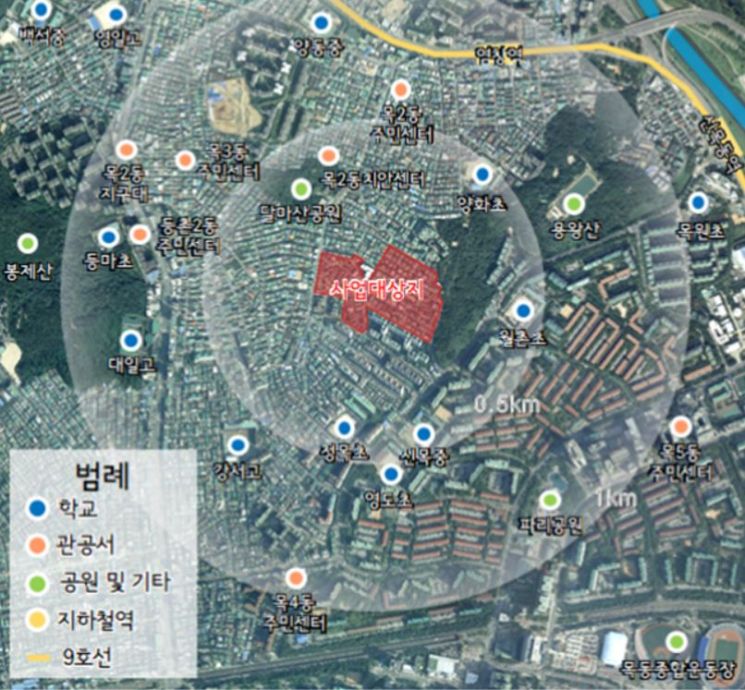
[Asia Economy Reporter Yuri Kim] Eomji Village in Mok 2-dong, Yangcheon-gu, Seoul is set to fully launch its managed residential environment improvement project.
On the 21st, Seoul City held the 14th Seoul Urban Planning Committee meeting and approved the designation of the maintenance area and the maintenance plan for the managed residential environment improvement project in Eomji Village, Mok 2-dong, Yangcheon-gu, as originally proposed, the city announced on the 22nd.
The area in question is the 231 block of Mok 2-dong, Yangcheon-gu, a low-rise, aging housing dense area. Due to many deteriorated and poor-quality houses and a lack of safety infrastructure, the area requires infrastructure maintenance and expansion as well as housing improvement. According to the maintenance plan, the village environment will be improved through infrastructure maintenance such as installation of safety facilities and improvement of main roads, and a project reflecting the characteristics of Eomji Village will be promoted by creating resident rest areas and community facilities.
At the same meeting, the committee also approved with modifications the detailed facility creation plan for urban planning facilities at Sejong University in Gunja-dong, Gwangjin-gu, allowing the construction of symbolic monuments, an auditorium and gymnasium utilizing underground space, and parking lots in the symbolic landscape zone. A city official said, "The basic plan was decided considering the characteristics of the university and the impact on the surrounding urban space," adding, "The construction of the Daeyang Complex Building on campus will improve the educational environment." The Daeyang Complex Building is scheduled to begin construction in November next year after related procedures such as underground stability impact assessment and is expected to be completed in 2022.
The 2021 amendment to the metropolitan area (Seoul) development restriction zone management plan was also approved as originally proposed, opening the door for the construction of the Manguri Park Welcome Center. The plan involves demolishing poor management facilities within Manguri Park and constructing a multipurpose management facility. Since the building area exceeds one-fifth of the originally planned floor area, it was submitted to be reflected in the development restriction zone management plan according to relevant laws. This plan will undergo further review and approval by the Central Urban Planning Committee and the Minister of Land, Infrastructure and Transport before final establishment.
The urban planning facility decision for the tunnel-type power transmission line to be installed from Gangnam-gu to Songpa-gu was conditionally approved. This decision involves establishing urban planning facilities to install a tunnel-type power duct with a total length of 6,049.1 meters in preparation for increased power demand due to the development of the International Exchange Complex District.
The urban planning facility change decision for the Eungbong Retention Basin in Seongdong-gu was also approved as originally proposed, changing the Eungbong Retention Basin at 210-3 Eungdongbong, Seongdong-gu, which was previously designated as a sewer, to a retention basin that complies with usage status and facility regulations. Installation of a combined sewer overflow (CSOs) retention tank to prevent water pollution occurring in the early stages of rainfall will also be carried out.
© The Asia Business Daily(www.asiae.co.kr). All rights reserved.

















