Increase in 20s and 30s Actively Investing in Domestic and Foreign Companies
Behind the Stock Frenzy Lies 'Anxiety About Future Preparedness'
Growing Number of 'High-Risk Groups' Investing with Debt Like Overdrafts
Financial Authorities "Investors Should Be Aware of the Risks of Reckless Stock Investment"
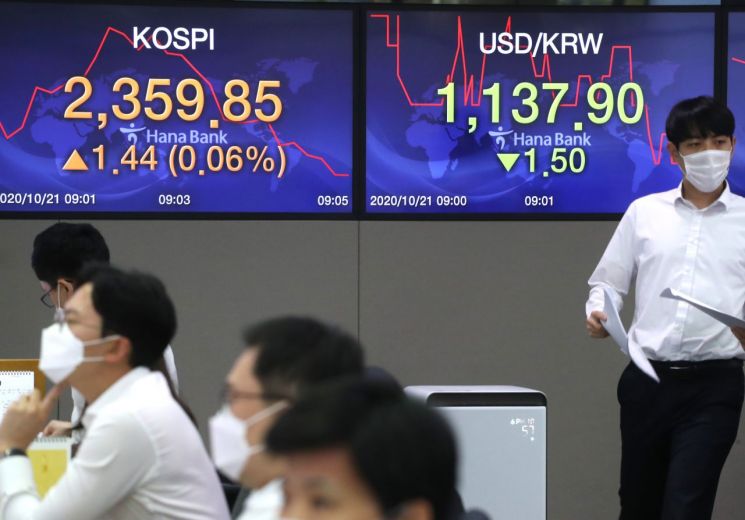 On the morning of the 21st, when the KOSPI showed a flat trend, dealers began their work in the dealing room of Hana Bank in Seoul. / Photo by Yonhap News
[Asia Economy Reporter Lim Juhyung] #Office worker A (28) has been fully engaged in investing in foreign IT companies through overseas stock trading platforms recently. He checks foreign news articles daily to grasp global economic trends and shares the latest information with other investors in stock study communities. A said, "For now, it's a small investment, but I plan to steadily realize profits and grow a substantial fund in the future," emphasizing, "In this era of low interest rates and low growth, stocks are ultimately the only way to buy a house."
Recently, the number of individual investors in their 20s and 30s attempting domestic and overseas corporate stock investments is increasing. They choose stocks as a means to accumulate assets in advance to prepare for an uncertain future. However, some among them take on high-risk investments by recklessly borrowing through overdraft accounts and other loans to pour money into stocks, raising concerns.
The government financial authorities advised prudent investment, warning that individual investors lacking professional knowledge or response capabilities could suffer significant losses if they continue reckless investments.
According to an analysis of the overseas stock application 'MiniStock' by Korea Investment & Securities on the 28th of last month, 20s and 30s accounted for 71.2% of all customers, making up the majority. These 2030 generation individual investors preferred to buy representative U.S. IT and technology companies such as Tesla, Apple, Amazon, and Nvidia.
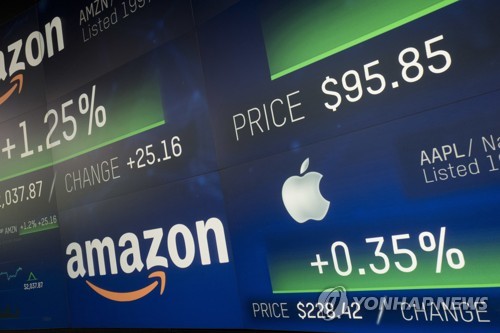 In 2018, information about leading American IT companies was displayed on the Nasdaq market billboard in New York, USA. / Photo by Yonhap News
The active stock investment by the 2030 generation is to prepare for an uncertain future. According to a survey conducted by Mirae Asset Retirement Research Institute in July targeting 700 men and women aged 25 to 39 nationwide, the reasons they showed interest in financial investments such as stocks were 'to purchase a house' (31%) and 'for retirement asset accumulation' (23%). This means 54% of all respondents invest in stocks as a means to secure a home and prepare for old age.
Other foreign media also reported in detail on the 2030 individual investors emerging as key players in the Korean stock market, pointing out that behind this young generation's stock fever lies 'anxiety about the stagnant economy.'
U.S. media 'Bloomberg' reported on the 21st of last month (local time), "The proportion of individual investors in Korea's KOSPI trading volume increased sharply from 48% last year to 65% this year," adding, "Most new investors are in their 20s and 30s, generally young."
It further noted, "Korean millennials want to resolve economic difficulties that were severe even before the COVID-19 pandemic through stock gains," pointing out that more of them are choosing stock investment as a way to overcome hardships such as a stagnant job market and high housing prices.
The problem is that among these 2030 individual investors, the number of 'high-risk investors' recklessly borrowing to pour money into stock investments is also increasing.
According to data from the Korea Financial Investment Association on the 1st, as of the 25th of last month, the balance of margin loans (where securities companies lend funds to customers for stock purchases under agreements) reached 17.0625 trillion won, indicating that the so-called 'debt investment' phenomenon has peaked amid the stock investment fever of individual investors.
Also, according to data received by Kim Sang-hoon, a member of the National Assembly Land, Infrastructure and Transport Committee from the Financial Supervisory Service, the number of newly opened overdraft accounts by the 2030 generation reached 1,232,123 as of the end of July this year, accounting for nearly 36.5% of the total 3,374,908 accounts opened during the same period.
Accordingly, the overdraft loan amount for the 2030 generation is steadily increasing. It rose from 15.8659 trillion won in 2017 to 16.4105 trillion won last year, and recorded 14.2011 trillion won as of July this year. This shows a clear tendency among the 2030 generation, who have relatively fewer accumulated assets compared to older generations, to borrow money.
Regarding this, Assemblyman Kim expressed concern, saying, "Due to rising housing prices and employment difficulties, the younger generation is engaging in 'young-chul' (all-in borrowing) to buy homes and 'debt investment' for stock investments," adding, "The longer the economic downturn lasts, the greater the debt burden on the younger generation with relatively fewer assets and income."
The financial authorities urged prudent investment, warning that such high-risk investments could cause significant losses to individual investors. Domestic investors inevitably have limited access to overseas stock information and, if exposed to 'currency risk' due to exchange rate fluctuations, have no means to respond.
Son Byung-doo, Vice Chairman of the Financial Services Commission, emphasized at the Financial Risk Response Team meeting on the 23rd of last month, "With the continued spread of COVID-19, there is a possibility of increased volatility in the stock market," and stressed, "Individual investors should once again be mindful of the risks of stock investments through reckless loans and overseas investments made without sufficient information."
© The Asia Business Daily(www.asiae.co.kr). All rights reserved.



















