Third Meeting of the 3rd Council Held After a Month
Son Byung-du, Vice Chairman of the Financial Services Commission, "Continuous Listening to Field Voices"
Financial Sector and Big Tech Still Differ on Reverse Discrimination, Agreement Unlikely
[Asia Economy Reporter Kangwook Cho] "Discussions related to digital finance risk being bogged down by conflicts between financial companies and big tech (large information and communication companies), potentially stifling innovation momentum."
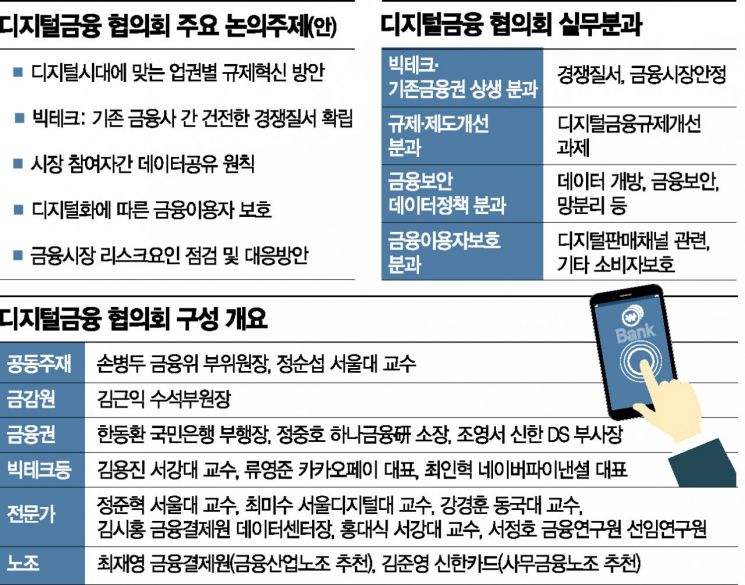
At 10 a.m. on the 21st, the 3rd Digital Finance Council was held at Front1 in Mapo-gu, Seoul. A representative from a fintech company stated this and emphasized, "Regulatory improvements must continue to keep pace with the rapid changes in the digital environment." Following the 2nd meeting held on the 24th of last month, this meeting, held about a month later, discussed advanced open banking measures such as expanding open banking participation by secondary financial institutions and small fintech companies, as well as the difficulties faced by big tech and fintech in the field and policy directions.
Son Byung-doo, Vice Chairman of the Financial Services Commission, who presided over the meeting, stressed, "Going forward, we will continuously listen to the voices from the field not only in the fintech sector but also from financial companies during the digital finance promotion process, so that discussions can be held promptly." He added, "Since many issues and topics have been substantially specified through voices from the field and discussions, we will reorganize the discussion schedule for each issue and ensure that working-level subcommittee meetings are conducted systematically and intensively."
The Digital Finance Council was established last month as a public-private joint effort with the purpose of promoting financial innovation among financial companies, big tech, and fintech. Based on the tasks discussed until the end of the year, the goal is to prepare practical alternatives and announce them externally. So far, three official meetings have been held. However, the differences in positions between the financial sector and big tech/fintech remain tense. A representative from a big tech company stated, "The entry barriers to the financial market are still high," and argued, "Discussions should be held to lower these barriers and activate innovation."
On the other hand, the financial sector views big tech’s entry into financial services as the greatest threat to their survival, even more concerning than the impact of the COVID-19 pandemic. The most emphasized issue is resolving the reverse discrimination between big tech and the financial industry. A representative from Financial Company A said, "Since big tech’s entry into financial services is a new phenomenon, it is difficult to regulate under the existing legal framework," and pointed out, "Big tech tries to exploit blind spots to gain 'regulatory arbitrage.'"
For example, regulation of prepaid electronic payment instruments, which are the main financial services of big tech’s simple payment systems, is guided by supervisory regulations rather than laws. According to the 'Trends and Future Tasks of Financial Innovation from the Perspective of Financial Industry Structure' report by the National Assembly Research Service, the simple payment market is led by big tech companies whose main business is non-financial. Initially, about 30 companies entered this market, but as of last year, Naver Pay, Kakao Pay, and Samsung Pay accounted for about 57% of the mobile payment market.
Financial Companies "Regulatory Reverse Discrimination" vs. Big Tech & Fintech "High Financial Entry Barriers"
Data sharing issues are also cited by financial companies as examples of reverse discrimination. With the review of 'MyData (personal credit information management business),' a key issue of the amended Credit Information Act, financial companies complain about the extensive non-financial data of big tech, platform network effects, and unfairness in data sharing regulations. A representative from Financial Company B raised, "Financial companies have to provide all financial data, but big tech does not provide data that is not credit information under the amended Credit Information Act, so the starting line for the MyData business is different."
Big tech companies have a negative stance on providing information that does not fall under credit information. A representative from Big Tech Company C said, "If each side only insists on their own position, it may be difficult for discussions to progress," and pointed out, "It is necessary to prioritize judgment from the perspective of consumer welfare."
The problem is whether a proper conclusion can be reached as both sides continue to run on endless parallel lines. Initially, financial authorities planned to reach a consensus within this year, but due to the COVID-19 pandemic and the fact that meetings are held remotely, as well as criticisms that working-level subcommittee meetings are not properly conducted, the process has been rocky from the start. There are even complaints that the financial authorities are just setting the stage for show without real substance.
At a seminar hosted by the Korea Institute of Finance yesterday titled 'New Business Creation and Development Plans for Banks in the Post-COVID Era,' sharp confrontations related to the 'tilted playing field' issue were also presented.
During the panel discussion, Kim Jisik, Director of Naver Financial, criticized, "The fundamental reason why the tilted playing field is being discussed is regulatory discrimination," and said, "Currently, the financial market is monopolized and there is no competition at all."
On the other hand, Cho Jaebak, Head of KPMG Digital Division, emphasized, "The recent talk about the tilted playing field is about the MyData part, where non-financial companies maintain their existing competitiveness while also taking financial data, which is the competitiveness of financial companies," and added, "Since the platform’s competitiveness as a sales channel is very strong, how to address this through regulation or policy is an important issue."
© The Asia Business Daily(www.asiae.co.kr). All rights reserved.
![Clutching a Stolen Dior Bag, Saying "I Hate Being Poor but Real"... The Grotesque Con of a "Human Knockoff" [Slate]](https://cwcontent.asiae.co.kr/asiaresize/183/2026021902243444107_1771435474.jpg)
















