Infections Continue at Schools and Academies in the Seoul Metropolitan Area... Growing Concerns Over Spread
Experts: "Infections Increase with More Outdoor Activities... Long-Term Measures Needed"
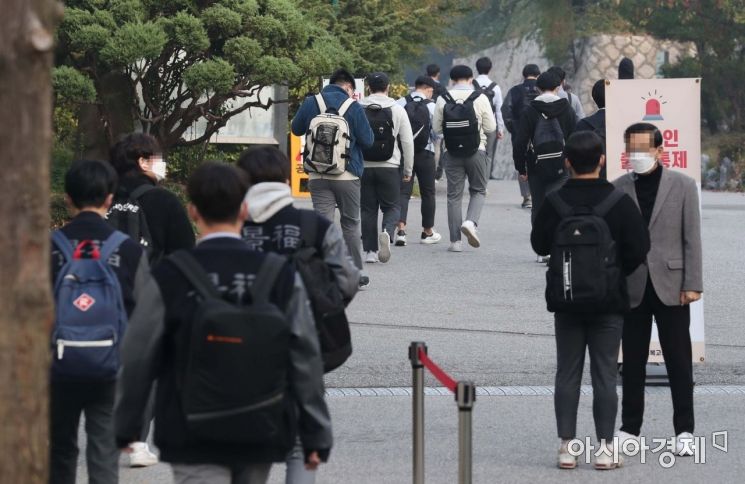 On the 19th, students are attending school at Gyeongbok High School in Jongno-gu, Seoul, where the nationwide school attendance limit has been eased to within two-thirds. Photo by Mun Ho-nam munonam@
[Asia Economy reporters Han Seung-gon and Kang Joo-hee] Although social distancing measures have been eased to Level 1 due to a decrease in confirmed cases of the novel coronavirus infection (COVID-19), small-scale infections continue to occur mainly in schools and academies, increasing public anxiety.
In particular, since the government expanded in-person classes at kindergartens, elementary, middle, and high schools nationwide starting from the 19th, concerns have arisen that group infections could occur within schools and academies.
Experts emphasized that as outdoor activities increase, COVID-19 cases are bound to rise, and long-term measures are necessary.
According to health authorities, on the 20th in Incheon, a high school senior student, Mr. A, attending a high school in Namdong-gu, was confirmed positive for COVID-19. Mr. A was classified as a contact after his parents (Incheon cases 1001 and 1002) tested positive on the previous day (19th), and after undergoing a specimen test, he was confirmed positive around midnight on the 20th.
Mr. A attended school and took classes that morning, and health authorities are conducting specimen tests on 334 people, including 267 high school seniors and 67 faculty members at the school. The school has switched all grades from in-person to remote classes.
In Bucheon, Gyeonggi Province, on the 20th, middle school student Mr. B and high school student Mr. C, brothers living in Wonmi-dong, were confirmed positive for COVID-19. Mr. B had attended his middle school until last week but did not attend school the day before. Mr. C attended school throughout last week and was also present on the 19th when in-person classes were expanded. The brothers’ schools have currently canceled all in-person classes and closed the schools.
Additionally, a large academy instructor in Daechi-dong, Gangnam, Seoul, tested positive, leading to about 50 students entering self-quarantine. COVID-19 cases are emerging mainly in schools and academies in the metropolitan area, heightening public concern.
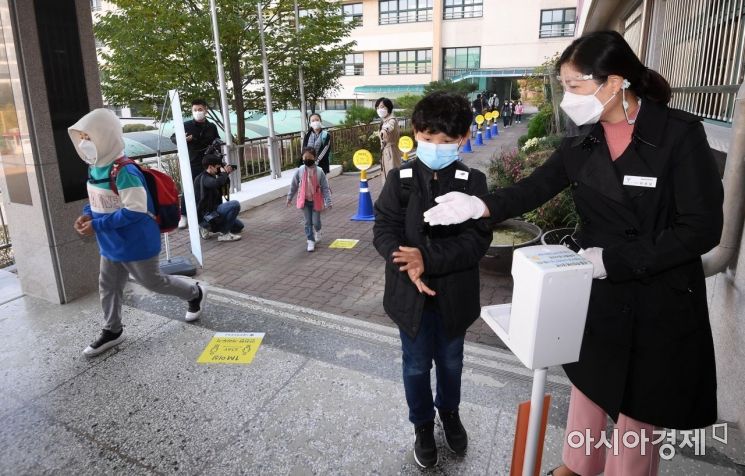 On the 19th, when in-person classes for kindergarten, elementary, middle, and high schools nationwide were expanded following the adjustment to Level 1 social distancing, children at Munbaek Elementary School in Geumcheon-gu, Seoul, were sanitizing their hands as they attended school. Photo by Kim Hyun-min kimhyun81@
Mr. D, a parent of a first-grade elementary school student, said, "Full in-person classes started this week, and there are about 30 children in one class," expressing concern, "I tell my child not to take off the mask and to avoid touching other objects as much as possible, emphasizing the importance of following quarantine rules, but with so many children in the same space, it seems difficult to maintain social distancing."
Another housewife, Ms. E, said, "From this week, children go to school three times a week. While I am glad to send them to school for education, it is true that I am worried because we never know when or where infection might occur," adding, "As expected, hearing that infections have occurred at school makes me even more anxious."
Earlier, the government decided to expand in-person classes at kindergartens, elementary, middle, and high schools nationwide starting from the 19th. Accordingly, the limit on the number of students attending in person was relaxed from one-third (two-thirds for high schools) to two-thirds. In non-metropolitan areas, schools that are not overcrowded or do not have large classes are effectively conducting daily in-person classes.
As a result, concerns have been raised that confirmed cases could surge, especially since colder weather makes ventilation in enclosed spaces like classrooms inadequate, increasing vulnerability to infection. Some voices are calling for reconsideration of the government's decision to expand in-person classes.
Experts warned that as people engage in more outdoor activities, COVID-19 cases will inevitably increase.
Professor Kim Woo-joo, an infectious disease specialist at Korea University Guro Hospital, said, "I judged that easing social distancing to Level 1 early last week was premature, and the number of new confirmed cases was not controlled below 50. Given this situation, it was already expected that confirmed cases could occur in schools after expanding in-person classes."
He added, "The epidemic keeps fluctuating, subsiding and then increasing repeatedly, and we know from trial and error that easing social distancing leads to more confirmed cases, yet the same mistakes are being repeated. Proper preparation and policy implementation are necessary, but it is problematic that emergency announcements about easing social distancing are always made hastily on weekends."
Professor Kim stated, "COVID-19 has already forced and compelled changes in our lives. Since COVID-19 will not end soon, long-term measures are needed. Just because confirmed cases have decreased does not mean we should insist on offline education; we need to consider ways to provide safe and high-quality education even during the COVID-19 situation, such as remote or hybrid classes."
© The Asia Business Daily(www.asiae.co.kr). All rights reserved.


















