Possibility of a US-Russia 'October Surprise' Ahead of the US Presidential Election
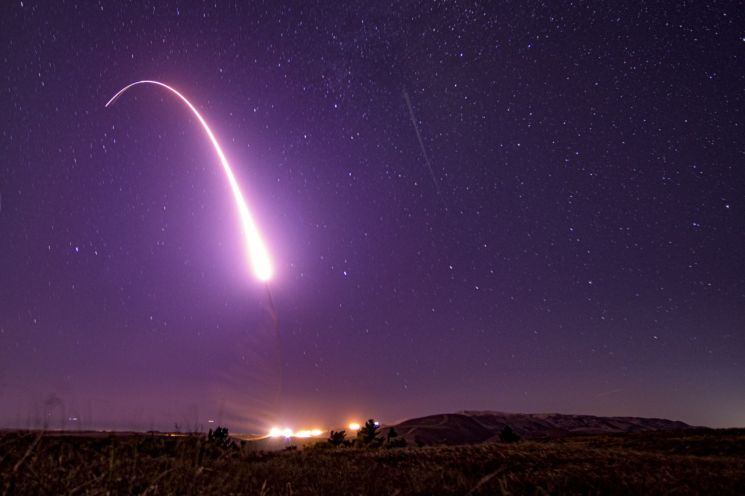 The United States is test-firing the Minuteman III intercontinental ballistic missile.
 [Image source=AP Yonhap News]
[Asia Economy New York=Correspondent Baek Jong-min] It has been reported that the United States and Russia have approached a one-year extension of the nuclear arms control treaty, the "New Strategic Arms Reduction Treaty" (New START). This is a positive development for the Donald Trump administration, which hopes to reach a negotiation settlement with Russia before the November presidential election.
The American daily Wall Street Journal (WSJ) reported on the 20th (local time) that a White House official said, "Russia has agreed to freeze nuclear warheads. The deal is close."
The WSJ report came after the Russian Ministry of Foreign Affairs stated in a press release that day, "We propose a one-year extension of New START and are ready to take on a political obligation to freeze the number of nuclear warheads currently held by both countries together with the United States."
Earlier, Robert O'Brien, White House National Security Advisor, had rejected Russian President Vladimir Putin's unconditional proposal for a one-year extension of New START, saying, "Putin's response to extend New START without freezing nuclear warheads is unlikely to succeed."
O'Brien then made a relatively simple proposal to first extend the New START agreement, which is set to expire in February next year, by one year and limit the number of nuclear warheads for one year.
Although both sides have approached an agreement on fundamental positions, U.S. officials expect that verification of the nuclear warhead freeze and the definition of nuclear warheads will be the final hurdles to concluding the negotiations.
Morgan Ortagus, State Department spokesperson, also expressed gratitude for Russia's willingness to advance nuclear arms control issues, stating, "The United States is ready to meet immediately to finalize a verifiable agreement."
New START, signed in April 2010 by then U.S. President Barack Obama and Russian President Dmitry Medvedev, aims to reduce the number of deployed nuclear warheads to fewer than 1,550 and the delivery vehicles such as intercontinental ballistic missiles (ICBMs), submarine-launched ballistic missiles (SLBMs), and strategic bombers to fewer than 700.
The 10-year agreement, which came into effect on February 5, 2011, expires on February 5, 2021, but can be extended for five years if both countries agree.
WSJ evaluated that the U.S. and Russia sought to buy time to extend New START by one year and prepare for new negotiations including China's participation. According to sources involved in the negotiations on both sides, there will be no mention of China in this round of talks, WSJ reported.
© The Asia Business Daily(www.asiae.co.kr). All rights reserved.

















