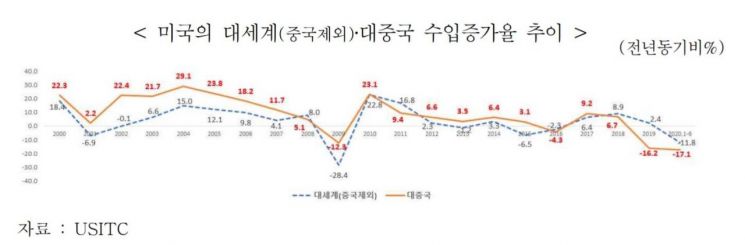
[Asia Economy Reporter Hwang Yoon-joo] Since the United States imposed additional tariffs on Chinese products in July 2018 as a sanction, companies have clearly been restructuring their global supply chains around the U.S. import market.
According to the "Changes in U.S. Import Market Share and Implications after U.S. Trade Sanctions (Tariffs) on China" report released on the 22nd by the Korea International Trade Association's International Trade and Commerce Research Institute (Director Choi Yong-min), the share of Chinese products in the total imports of U.S. sanctioned items fell by 4.04 percentage points from 17.25% in the first half of 2018 to 13.21% in the first half of this year.
During the same period, the market shares of Asian countries such as Vietnam (+1.30%p), Taiwan (+1.04%p), Korea (+0.87%p), Singapore (+0.54%p), and Thailand (+0.52%p) increased, contrasting with China. Notably, the ASEAN 10 countries' share rose significantly from 7.65% to 10.74%, an increase of 3.09 percentage points.
Korea particularly benefited from the sanctions through exports of intermediate goods. In the intermediate goods sector of the U.S. sanctioned items import market, Korea's share increased by 1.16 percentage points from 4.13% in the first half of 2018 to 5.29% in the first half of this year, marking the highest growth among competitors such as Germany, Japan, Taiwan, and Vietnam.
The U.S. sanctioned items that caused the greatest damage to China were industrial electronic products, semiconductors, home appliances, and other electrical and electronic products, machinery, and daily necessities. Especially, the share of Chinese electrical and electronic products dropped sharply by 14.11 percentage points from 35.3% in the first half of 2018 to 15.7% in the first half of this year. In contrast, agricultural and marine products, and non-ferrous metal products were minimally affected by the sanctions.
The report stated, "The rapid change in the structure of the U.S. import market over two years is due to companies actively diversifying their global supply chains to regions other than China to avoid risks from the U.S.-China conflict after the U.S. sanctions on China," and added, "With the recent spread of COVID-19, the trend of supply chain diversification is expected to continue for the time being."
Jung Hye-sun, senior researcher at the Korea International Trade Association, emphasized, "Since the U.S.-China trade dispute, the global supply chains of major countries surrounding the world's largest market, the United States, are rapidly changing," and said, "To maximize export opportunities amid the changing supply chain order, it is necessary to strengthen cooperation bases with countries emerging as new production hubs."
© The Asia Business Daily(www.asiae.co.kr). All rights reserved.

















