Board of Audit and Inspection Publishes 'Audit on Early Shutdown Feasibility of Wolseong Unit 1'
"Unit 1's Economic Feasibility Was Unreasonably Undervalued," Points Out
However, "Only Economic Feasibility Was Assessed... Limitations in Overall Feasibility Evaluation"
Opposition: "Audit Results Are a De Facto Death Sentence for Nuclear Phase-Out"
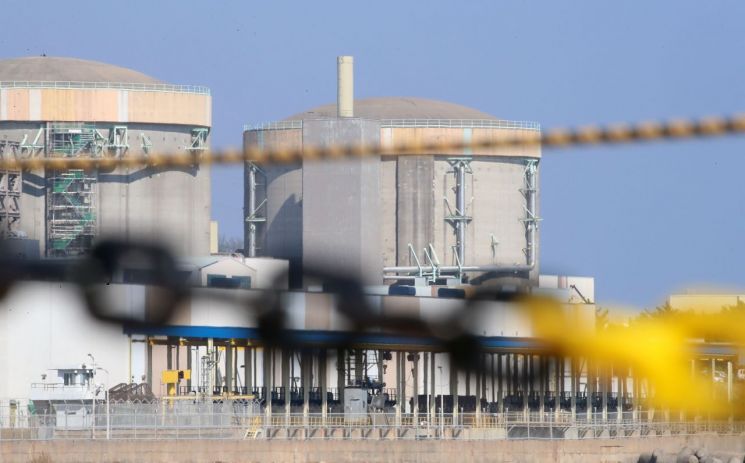 On the afternoon of the 20th, the Wolsong Unit 1, which has been shut down, can be seen at the Wolsong Nuclear Power Plant in Yangnam-myeon, Gyeongju-si. On the same day, the Board of Audit and Inspection released the audit conclusion on the "Validity of the Early Shutdown Decision of Wolsong Unit 1."
 The Board of Audit and Inspection (BAI) announced on the 20th that the 'economic feasibility,' which was the key basis for the early shutdown decision of Wolseong Unit 1, was unreasonably undervalued. However, the audit mainly focused on the economic feasibility evaluation and did not conclude whether the government's early shutdown decision was appropriate or inappropriate. While the Moon Jae-in administration's nuclear phase-out policy avoided a fatal blow, controversies surrounding the BAI, such as allegations of external pressure and audit resistance, are expected to intensify.
The BAI released the final report of the 'Audit on the Validity of the Early Shutdown Decision of Wolseong Unit 1,' which had been fraught with noise for over a year, this afternoon. This came 386 days after the National Assembly requested the audit on September 30 of last year, and 234 days after the legal audit deadline passed at the end of February.
The BAI revealed that employees of Korea Hydro & Nuclear Power (KHNP) knowingly used a sales price in the economic feasibility evaluation service report that was set lower than the actual price without correcting it, and that officials from the Ministry of Trade, Industry and Energy were also involved in the decision-making process. The BAI stated, "The economic feasibility of continuing operation compared to immediate shutdown of Wolseong Unit 1 was unreasonably undervalued."
However, the BAI did not provide a clear judgment on whether the government's decision to shut down the nuclear plant early was appropriate or inappropriate, which was the purpose of the audit.
The BAI explained that this audit examined the appropriateness of the economic feasibility evaluation of Wolseong Unit 1, and "the appropriateness of the policy decision to pursue the early shutdown of Wolseong Unit 1 is outside the scope of this audit."
It added, "The shutdown decision was made by comprehensively considering factors such as safety and local acceptance in addition to economic feasibility," and "issues related to safety or local acceptance were excluded from the scope of this audit."
Furthermore, the BAI emphasized, "There are limitations in viewing the results of this audit as a comprehensive judgment on the validity of the immediate shutdown decision of Wolseong Unit 1."
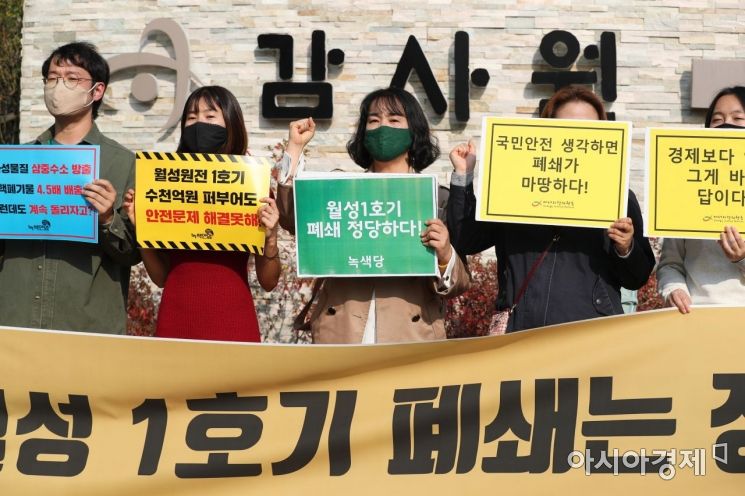 On the 20th, when the Board of Audit and Inspection disclosed the audit results on the "Validity of the Early Shutdown Decision of Wolseong Unit 1," the Anti-Nuclear Civic Action urged the shutdown of Wolseong Unit 1 in front of the Board of Audit and Inspection in Jongno-gu, Seoul. Photo by Moon Honam munonam@
Although the audit, which dragged on for over a year, has been concluded in this way, the political aftershocks are expected to intensify further.
By deferring the validity evaluation on the grounds of focusing on 'economic feasibility,' the government's nuclear phase-out policy has, for now, avoided a fatal blow. However, the fact that there were problems with the economic feasibility evaluation has become clear, making damage to government credibility and the nuclear phase-out policy inevitable.
Yoon Hee-seok, spokesperson for the People Power Party, immediately issued a verbal comment after the audit results were announced, claiming, "The BAI's audit result that the economic feasibility of continuing operation of Wolseong Unit 1 was undervalued is a practical death sentence for the Moon Jae-in administration's nuclear phase-out policy, which had been pursued without principles and without evidence."
The People's Party also stated in a comment, "No matter how important the nuclear plant shutdown is, manipulating objective figures is an unimaginable criminal act and a deceitful act that has corrupted national governance."
Earlier, as expectations grew that the BAI would reach a provisional conclusion that the economic feasibility of Wolseong Unit 1 was undervalued, conflicts between Director Choi Jae-hyung and the ruling party surfaced. Along with suspicions of external pressure on the audit, there were reports of clashes between Director Choi and pro-government audit commissioners, as well as controversies over the BAI's coercive investigation of current and former officials of KHNP and the Ministry of Trade, Industry and Energy. Director Choi said at the National Assembly audit on the 15th, "This audit faced significant resistance," adding, "After the National Assembly requested the audit, Ministry of Trade officials deleted all related materials, which took time to recover, and the process of taking statements was also very difficult."
The People Power Party issued a statement on the 20th in the name of all members of the Industry, Trade, and Energy Committee, saying, "We will hold those responsible accountable," and "Through investigations into audit obstruction, we must clearly uncover suspicions of further manipulation intended to conceal fabrication."
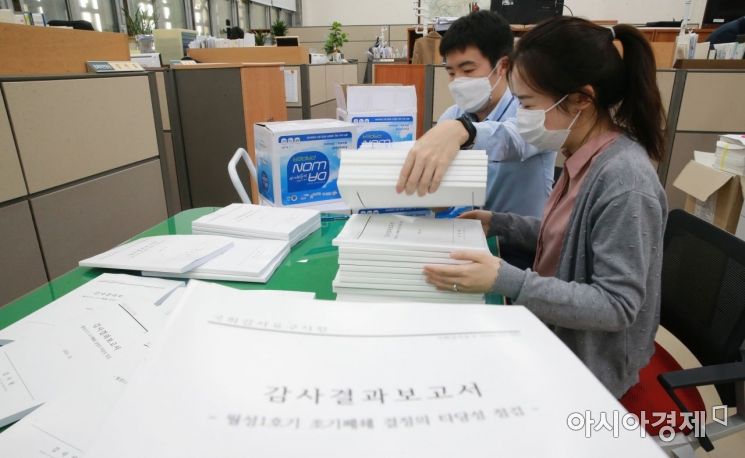 On the 20th, staff at the National Assembly's Legislative Affairs Department were organizing the audit result report submitted by the Board of Audit and Inspection, which examined the validity of the decision to prematurely shut down Wolseong Unit 1. On that day, the Board of Audit and Inspection announced that the economic feasibility, the reason for the early shutdown of Wolseong Unit 1, had been unreasonably underestimated. However, they stated that it was difficult to make a comprehensive judgment on the validity of the early shutdown. Photo by Yoon Dong-ju doso7@
On the other hand, the Democratic Party of Korea took the position that "the time for futile debate must end." Spokesperson Shin Young-dae said in a verbal comment regarding the BAI's economic feasibility evaluation, "There were only criticisms about reliability degradation, but no overall criticism that the economic feasibility evaluation was wrong," and urged, "Now the opposition party should stop the futile debate and join us in the energy transition policy."
The Blue House did not issue any particular statement regarding the audit results. A senior Blue House official said, "We will issue a statement if necessary after reviewing the full report," but added, "It seems there will be no special statement. The relevant ministries will provide explanations."
KHNP released a statement titled 'KHNP's Position on the BAI Audit Results of Wolseong Unit 1' on the same day, saying, "We fundamentally accept the BAI's audit results on Wolseong Unit 1." The BAI gave a 'strict warning' to KHNP President Jeong Jae-hoon in the report, pointing out that KHNP employees failed to properly supervise actions that undermined the reliability of the economic feasibility evaluation.
© The Asia Business Daily(www.asiae.co.kr). All rights reserved.
![User Who Sold Erroneously Deposited Bitcoins to Repay Debt and Fund Entertainment... What Did the Supreme Court Decide in 2021? [Legal Issue Check]](https://cwcontent.asiae.co.kr/asiaresize/183/2026020910431234020_1770601391.png)