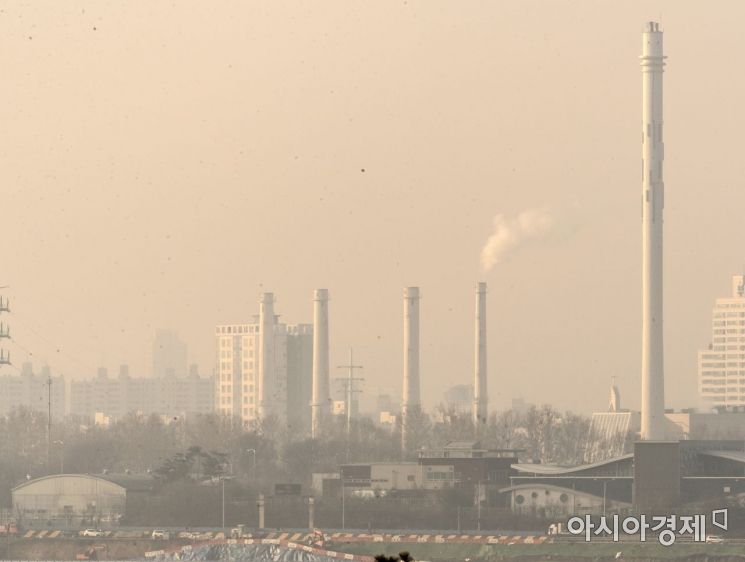
[Asia Economy Reporter Kim Bo-kyung] The Ministry of Environment has completed the annual emission allowance allocation for a total of 799 workplaces subject to the total emission management system for air pollutants, which will be expanded nationwide starting this year, and will fully implement the system.
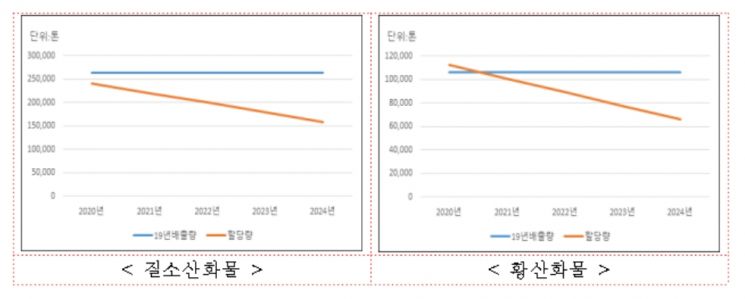
With the expansion of the total emission management system for workplaces, the goal is to reduce nitrogen oxides by 39.7% and sulfur oxides by 37.7% by 2024 compared to last year.
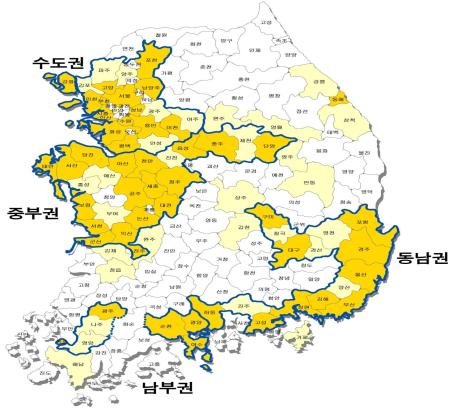
This emission allowance allocation sets annual emission limits for air pollutants over five years (2020?2024) for workplaces in three regions?Central, Southern, and Southeastern?excluding the metropolitan area where the total emission management system is already in effect.
The workplaces allocated emission allowances this time are 799 facilities located in the expanded regions classified as types 1 to 3, which emit nitrogen oxides (NOx), sulfur oxides (SOx), and dust?pollutants subject to total emission management?above the standard levels.
As a result of the annual emission allowance allocation, by 2024, nitrogen oxides (NOx) will be reduced by 104,000 tons (a reduction rate of 39.7%), and sulfur oxides (SOx) will be reduced by 39,000 tons (a reduction rate of 37.7%) compared to last year.
By region, the Central and Southeastern regions, where large-scale and high-pollutant-emitting workplaces such as power plants, steel mills, and refineries are concentrated, show relatively higher reductions. By industry, reductions in the steel and power sectors account for 71.9% and 87.3%, respectively, of the total nitrogen oxide and sulfur oxide reductions across all workplaces.
The emission allowances for each workplace were allocated comprehensively considering recent emission levels and reduction potential within the regional emission allowance ranges set by the Basic Plan for Air Environment Management.
For 2020, considering the adaptation period for workplaces, allowances were allocated based on recent (2019) emission levels, but early reduction workplaces applied a five-year average emission to ensure no disadvantages from early reduction activities.
Early reduction workplaces refer to those that emit at concentrations lower than the 2024 Best Available Control Technology (BACT) levels due to proactive investments in pollution control facilities.
For 2024, allowances were allocated at emission levels achievable by installing optimal control facilities on emission sources to ensure that actual reduction activities such as facility improvements are accompanied.
Optimal control facilities refer to the most efficient air pollutant reduction technologies currently in use or recognized as having the best reduction efficiency considering future technological advancements.
Workplaces subject to total emission management must emit pollutants within the allocated emission allowance range. Compliance with the allocated emission allowances will be managed through monthly emission reporting and verification.
Workplaces emitting less than their allocated allowances can sell their remaining emission allowances. Conversely, workplaces emitting more than their allowances can purchase emission rights within the same region.
Workplaces whose final emissions exceed their allocated emission allowances will be subject to total emission excess fines and will have their next year's allowances reduced.
The Ministry of Environment provides incentives such as applying special provisions under the Air Environment Conservation Act to ease the burden on total emission management workplaces.
Basic charges on emissions for pollutants subject to total emission management under the Air Environment Conservation Act are exempted, and type 3 workplaces emitting less than 20 tons annually have their emission standards under the Act relaxed by 130%.
The Ministry of Environment is currently accepting objections to the annual emission allowances notified to total emission management workplaces. The final emission allowances reflecting the review results of these objections are scheduled to be confirmed by the end of this month.
Choi Jong-won, Director of Air Environment Policy at the Ministry of Environment, stated, "The contribution rate of workplace pollutants to ultrafine dust is about 39%, which is high, so it is necessary to manage the total emission system to ensure it leads to substantial reductions."
© The Asia Business Daily(www.asiae.co.kr). All rights reserved.



















