San Francisco Rent Drops 24.2% in September... Sacramento, 2 Hours from Silicon Valley, Rises 10.1%
Facebook, Twitter, and Other US IT Companies Normalize Remote Work... Moving Out of Silicon Valley for Larger, Cheaper Homes

[Asia Economy Reporter Jeong Hyunjin] Jesse Bulk and Shani Bulk, a couple working at IT companies in Silicon Valley, USA, purchased a four-bedroom house on the outskirts of Fair Oaks, Sacramento, California last month. Until this spring, they had to work facing each other on laptops in a small apartment without air conditioning in the heart of Silicon Valley, San Jose. With the possibility of working from home, they no longer had to consider commuting to the office and created an office in a spacious room while maintaining their jobs. Shani said, "Due to COVID-19, I no longer wanted to be in a cramped space. However, there was no house we could afford in San Jose, so we ended up moving to Sacramento, which is relatively far away."
The remote work introduced by IT companies due to the COVID-19 pandemic is changing not only the work landscape in Silicon Valley but also the real estate market. As demand for real estate changes, prices of offices and houses in areas where major IT company headquarters were concentrated have dropped significantly. IT companies, which had raised wages due to high living costs, are now facing conflicts as they try to cut wages for employees moving to suburban areas with cheaper housing rental costs.
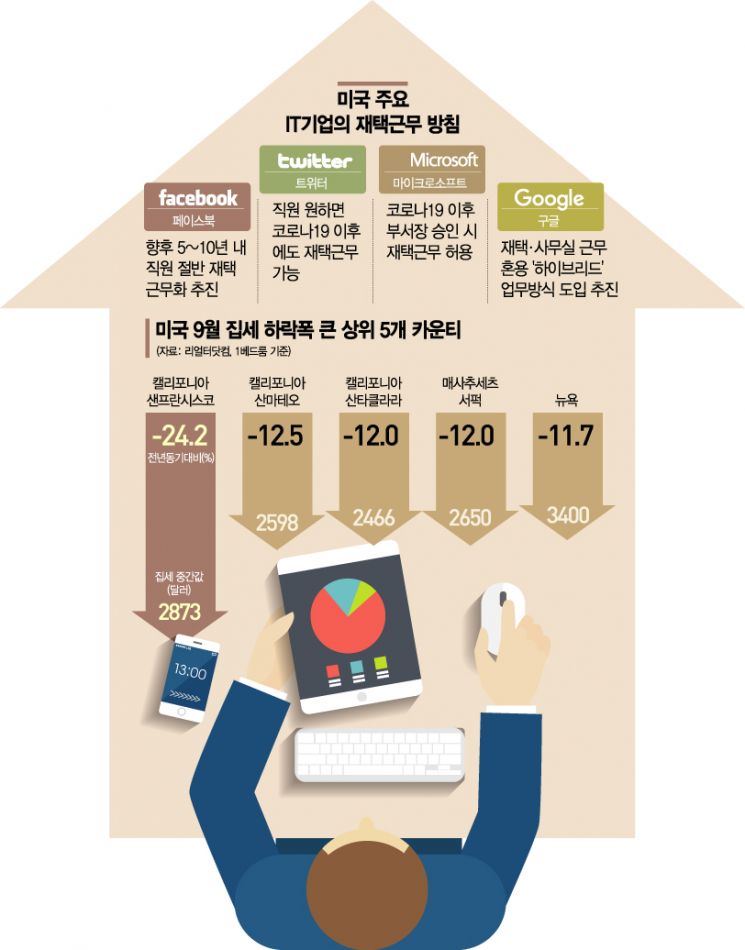
According to Realtor.com, a U.S. real estate company, on the 19th (local time), among the top 100 largest counties nationwide, the area with the largest drop in rent for one-bedroom houses last month was San Francisco County, California, near Silicon Valley, with a 24.2% decrease compared to the same period last year. San Francisco is famous for having higher living costs than New York, especially with notoriously high housing rental costs. The monthly rent for houses in San Mateo County, which includes Palo Alto and Mountain View, where IT companies are concentrated, fell by 12.0%, and Santa Clara County, California, also dropped by 12.5%, ranking among the counties with the largest declines.
The decrease in real estate demand originating from Silicon Valley has affected not only housing but also office rentals. According to The Wall Street Journal (WSJ), office rents in San Francisco fell by 4% between the end of March and the end of September during the COVID-19 pandemic. The size of new office leases in San Francisco in the third quarter of this year was 700,000 square feet (about 65,000㎡), an 81% decrease compared to the same period last year. Chris Lawder, a broker at global real estate services company JLL, said, "There are almost no office tours or deal proposals. Deal activity has virtually dried up."
On the other hand, areas where real estate prices have relatively increased due to these changes include Sacramento, the state capital about two hours away from Silicon Valley. The monthly rent for one-bedroom houses in Sacramento rose by 10.1% last month, ranking within the top five among the top 100 counties nationwide. Nicholas Bedo, an economic indicator analyst at Realtor.com, explained, "IT company employees who lived in the Bay Area, including San Francisco, which has the highest rents in the U.S., now have the opportunity to work remotely, creating room to move to more reasonable areas."
The change in real estate demand stems from the expansion of remote work by IT companies due to the COVID-19 pandemic. In March, as COVID-19 spread, most IT companies immediately implemented remote work and are considering long-term changes to work styles. Facebook announced plans to have half of its employees work remotely within the next 5 to 10 years. Twitter and Microsoft (MS) decided to allow remote work depending on circumstances even after COVID-19. Google announced it is exploring a 'hybrid' work style that allows employees to split time between home and office. Although it is still difficult to say this is a complete shift in work style, the large-scale remote work experiment triggered by COVID-19 shows that the overall trend is changing.
This expansion of remote work has led to another issue following changes in real estate demand: the controversy over 'pay localization,' which cuts salaries based on residential areas. IT companies that raised wages considering the high living costs of Silicon Valley when recruiting talented professionals are now trying to lower wages according to local living costs during the expansion of remote work. WSJ noted, "The cost of living in the Bay Area is much higher than in Boise, Idaho, or Topeka, Kansas," and added, "It will be difficult to find jobs in those areas that pay as much as salaries in San Francisco."
Facebook, Twitter, MS, and others have announced plans to differentiate salaries by region. Some companies, including Facebook, have asked employees to notify the company of their moving plans by January 1 next year. Online payment company Stripe recently offered a one-time moving bonus of $20,000 to employees relocating from San Francisco or New York to other areas, in exchange for a 10% salary cut.
Brian Krop, senior research manager at market research firm Gartner, said, "The reduction in wages will be outweighed by the decrease in living expenses," adding that even if wages decrease by 10-20%, living in Austin, Texas, or Nashville, Tennessee, will allow for a more comfortable lifestyle.
© The Asia Business Daily(www.asiae.co.kr). All rights reserved.


















