35% of Google's Top 20 Revenues from China
Zero Game License Issuance for Korean Games for 4 Years
Up to 17.5 Trillion KRW Lost in Chinese Revenue
Ministry of Culture, Sports and Tourism: "No Separate Related Statistics"
[Asia Economy Reporter Buaeri] While major Chinese mobile games are dominating the Korean game charts, it has been confirmed that our government does not even have related statistics on Chinese games distributed in Korea. As the issuance of 'Panhu' (game service licenses in China) has stopped, causing difficulties for the domestic game industry to enter the Chinese market, there are calls for the government to prepare detailed countermeasures.
Strengthened Chinese Games
On the 20th, Lee Sang-heon, a member of the National Assembly’s Culture, Sports and Tourism Committee from the Democratic Party, inquired about the "status of Chinese games distributed domestically," and the Ministry of Culture, Sports and Tourism responded, "We do not separately compile related statistics." Lee said, "Currently, the Korea-China game market is structured so that we only get hit and cannot hit back. We need to prepare response strategies in advance, but it is regrettable that there are no statistics on Chinese games distributed domestically," adding, "Data should be prepared in advance to be used during Panhu negotiations between Korea and China."
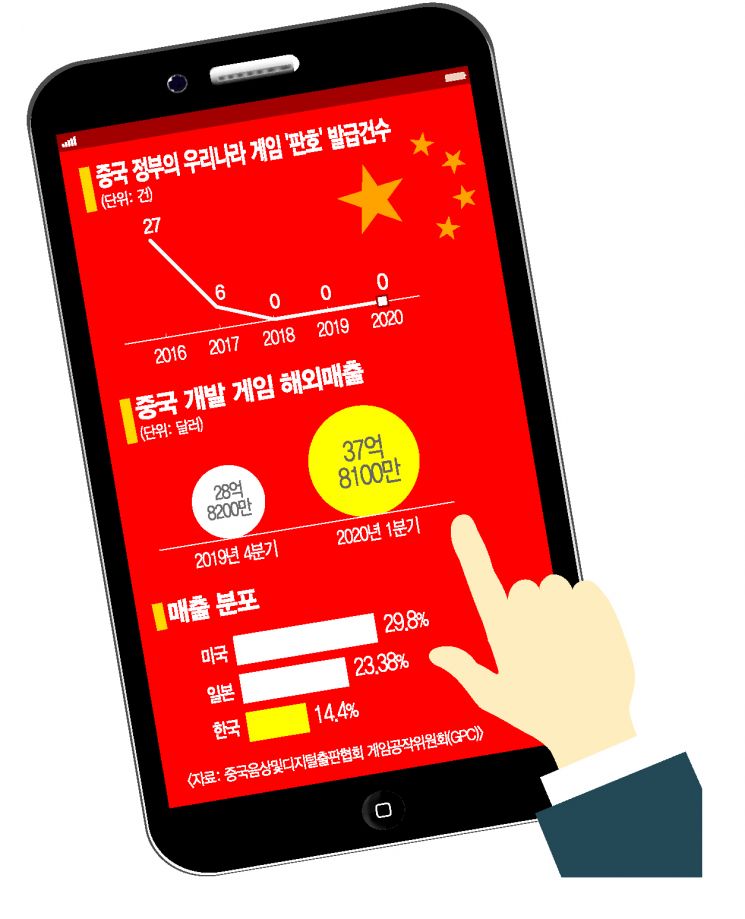
Currently, based on Google Play sales rankings in Korea, 35% of the top 20 games are Chinese. In the past, Chinese games were criticized for inferior graphics and content, but they have rapidly grown in recent years. Sales of Chinese games in the Korean market are also increasing. According to the Game Production Committee (GPC) of the China Audio-Video and Digital Publishing Association, overseas sales of Chinese self-developed games rose from $2.882 billion in Q4 last year to $3.781 billion in Q1 this year. By country, Korea accounts for 14.4%. From China’s perspective, Korea is the third largest export market after the U.S. (29.8%) and Japan (23.38%).
Only 33 Panhu Issued in 5 Years
On the other hand, Korean games have failed to enter the Chinese market since March 2017 due to the suspension of Panhu issuance. According to data submitted by the Ministry of Culture, Sports and Tourism to Assemblyman Lee, only 33 Panhu licenses were issued to Korean games by the Chinese government over the past five years: 27 in 2016 and 6 in 2017.
Since March 2017, there have been zero cases. Although the Chinese government recently issued Panhu licenses for some foreign games, Korea was not included this time either. Meanwhile, even U.S. games, which have trade conflicts with China, as well as Japanese games, received Panhu licenses. According to the Korea Creative Content Agency, 28 foreign games were issued Panhu licenses in August this year. Among them, Japanese developers accounted for 12, the U.S. had 5, Europe 9, and Southeast Asia 2. Even during 2018-2019, when Korea had zero Panhu issuances, Japanese and American games received Panhu licenses and were distributed in China. Japan received 15 licenses in 2018 and 63 in 2019, while the U.S. received 14 in 2018 and 17 in 2019.
With the suspension of Panhu, domestic game companies are missing out on the Chinese game market worth 39 trillion KRW. According to the GPC, the Chinese game market has been growing annually from 214.4 billion yuan (about 36.62 trillion KRW) in 2018 to 230.8 billion yuan (about 39.42 trillion KRW) in 2019. Professor Wi Jeong-hyun of Chung-Ang University’s Business Administration Department, president of the Korea Game Society, analyzed that sales worth 10 trillion to 17.5 trillion KRW have disappeared over the past four years since Panhu issuance for domestic games was halted.
In this regard, the Ministry of Culture, Sports and Tourism stated, "We are requesting the Chinese government to resume issuing Panhu for domestic games through various channels," adding, "While seeking new export markets to revitalize the domestic game industry, we are making multifaceted efforts such as providing support behind the scenes to maintain private exchanges like the Korea-China Game Association."
© The Asia Business Daily(www.asiae.co.kr). All rights reserved.
![User Who Sold Erroneously Deposited Bitcoins to Repay Debt and Fund Entertainment... What Did the Supreme Court Decide in 2021? [Legal Issue Check]](https://cwcontent.asiae.co.kr/asiaresize/183/2026020910431234020_1770601391.png)















