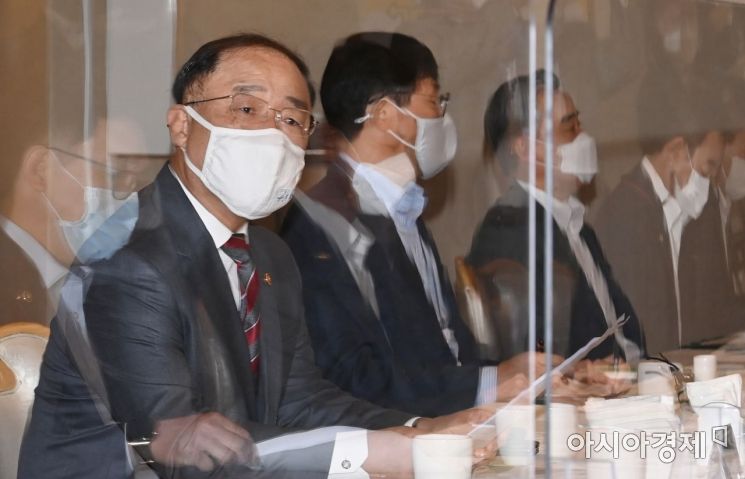
 Hong Nam-ki, Deputy Prime Minister and Minister of Economy and Finance, is delivering opening remarks at the "8th Real Estate Market Inspection Meeting of Related Ministers" held on the 14th at the Government Seoul Office in Jongno-gu, Seoul. Photo by Kang Jin-hyung aymsdream@
[Asia Economy Reporter Park Cheol-eung] The Democratic Party of Korea is pushing for a policy shift on real estate ahead of the by-elections in April next year, focusing on expanding housing supply and easing taxation on single-homeowners. Meanwhile, the People Power Party's think tank has argued that the introduction of a 'deferred capital gains tax on real estate'?previously raised by some ruling party lawmakers?should be actively considered. While the focus has so far been on tightening regulations on multi-homeowners, there are signs that discussions on meeting demand and revitalizing transactions will become more active going forward.
On the 19th, Democratic Party leader Lee Nak-yeon stated at the Supreme Council meeting, "The increasingly sophisticated and diversified demand cannot be addressed by the traditional concept of housing supply rates," adding, "We need a new approach reflecting on past real estate policies." Under the policy direction of expanding housing supply and reducing tax burdens for long-term single-homeowners, a 'Future Housing Promotion Team' will be formed together with private experts.
In this regard, Han Jeong-ae, chair of the Democratic Party's Policy Committee, said at the National Assembly audit countermeasure meeting on the 20th, "We will convey the party's opinion that the effects of the official property price realization must be taken into account," and "We will reach a conclusion on property tax-related matters through future party-government consultations." This statement is interpreted as considering the possibility of some easing, given the significant increase in property tax burdens due to the official property price realization.
However, Chair Han emphasized, "The party and government have not considered nor planned any expansion of comprehensive real estate tax reductions," adding, "Currently, the comprehensive real estate tax deduction rate for long-term single-homeowners is as high as 80%."
Earlier, Minister of Land, Infrastructure and Transport Kim Hyun-mi stated at the National Assembly audit on the 16th, "When we announce the official property price realization roadmap (within this month), since the realization rate for mid-to-low priced apartments will increase, we will also announce measures to lower the tax burden by reducing property tax rates."
Meanwhile, Lee Jong-in, senior research fellow at the People Power Party's Yeouido Institute, recently stated in a report titled 'Diagnosis and Implications of Strengthening Real Estate Taxation,' "One policy alternative that needs active consideration is the introduction of a 'tax deferral system' to ease the tax burden on real demand single-homeowners caused by excessive capital gains tax hikes."
This tax system defers the capital gains tax payable when purchasing a more expensive home with the proceeds from selling a previously occupied home, collecting the tax in a lump sum on the last home held. The research fellow explained, "It is a reasonable system to protect single-homeowners who need to relocate and retirees without income," adding, "It also has the effect of refunding taxes when housing prices fall and has been implemented or is being implemented in countries such as the United States, Sweden, and Germany."
Since some ruling party lawmakers have already requested the government to introduce the tax deferral system not only for capital gains tax but also for comprehensive real estate tax, if the People Power Party takes the lead, discussions could accelerate rapidly.
Democratic Party lawmaker Lee Kwang-jae questioned Deputy Prime Minister and Minister of Economy and Finance Hong Nam-ki at the National Assembly Planning and Finance Committee meeting in late July, saying, "Even when moving to the same 32-pyeong apartment next door, capital gains tax must be paid, so moving is difficult," and asked, "In the United States, if you keep moving to larger homes, you don't pay taxes until the final settlement, or if you move to a smaller home, you pay tax once. Don't we need such an incentive tax system as well?"
Hong Ik-pyo, head of the Democratic Research Institute, the Democratic Party's think tank, also said, "If a comprehensive real estate tax deferral system is implemented for those aged 65 and over with certain income levels, allowing lump-sum payment at inheritance and gift times, complaints like 'I can't pay because I don't have money' would not arise."
Deputy Prime Minister Hong said, "The deferral system fundamentally changes the taxation system," adding, "I think national consensus is necessary. We will consider it."
© The Asia Business Daily(www.asiae.co.kr). All rights reserved.

















