Government Reviews and Approves Three Employment Ministry-Related Bills at Cabinet Meeting
Enforcement Decree of Employment Insurance Act Promulgated and Enforced Same Day Due to Urgency
Introduces Labor Commission Relief Procedures for Workplace Sexual Harassment Victims
Simplifies Small Amount Wage Claim Payment Procedures and Extends Eligibility to Current Employees
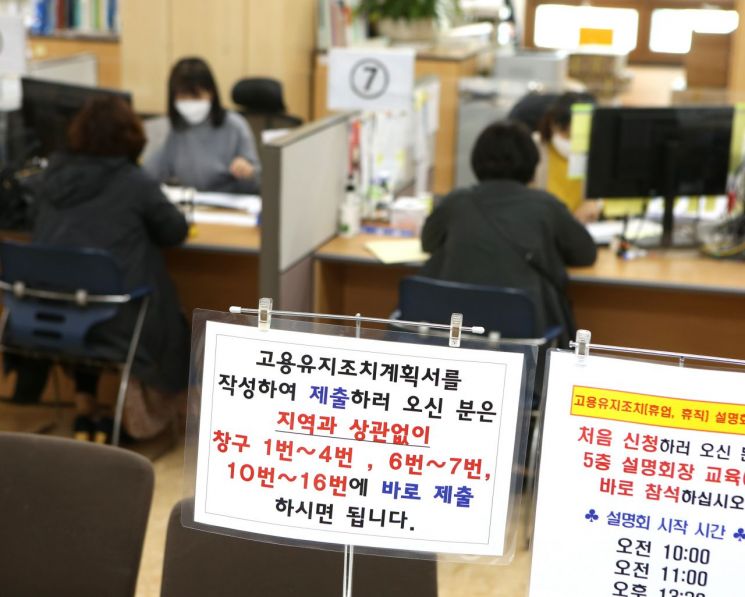
[Asia Economy Reporter Kim Bo-kyung] Starting today, the payment period for the Employment Retention Support Fund is extended from 180 days to 240 days per workplace annually. Workplaces where the support period for leave and suspension allowances has already expired due to the prolonged COVID-19 pandemic will now be able to receive an additional 60 days of support.
On the 20th, the government reviewed and approved amendments to the Enforcement Decree of the Employment Insurance Act, as well as amendments to the Act on Gender Equality in Employment and the Wage Claim Guarantee Act, at the Cabinet meeting.
The Employment Retention Support Fund is a system that partially supports employers who, due to business difficulties, find employment adjustments unavoidable and place workers on leave or suspension while paying leave allowances. Previously, the fund could support up to 180 days annually, but with this amendment to the enforcement decree, support is extended to 240 days for this year only.
The budget for this extension was already reflected in the 4th supplementary budget approved by the National Assembly plenary session last September. With an additional 484.5 billion KRW allocated, the total budget for the Employment Retention Support Fund amounts to 2.6476 trillion KRW.
Considering the urgency of employment instability caused by the spread of COVID-19, the amended enforcement decree is promulgated and enforced on the same day. A Ministry of Employment and Labor official explained, "Even employers whose support period for the Employment Retention Support Fund has expired can receive the support if they had previously reported their employment retention plan to the employment center."
The amendment to the Act on Gender Equality in Employment, approved on the same day, introduces a labor committee relief procedure for workers who have suffered sexual harassment or gender discrimination in the workplace and allows the use of parental leave during pregnancy.
When an employer fails to fulfill their obligation to take measures for workers who have suffered sexual harassment or employment discrimination in the workplace, the victim can apply for correction to the labor committee. The labor committee then conducts investigation and hearings and decides whether to issue a correction order or dismiss the case.
Regarding the confirmed correction order, the Minister of Employment can request the employer to submit a compliance report, and the effect of the correction order extends beyond the parties involved to other workers who have experienced discrimination. The amendment also includes a provision to impose a fine of up to 100 million KRW if the employer fails to comply with the correction order.
Additionally, to protect female workers at risk of miscarriage or stillbirth, a "Parental Leave During Pregnancy" system is introduced. Maternity leave, which can be used up to 44 days before childbirth, was considered insufficient to reduce the risk of miscarriage or stillbirth. This leave can be used within the one-year parental leave period, and parental leave used during pregnancy will not be deducted from the number of leave splits. A Ministry of Employment official stated, "This will help prevent miscarriage and stillbirth among high-risk pregnant workers and can be utilized even in emergencies such as COVID-19."
The amendment to the Wage Claim Guarantee Act aims to enable workers who have experienced wage arrears to receive wage claims quickly and easily, strengthen the recovery procedures for repayment, and increase additional charges in cases of fraudulent claims. The wage claim guarantee system is where the state pays a portion of unpaid wages on behalf of the employer to workers who have not received wages or retirement pay due to company bankruptcy, etc.
The amendment allows the payment of small wage claims with a certificate issued by the local labor office without a court-confirmed judgment and extends eligibility to current employees as well as retirees. The system for current employees will be applied first to low-income workers and gradually expanded in the future.
After paying the wage claims, the recovery procedure for repayment from the employer is changed to the national tax delinquency disposition procedure to ensure effective recovery, and additional charges for fraudulent claims are increased from up to one times the payment amount to up to five times.
© The Asia Business Daily(www.asiae.co.kr). All rights reserved.
![User Who Sold Erroneously Deposited Bitcoins to Repay Debt and Fund Entertainment... What Did the Supreme Court Decide in 2021? [Legal Issue Check]](https://cwcontent.asiae.co.kr/asiaresize/183/2026020910431234020_1770601391.png)
















