Nearby Local Governments Oppose Fukushima Contaminated Water Discharge
Over 50% of Japanese Citizens Oppose in Poll
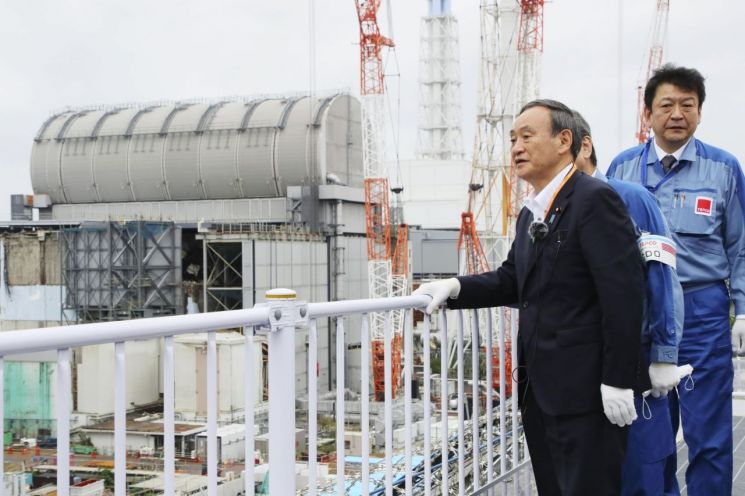
[Asia Economy Reporter Hyunwoo Lee] As the Japanese government is reportedly set to finalize its policy to discharge radioactive contaminated water from the Fukushima Daiichi Nuclear Power Plant into the ocean, Miyagi Prefecture, which is adjacent to Fukushima, has expressed strong opposition, citing insufficient national discussion. Not only Miyagi Prefecture but also local governments near Fukushima are strongly against the government’s policy, and it is reported that more than half of the Japanese public opposes the ocean discharge of the contaminated water.
According to foreign media such as Kyodo News, on the 19th, Yoshihiro Murai, governor of Miyagi Prefecture, stated at a regular press conference, "We are taken aback by the sudden reports on the ocean discharge of Fukushima’s contaminated water without any information provided by the government," and strongly opposed the plan, saying, "There has been no national discussion on this issue." Governor Murai emphasized, "The ocean discharge of contaminated water will have a significant impact not only on Fukushima and neighboring areas but on all of Japan," and added, "Discussion at the level of local governments nationwide is necessary."
Earlier, Japan’s Ministry of Economy, Trade and Industry (METI) and Tokyo Electric Power Company (TEPCO), the operator of the Fukushima Daiichi Nuclear Power Plant, after an expert subcommittee under METI proposed ocean discharge and atmospheric release as disposal methods for the contaminated water in February this year, held seven sessions to gather opinions from 29 stakeholder groups, including the National Federation of Fisheries Cooperative Associations. However, no public hearings allowing for pro and con debates were held.
Public opinion in Japan is also unfavorable. According to a Yomiuri Shimbun poll conducted from the 16th to the 18th of this month with 1,051 voters nationwide, 50% opposed the ocean discharge of contaminated water from the Fukushima nuclear plant, while only 41% supported it. Nevertheless, the Japanese government is reportedly determined to proceed with the discharge policy by October 2022, as the storage tanks for contaminated water at the Fukushima plant will reach capacity, and the decommissioning work, which has yet to remove the contaminated water inside the plant, is also delayed.
The Fukushima Daiichi Nuclear Power Plant has been generating 160 to 170 tons of contaminated water daily due to rainwater and groundwater mixing with circulating cooling water used to cool the molten nuclear fuel inside the reactors, which exploded during the Great East Japan Earthquake in 2011. TEPCO currently filters this contaminated water using a device called the Advanced Liquid Processing System (ALPS) and stores it in tanks on the plant site under the name "treated water." As of September, the Japanese government and TEPCO are seriously considering a plan to reprocess this treated water, which has increased to about 1.23 million tons, to reduce the contamination concentration below the standard level and then release it into the Pacific Ocean.
© The Asia Business Daily(www.asiae.co.kr). All rights reserved.
![Clutching a Stolen Dior Bag, Saying "I Hate Being Poor but Real"... The Grotesque Con of a "Human Knockoff" [Slate]](https://cwcontent.asiae.co.kr/asiaresize/183/2026021902243444107_1771435474.jpg)
















